5 MPa War Within the Chamber or Stress and Strain: A 515
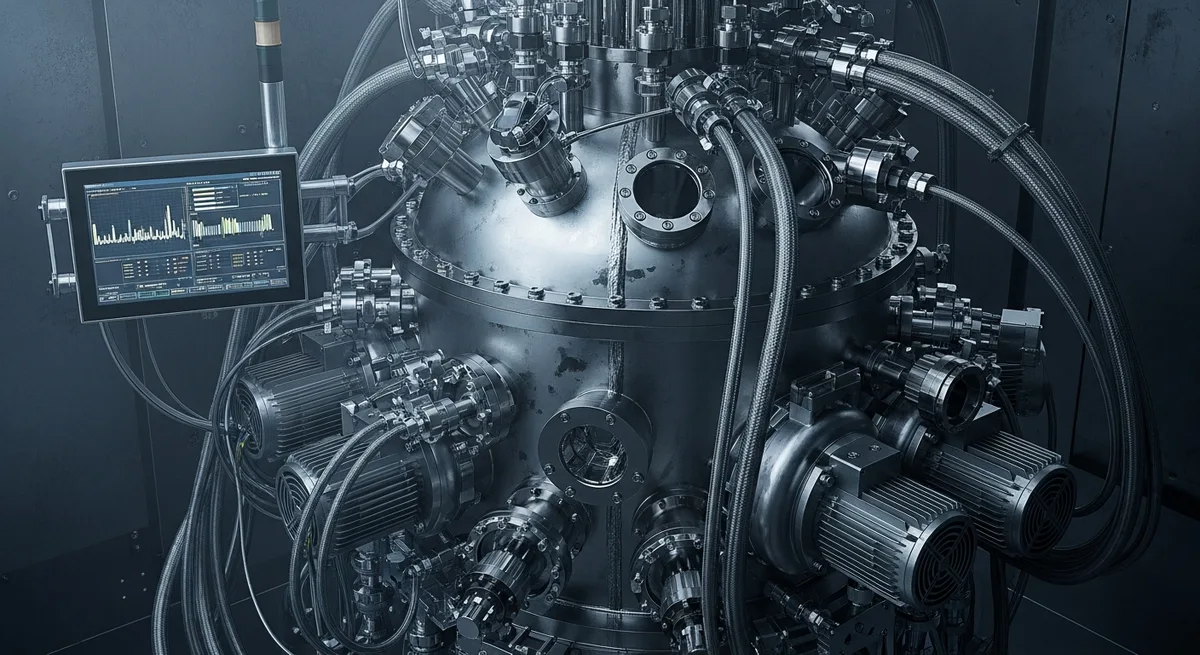
In this room, the air is never truly in motion. It hangs, chillingly stagnant, saturated with the scent of ozone and metallic dust—a sensory residue that clings to one’s clothing long before the shift begins. Before me stands the ALD system; it is no sleek, promotional-brochure vision of the future, but a jagged assemblage of rusted memories and brutal functionality. It is a monolithic steel block, five feet in height, its surface mapped with fingerprints and micro-abrasions—the cartography of past attempts to tame a process that perpetually strains against its own containment.
The primary chamber, welded from 304L stainless steel, is a zone of constant, agonizing stress. As the pumps evacuate the atmosphere to reach a vacuum of 10^-6 mbar, the metal does not yield with silent grace; it responds with a low, barely audible groan. This is a struggle of 515 MPa tensile strength against an external atmosphere that crushes the walls like an invisible, all-consuming ocean. There is no elegance here—only the cold, brutal dictate of physics. The walls, despite their thickness, have become like arthritic joints after thousands of cycles, emitting a sharp, metallic click each time the vacuum threshold is breached. It is never a perfect vacuum; it is a fragile compromise between system integrity and the encroaching entropy that inevitably finds purchase through the microscopic porosity of the weld seams.
The turbomolecular pumps hum with a discordant, high-frequency vibration that I feel through the soles of my boots. This is no smooth operation; it is the mechanical sound of agony, reminiscent of a jet turbine seized within a narrow corridor. As the 500 liters-per-second flow initiates, the chamber turns frigid, and a shroud of condensation blooms across its surface. This machine does not exist in harmony with its environment; it rejects it. Every molecule stripped from the interior leaves a void that nature desperately seeks to fill, yet the 1.33 x 10^-6 Pa m^3/s leak rate remains the only barrier between our world and the volatile vacuum within.
The 6061-T6 aluminum alloy susceptor is an engineering compromise that irritates me daily. It is intended to be a perfect thermal conductor, yet its 237 W/mK rating frequently falters. As the 300-millimeter wafer heats, the susceptor expands with agonizing unevenness. We know its 310 MPa yield strength will hold it in place, but at the microscopic level, stresses emerge that distort the nanostructures. This is no triumph; it is a precarious balancing act. We accept this imperfection because the alternative—materials far more complex and costly—would simply fail to withstand the cyclic thermal load that forces the aluminum to "breathe" in unison with the silicon wafer at 500 degrees.
The Kanthal A-1 heating element is the source of the machine’s volatile temperament. Its 1.45 x 10^-6 Ωm electrical resistivity converts power into a heat that is often unruly. This is no gentle warming; it is a violent surge, akin to the dance of an electric arc within ceramic insulation. As the element glows, it emits infrared radiation that forces the entire internal structure to expand. We hear the metal "walking"—not the clichéd "technological dance," but a loud, harsh cracking, as if dry timber were being snapped in the dead of night. This is the moment the machine nears its breaking point, where the 1400-degree melting threshold feels less like a safety limit and more like a looming threat.
The PLC controller, with its 100 MHz processor, is the only thing preventing total collapse. Its 10-inch screen flickers incessantly, displaying data packets that lag by milliseconds. Monitoring these figures is an exhausting endeavor—it is like watching the EKG of a patient perpetually suspended between life and death. We do not see the reaction itself; we see only its echoes. Pressure fluctuations, flow irregularities—these are status reports that usually arrive only to confirm what has already gone wrong. This is not observation; it is a constant, reactive struggle against system failure.
The gas delivery system, composed of PFA tubing, is the most vulnerable point of failure. These lines, coiled at a 2.5-inch radius, appear flexible, yet they are ticking time bombs. The 1/4-inch VCR fittings, intended to ensure hermetic seals, begin to show signs of fatigue after a year of service. As gases flow through them at 0.1–100 sccm, we pray that no microscopic particulate clogs the valve. When the valve reacts within 10 milliseconds, it is not a neural impulse—it is a mechanical strike that sends a pressure wave through the entire system. It is a crude, percussive process, far removed from the grace depicted in science fiction.
The deposition process resembles not a miracle of nature, but the slow, grueling labor of a construction site. The introduction of the precursor, the wait for adsorption, the purging with inert gas—it is a cycle frequently interrupted by the slightest impurity. We possess no "biomimetic" elegance; we have only the stubbornness of chemical engineering. When the inert gas flushes the surface, it does not always remove everything. Sometimes "shadows" remain—unwanted atoms that ruin the entire layer. It is a process where error is the rule, and a perfect result is a statistical anomaly we celebrate as a victory.
Hundreds, thousands of cycles. Each one is a battle against time and material fatigue. To hear the clicking of the pneumatic valves is to hear the machine fighting its own entropy. This is no "metallic heartbeat"; it is a mechanical rattling that wears down the ears and the nerves. It is a sound that reminds us we are building structures no other technology could achieve, yet the price we pay is constant, draining maintenance and the dread of every subsequent cycle.
We can no longer "carve" microchips, so we grow them, but this growth is dirty, dangerous, and unpredictable. The ALD system is merely a tool that functions despite our constant forcing of it to perform tasks for which it was never fully intended. Every high-aspect-ratio surface we attempt to coat is a challenge to physics that we win only half the time. It is an engineering response that frequently leaves more questions than answers.
The steel groans not for aesthetic effect, but because it cannot withstand thermal expansion without micro-fracturing. The 0.5 mm apertures of the 316L stainless steel showerhead frequently clog, causing the gas flow to become uneven, meaning half the wafer will be coated perfectly while the other half resembles ruined fabric. This is no religion of perfection; it is a daily struggle against the imperfection of materials. Every aperture is a probability of failure, and we are forced to live with it.
Technological evolution here is not a straight line. It is a zigzag path, riddled with retreats and compromises. PFA tubing, though chemically inert, loses its structural integrity over time, becoming brittle. This is no longevity; it is a brief stop on the road to something we cannot yet fully control. We use these systems because we have no other choice, not because they are perfect.
To observe an ALD system is to see not the triumph of humanity, but its persistence. We are prepared to fight against a 10^-9 Pa m^3/s leak threshold because it is the only way to keep the semiconductor industry alive. A 1-degree Celsius fluctuation is not "religious" precision; it is simply the boundary beyond which loss begins. This is the place where engineering meets disappointment, and success is merely a short pause before the next breakdown.
In today’s industry, ALD is a necessity we hide behind a veil of "innovation." We build the processors that govern the world, but they are born in these dusty, noisy boxes that demand constant attention. This is no invisible backbone; it is a fragile, constantly repaired mechanical body that we keep alive only to continue our digital existence for one more day.
When the system completes its work and the chamber opens, we see no "miracle." We see a wafer that looks exactly as it did before the process began. Only under a microscope, after hours of analysis, can we say if we have succeeded. This is no triumph of technology; it is a game of probability where we stake everything on the hope that, this time, the metal and the gas will behave as we expect.
This is the essence of modern technology—we no longer build perfect machines. We build machines that function despite their imperfections, despite the groaning of their metal and the aging of their tubes. The ALD system stands at the center of this chaos, humming its imperfect song, arranging atoms not because it is easy, but because it is the only way we have found to remain in the race.