Infinity Locked in a Vacuum: The Quest for Ultimate Precision
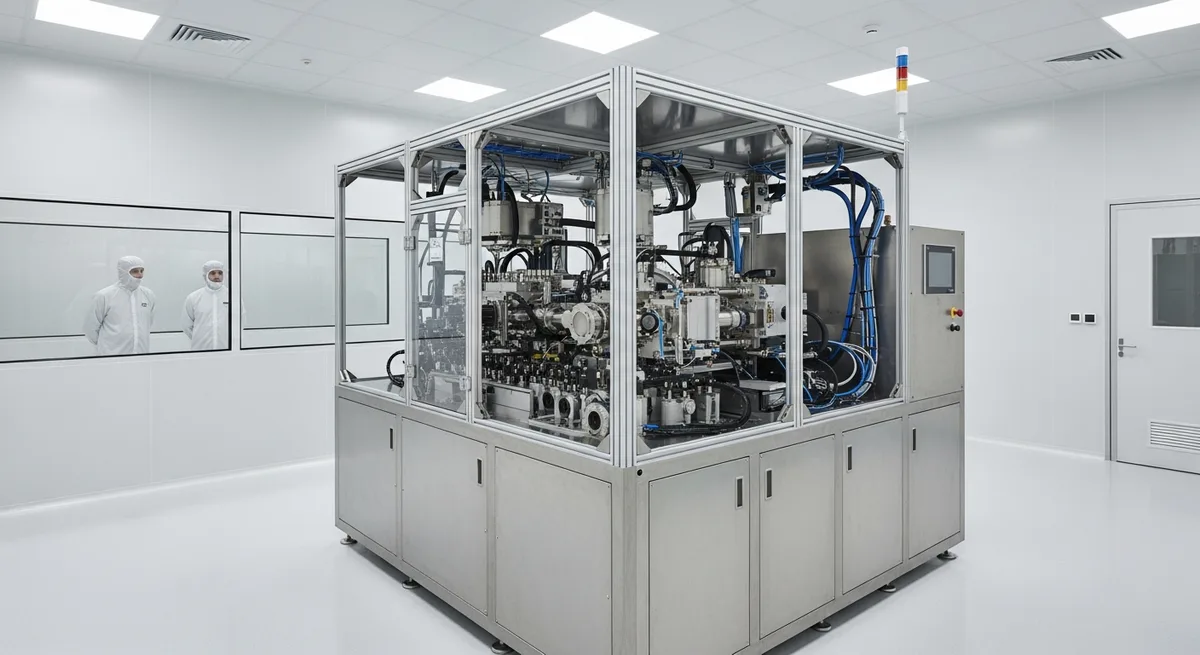
In this chamber, air is but a distant, almost apocryphal memory. Turbomolecular pumps execute a ruthless operation here: they evacuate every oxygen molecule, every stray mote of dust, every errant atom, leaving behind only a profound, cosmic void. As the pressure plummets to 10⁻⁶ mbar, space ceases to be a mere location. It transmutes into an existential vacuum where matter forfeits its inherent right to exist. Only the ten-millimeter-thick walls of SS304L steel, cold and indifferent, shield this stillness from the chaos of the external world. Press an ear against this metal, and you will hear not the hum of machinery, but silence itself—that dense, taut silence found only where physics has been forced to submit to human will.
At the heart of the system lurks a 193-nanometer argon-fluoride excimer laser. This is no light source in the traditional sense; it is a blade of photons forged from bursts of gargantuan energy. Each pulse, lasting a mere few tens of nanoseconds, is a microscopic lightning bolt, harnessed and confined within an optical cage. When this laser “fires,” it does not merely emit light—it lacerates space, leaving behind invisible yet geographically precise footprints. It is a process where energy becomes a solid, physical object, capable of carving structures whose dimensions pale before a strand of human DNA. This is not manufacturing; it is molecular surgery, performed with the chilling composure of a lethal weapon.
The optical path traversed by this photon stream is an engineering masterpiece, constructed from material that abhors change. Ultra-low expansion glass performs its role with near-religious devotion. When the environment attempts to distort it, the glass remains immobile, as if suspended in time. It is anchored by a silicon carbide frame with a stiffness of 30,000 MPa—the machine’s spine, which absorbs every vibration, every tremor of the world outside. This frame is not merely a chassis; it is an engineering shield capable of dissipating energy fluxes of 490 W/m-K, preventing them from devolving into destructive heat. Should this frame lose its rigidity for even a heartbeat, the entire optical system would collapse into a chaos of meaningless reflections.
The lens assembly functions as a fragile yet profoundly complex mechanism. A 0.85 numerical aperture focuses light into a point deeper than 150 nanometers, where light ceases to be a wave and becomes a tool. This is the threshold where engineering meets molecular precision. Each lens is aligned with such rigorous exactitude that any deviation exceeding 0.1 nanometers—a distance smaller than an atomic nucleus—would compromise the entire process. This is the moment when engineers become invisible sculptors, working upon matter they themselves have brought into being.
Yet the true dance of the system occurs not in the light, but upon the air-bearing stage. The ten-kilogram wafer table glides at a velocity of 500 millimeters per second, as if floating upon an invisible cushion. It is an engineering ballet where friction has been erased from the equations. Gecko-inspired air bearings maintain a contact force of 10–100 kPa, ensuring the table moves with a precision of ±0.1 nanometers. When the table brakes or shifts direction, the SiC frame remains so resolute that even sudden inertial shifts induce no deformation. It is a symbiosis of force and grace, where a linear motor generating 100 newtons of force is governed by algorithms operating at a 10 kHz frequency.
Every millisecond, the computer processes thousands of data points. It is akin to a spider’s sensory system, reacting instantaneously to the slightest tremor in the web. DSP and FPGA technologies converge here with artificial intelligence algorithms, which, trained on tens of thousands of iterations, sense the system’s state more acutely than any human. This intelligence does not predict—it knows. It corrects the trajectory before the laser even touches the surface, as if preemptively sensing where the seeds of entropy might take root.
Thermal stability here is a sacred tenet. Thermoelectric coolers (TEC) and resistive heaters operate incessantly, maintaining temperatures within a margin of ±0.01°C. The SS304L steel chamber, with a yield strength of 250 MPa, acts as a thermostatic shield. It absorbs all ambient noise, preventing even the most minute temperature fluctuation from reaching the core. It is an isolation that permits only those processes envisioned by the engineers to unfold.
Once the wafer receives its dose of 10–50 mJ/cm², the chemical and thermal processing phase commences. This lasts up to 100 seconds—a long, taut duration during which the traces left by light transform into structural elements. It is a synthesis of chemistry and physics where the silicon surface becomes a microchip. Each transistor is precisely prepared, each interconnect formed with a precision that defies the mind. We watch as dead matter becomes an intellectual structure.
This system is not merely a tool. It is our species’ attempt to overcome the law of entropy, to master chaos and impose order where none existed before. We construct gargantuan, multi-ton machines solely to manipulate things invisible to the naked eye. This is the essence of our civilization: a power reminiscent of nature itself, but with a level of control nature never possessed. We are a nation of architects building cities on silicon wafers, and this apparatus is our instrument, our hand, our way of inscribing our existence into the very atoms of matter.
In the future, when this system with its 10 GHz brain becomes a mere relic of history, its legacy will endure in every digital process we perform. It is the pinnacle of engineering, where metal, glass, and silicon coalesce into a singular entity. Here, the concept of error ceases to exist, and the boundaries between the physical and digital worlds simply dissolve. We are moving toward a future where every nanometer is controlled, and every pulse is meaningful. And in this silent, vacuum-filled room, we feel the pulse of our civilization growing faster, more precise, and more powerful.