Forge of the Void
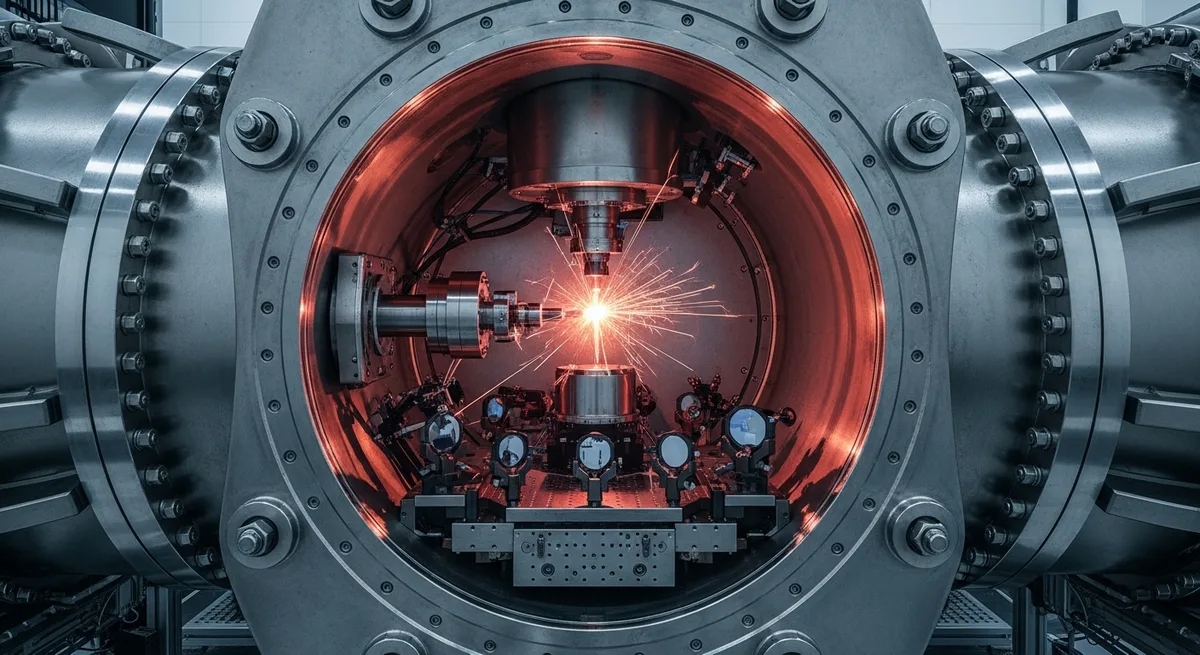
The twelve-ton steel housing, a frozen monolith of industrial intent, conceals a void of ruthless proportions. Within this chamber, the pressure is attenuated to a vacuum so profound it mirrors the serene emptiness of interstellar space; here, every stray gas molecule is an interloper, a kinetic obstruction to the propagation of light. As the turbomolecular pumps reach their operational zenith, their rotors spin at velocities approaching the sonic barrier, generating an acoustic backdrop that resonates like the distant, relentless roar of a tempest. This is no mere empty vessel; it is an engineering fortress, designed to hold reality at bay so that, within its sanctuary, the genesis of photons may occur.
The chamber walls are far more than a passive shell. They function as a structural anchor, a molecular framework engineered to dampen the micro-vibrations bleeding in from the surrounding industrial landscape. Each weld seam is an anatomical incision, its integrity a matter of existential necessity, for the slightest thermal expansion would transmute the precision of the process into chaotic noise. This metallic fabric must maintain its geometry against the crushing weight of the external atmosphere, which presses inward with the relentless force of tectonic plates converging upon a subterranean cavern.
At the heart of the laser, where kinetic energy transmutes into the searing fire of plasma, matter undergoes a metamorphosis akin to a lightning strike captured within a controlled environment. Pulses, repeating at a frequency of 50 kHz, bombard droplets of tin, forcing them into an instantaneous, incandescent, ionized state. This plasma, reaching densities of billions upon billions of particles per cubic centimeter, serves not only as the source of radiation but as a crucible of engineering stress. Each discharge triggers microscopic shockwaves that ripple through the system’s frame, compelling the metal to "groan" under the duress of constant thermal cycling.
The collector mirror faces an existential challenge: it must reflect extreme ultraviolet light while simultaneously enduring a relentless bombardment of high-energy photons. Its surface, coated in layers mere hundreds of nanometers thick, sustains an intense ion flux that, over time, alters the material’s internal matrix. This prolonged exposure induces irreversible shifts in the crystalline structure, where atoms, driven by the ceaseless pressure of radiation, begin to migrate from their lattice sites. This is not mere wear; it is a slow, molecular-level architectural decay, a process wherein the optical surface gradually forfeits its capacity for perfect reflection.
This material "fatigue" manifests as a haunting phenomenon: the reflection coefficient begins to fluctuate, not due to external interference, but as a direct structural response to the photon flux. As the molybdenum and silicon layers deform, they generate microscopic stress points that distort the reflected beam. It is an engineering paradox: the more precisely the reflective surface is designed, the more susceptible it becomes to the atomic chaos it generates through its own operation. This degradation has become the primary bottleneck, constraining not only the velocity of production but the ultimate resolution of the elements themselves.
The reticle stage acts as a high-precision balancer, its movement synchronized to the rhythmic pulse of the plasma. Its inertial mass is governed by laser interferometers that track position with nanometric error margins. Yet, the kinetic momentum generated during these rapid transitions creates subtle, perilous inertial vibrations. These oscillations propagate through the entire mechanical assembly, forcing the control software into a state of perpetual, corrective agitation. It is a relentless struggle between the physical law of inertia and the precision of digital control, a domain where every microsecond is a battleground.
The algorithmic logic governing this complex is a vast feedback network, where sensors continuously harvest data on the quality of the radiation flux. When the system detects that the degradation of the mirror’s surface is compromising the beam’s geometry, it automatically compensates, modulating the laser’s pulse frequency in real-time. This is not simple error correction; it is a dynamic adaptation to the physical decay of the system, a desperate attempt to maintain stability within an environment that is actively consuming itself through the intensity of its own photon bombardment.
The evolution from traditional optical lithography to this current paradigm was dictated by the boundaries of physics, yet we have arrived at a new impasse. As the structures we create grow increasingly infinitesimal, the influence of thermal deformation intensifies, and the crystalline structure of the material ceases to be a mere support, becoming instead a fundamental obstacle. The dissipation of thermal energy within the mirrors has become an engineering challenge that cannot be solved by increasing cooling capacity alone. The core problem lies in the nature of the material itself: the constant photon flux inevitably rearranges the atoms, ensuring that any optical element subjected to such energy possesses a finite lifespan, regardless of its initial precision.
This technical reality reveals a foundational limit: we have reached a point where the manufacturing tool has achieved a level of complexity and fragility equal to the product it creates. Each system cycle is not merely a step toward smaller semiconductors, but a step toward the total degradation of the material itself. This is not the end of technology, but it is a physical threshold where engineering confronts the law of entropy—a law that refuses to yield, even to the most precise systems humanity has ever devised. Ultimately, the system functions not because it is perfect, but because it manages to momentarily arrest its own decay long enough to execute one more, final act of carving.