The Precision Framework: 6061-T6 Aluminum Alloy as the Bedrock of Interfer
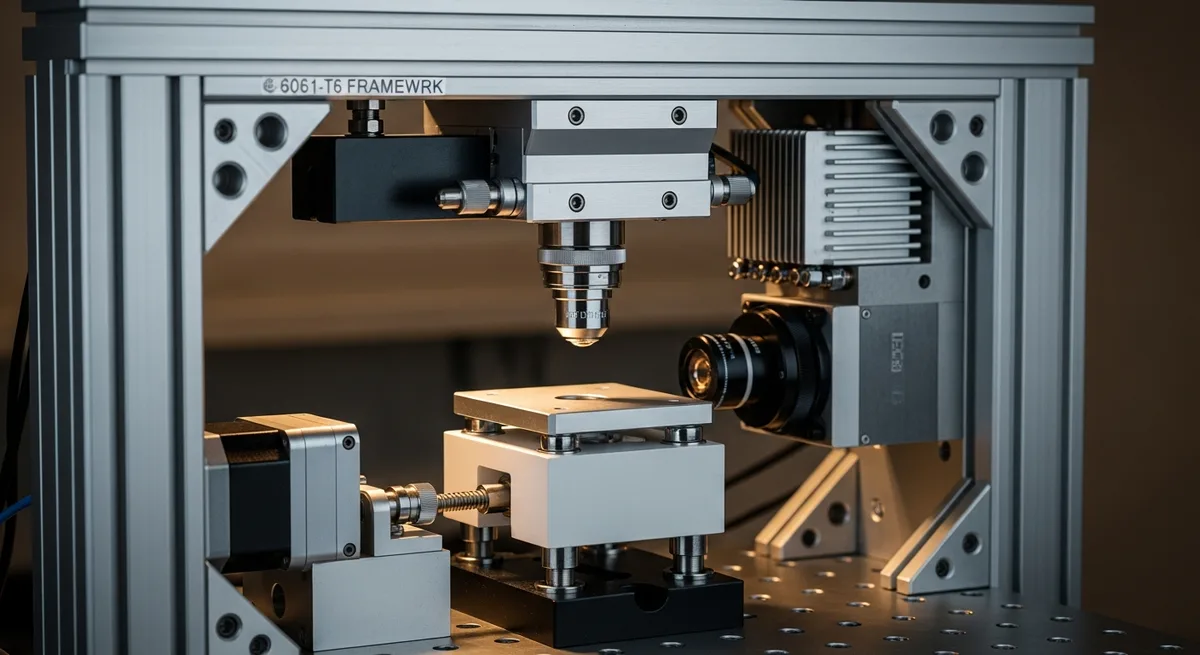
Within the laboratory’s vacuum of silence, where ambient noise is suppressed to the absolute threshold of perception, the scanning white-light interferometry microscope functions as a rigorously calibrated response mechanism. Its 450-millimeter frame, forged from 6061-T6 aluminum alloy, is no arbitrary selection. This alloy, prized for its superior strength-to-weight ratio and inherent corrosion resistance, provides the structural rigidity essential for maintaining the stability of the optical axis. Unlike steel, which risks excessive mass, or polymers, which succumb to deformation under the slightest pressure fluctuations, 6061-T6 offers a modulus of elasticity sufficient to dampen vibrations propagating through the building’s foundation long before they can reach the optical tract. It is an engineering mandate: to isolate the act of measurement from the chaotic physics of the macroscopic world.
The integrity of the assembly rests upon the precise control of thermal expansion. While 6061-T6 possesses a higher coefficient of expansion than more exotic alloys, its selection is predicated on manufacturing economy and predictable behavior. Engineers compensate for this trait through active thermoregulation, maintaining a constant temperature throughout the frame’s entire volume. Every micron of the structure is calculated to ensure that thermal deformation remains homogeneous rather than localized. This prevents the internal stresses that would inevitably arise from joining disparate materials, allowing the frame to function not as a collection of parts, but as a monolithic support capable of resisting the mechanical loads that, though invisible to the naked eye, perpetually exert pressure on the device’s geometry.
The essence of the structure lies in its capacity for geometric stillness. As ambient temperatures shift, the metal responds with expansion or contraction; however, the 6061-T6 crystal lattice, refined through solution heat treatment and artificial aging, ensures these transitions remain reversible and consistent. This is no passive slab of metal, but an active defensive system whose physical resistance to deformation is inextricably linked to the accuracy of the data. Should the frame "breathe" unevenly, the interference pattern would blur into incoherence. Thus, the engineering task here is not to eliminate physics, but to master it, transmuting the properties of matter into a predictable variable.
The microscope’s Z-axis platform utilizes a Zerodur ceramic block, chosen for a coefficient of thermal expansion approaching zero. This is a critical engineering intervention, as the platform must maintain positional accuracy at the nanometer scale. When the NEMA 17 motor transmits 10 Newtons of force through the screw mechanism, the platform moves with minimal inertia. The choice of the NEMA 17 motor represents a calculated compromise between torque and vibration; it provides sufficient power to overcome friction, yet its stepper operation necessitates sophisticated micro-stepping control to ensure fluid motion. A ten-nanometer step represents the physical limit dictated by the resolution of the mechanical drive.
The platform glides upon ruby ball bearings. Ruby, with a hardness of 9 on the Mohs scale, was selected for its exceptional resistance to compression and wear. Under constant microscopic pressure, steel bearings would eventually deform, creating minute indentations that would compromise the trajectory of movement. A friction coefficient of 0.1 ensures the platform moves without the "stick-slip" effect—the erratic, jerking motion caused by overcoming static friction. Each sphere acts as a load-bearing point, distributing stress across the entire contact surface to ensure the platform’s position remains stable at any point along the Z-axis.
The mechanical system is designed to withstand long-term operation without the need for frequent recalibration. The longevity of the ruby bearings is an engineering response to the necessity of keeping the device in a state of readiness for thousands of hours. This is not an aesthetic choice, but a technical requirement; any degradation of the bearing surfaces would manifest directly as measurement error. The stability of the platform is secured through precision surface polishing, achieving a roughness of a mere 10 nanometers, allowing for a seamless glide devoid of any interference that might corrupt the optical pattern.
A 100-watt halogen lamp serves as the light source, its 3200 Kelvin temperature ensuring stable spectral power within the 400–700 nanometer range. This light, passing through an SF11 glass objective, creates a telecentric system. SF11 glass, with a refractive index of 1.785, is selected for its high dispersion control, enabling efficient light focusing at a 0.9 numerical aperture. While this achieves high resolution, it introduces a severe thermal challenge: the source generates a significant quantity of infrared radiation capable of destabilizing the entire optical assembly.
To manage this thermal load, a specialized heat spreader with active circulation maintains a constant temperature of 50 degrees Celsius. This temperature is the optimal equilibrium point where the lamp’s spectral characteristics remain most stable. Should the temperature fluctuate, the wavelength of the emitted light would shift, distorting the interference measurements. A one-degree margin of error is the engineering limit enforced by the PID (proportional-integral-derivative) controller governing the cooling system. Here, thermal management is not merely component protection, but a vital stabilization measure for the optical system itself.
Thermal equilibrium is achieved through the meticulous routing of heat flows. The heat spreader is coupled to the frame via thermoelectric elements that not only extract heat but act as active stabilizers. This prevents the formation of temperature gradients that would otherwise induce uneven expansion in the frame. The engineering objective is to create a system where energy exchange is perfectly balanced, preventing heat from becoming a source of noise within the measurement process. It is a perpetual balancing act between energy consumption and systemic precision.
The CCD camera at the rear of the system is cooled to -20 degrees Celsius using a thermoelectric (Peltier) cooler. This extreme cold is essential to suppress dark current—the electronic noise generated within the sensor by thermal electron excitation. The 1024x1024 pixel matrix operates with 60 percent quantum efficiency, and a 12-bit depth provides the dynamic range necessary to isolate even the faintest interference signals from the background. This is the foundation of digital signal processing, where every photon is accounted for and converted into a discrete unit of data.
Sensor cooling is a critical process. The thermoelectric cooler, operating on the Peltier principle, transfers heat from the CCD matrix to the hot side, which is then dissipated into the environment via a heat exchanger. This process demands high electrical current stability, as any ripple in the current would induce temperature fluctuations in the sensor. From an engineering perspective, this is a complex circuit where the electronics must be as stable as the mechanical structure. Without this cooling, electronic noise would overwhelm the interference image, rendering measurements impossible.
The selection of the CCD matrix is predicated on its linearity and its ability to capture changes in light intensity with high precision. The 12-bit depth allows for the capture of 4096 levels of grayscale, a requirement for accurately reconstructing surface topography via Fourier transforms. Each pixel functions as an individual detector, and their collective output forms a system capable of observing the phase shifts of the interference pattern. It is a technical instrument that translates the interference of light waves into a mathematical model, enabling the measurement of surface height with nanometer-scale accuracy.
The process begins with the formation of an interference pattern as reflected light meets the reference wave. As the Z-axis platform performs a phase shift, the light waves interact, creating a pattern of varying intensity. Algorithms operating at a 10 MHz rate perform Fourier transforms, decomposing this pattern into a frequency spectrum that determines the height of every point on the surface. This is a mathematical operation that converts the physical collision of light into a digital elevation map. The process is entirely automated, requiring immense computational power to ensure real-time data processing.
This system is an extension of the human visual system, operating at the very limits of physical law. It perceives depth where optical microscopes see only a flat image. It is a triumph of engineering in which every component—from the 6061-T6 frame to the CCD sensor—is tuned to function as a unified mechanism. It is not merely a measurement tool; it is a bridge between visible matter and its invisible architecture. In the future of semiconductor manufacturing, where nanometer precision will become the standard, such devices will be the primary instruments for ensuring production quality.
Ultimately, the success of the system lies in its ability to remain motionless despite the influence of all internal and external forces. This is the essence of engineering: to create a structure that, in its depths, manages immense forces and precision to provide a clear and intelligible answer on the surface. Each measurement is a confirmation that the human mind is capable of mastering the smallest chaos. Gazing at the screen displaying the surface topography map, one sees not just a stream of data, but a triumph of engineering over the imperfections of matter, opening the possibility to understand the world atom by atom.