Thermal Fluctuation Catastrophe
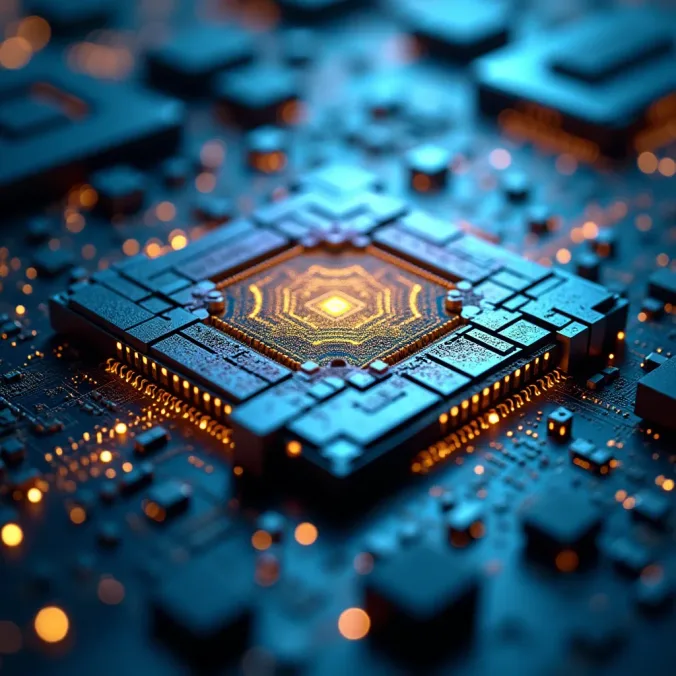
Deep within the architecture of the "Tunnel Falls" processor, a relentless dissolution of reality unfolds—a process engineers struggle to contain within quantum dots measuring a mere 42 nanometers in diameter. Here, the electron is no longer a simple particle; it is a fragile courier of information, imprisoned within a 22-nanometer FinFET variant where every microsecond is a skirmish against decoherence. As the system approaches the 100-millikelvin threshold, the molecular framework becomes hypersensitive to the slightest ambient vibration, and a thermal background—even at a mere 0.0001 Kelvin—triggers an irreversible collapse of the wave function. At this scale, the isotopic purity of silicon-28 becomes the only bulwark, as impurities in natural silicon generate an unpredictable magnetic chaos that erases any logical trace within nanoseconds.
The walls of the quantum dot, fashioned from 3.0 nanometers of aluminum oxide and 1.5 nanometers of hafnium oxide, function as electrostatic gates, yet their operation is fraught with uncertainty. This dielectric coating, with a k-constant of 19, creates a capacitance of 1.2 femtofarads per square micrometer, yet it is precisely here that the first informational distortions emerge. Every voltage spike intended to nudge an electron into its potential well inevitably exerts a parasitic influence on neighboring elements. Metal structures, forced to withstand thermal expansion coefficient differentials of 0.26 percent, are subject to constant microscopic stresses that warp the geometry of the potential barriers. These structural fluctuations are not merely "creaks"; they are physical variables that force the electron to "leak" from its intended state, transmuting a logical unit into indeterminate noise.
Each transistor, operating within the limits of 0.4 millielectronvolts of charging energy, confronts a fundamental chasm between theory and reality. Because this EC value is lower than the kBT thermal energy, the system perpetually balances on the edge of thermodynamic instability, where 400 microwatts of cooling power is the only factor arresting electron escape. The 28-nanometer width of the tunnel barrier is not fixed—it pulses in response to voltage fluctuations between 0.3 and 1.2 volts, creating an exponential instability in throughput. When an electron tunnels through this barrier, it performs an operation, but due to the slightest mismatch in energy levels, the operation becomes probabilistic. This means that quantum logic here is not deterministic but rather stochastic; every step in the computational chain accumulates errors that eventually coalesce into systemic uncertainty.
Upon coupling two quantum dots, the "J" exchange interaction, reaching 100 megahertz, becomes a primary source of information loss. The physical paradox lies in the fact that aligning the energy levels of electrons with absolute precision is impossible; any discrepancy forces the electron into a higher energy state, thereby shedding its original information. The singlet state, formed through the overlap of wave functions, is exceptionally vulnerable—the 10-microtesla magnetic field generated by nickel-iron alloy waveguides must be perfectly calibrated, yet even a 0.01 percent deviation in Rabi frequency induces spin "scattering." This is not merely a technical inaccuracy; it is a fundamental inability of the system to retain quantum information for longer than a few microseconds, forcing the entire processor to constantly "rewrite" its states.
The Pauli spin blockade, utilized as a readout mechanism, is a critical failure point where decoherence assumes its most visceral form. The 100-nanosecond process intended to distinguish the triplet from the singlet state often terminates in a false signal due to the weakness of the 0.5 elementary charge signal. When the quantum point contact detects this signal, it often registers not the information itself, but the charge noise accumulated within the dielectric. The influence of this noise floor means the system "hears" not only the quantum state but the entire surrounding electromagnetic chaos. Even with a signal-to-noise ratio of 100, the integrity of the information remains fragile, and errors arising from dielectric imperfections instantly dissipate the entire accumulated array of computational results.
Error-correction algorithms, implemented via a 3x3 dot array, represent an attempt to master this chaos, yet they introduce a new stratum of complexity. Although "CZ" gates operate within 30 nanoseconds, they induce a "crosstalk" effect caused by the 0.1 femtofarad capacitive interaction between gates. This implies that to rectify a single error, the system must perform a multitude of operations, which in turn generate new errors. The process resembles a mechanical watch where every gear is forged from liquid metal—the movement is synchronous, yet every vibration alters the precision of the whole. Engineers are forced to continuously escalate the complexity of error correction to compensate for the processor's physical imperfections, creating a vicious cycle where computational resources are expended solely to maintain the system’s elementary stability.
Gold interconnects, with a resistance of 1.5 micro-ohm centimeters, are the only means of limiting heat dissipation to a critical threshold, yet even this does not stave off thermodynamic imbalance. The "soul" of the processor is a fragile equilibrium between absolute cold and the heat generated by electron movement. Each epitaxial layer, grown via molecular beam epitaxy, must be perfectly homogeneous, as the slightest irregularity in atomic arrangement creates thermal "hot spots." These microscopic heat pulses propagate through the silicon substrate like seismic waves, shattering quantum states. It is an engineering dead end: the more qubits added for power, the greater the thermal load the dilution refrigerator must extract without compromising the 15-nanometer-thin structure.
The final engineering barrier concerns not the hardness or conductivity of materials, but the very nature of quantum information—the capacity to maintain integrity within a system that destroys itself through thermal exchange. Each additional qubit increases the number of wires, which inevitably heightens the probability of "crosstalk," regardless of cryo-CMOS integration. When the processor reaches its operational limit, information simply dissolves into thermal noise, as there is no way to fully isolate a quantum system from the effects of its own operation. It is a technical paradox: the more precisely a processor is designed, the faster it reaches its thermodynamic limit, where further computation becomes physically impossible without the loss of information, leaving engineers to watch as numbers dissolve into clouds of probability.