Stereolithography: The Harmony of Photopolymerization and Precision
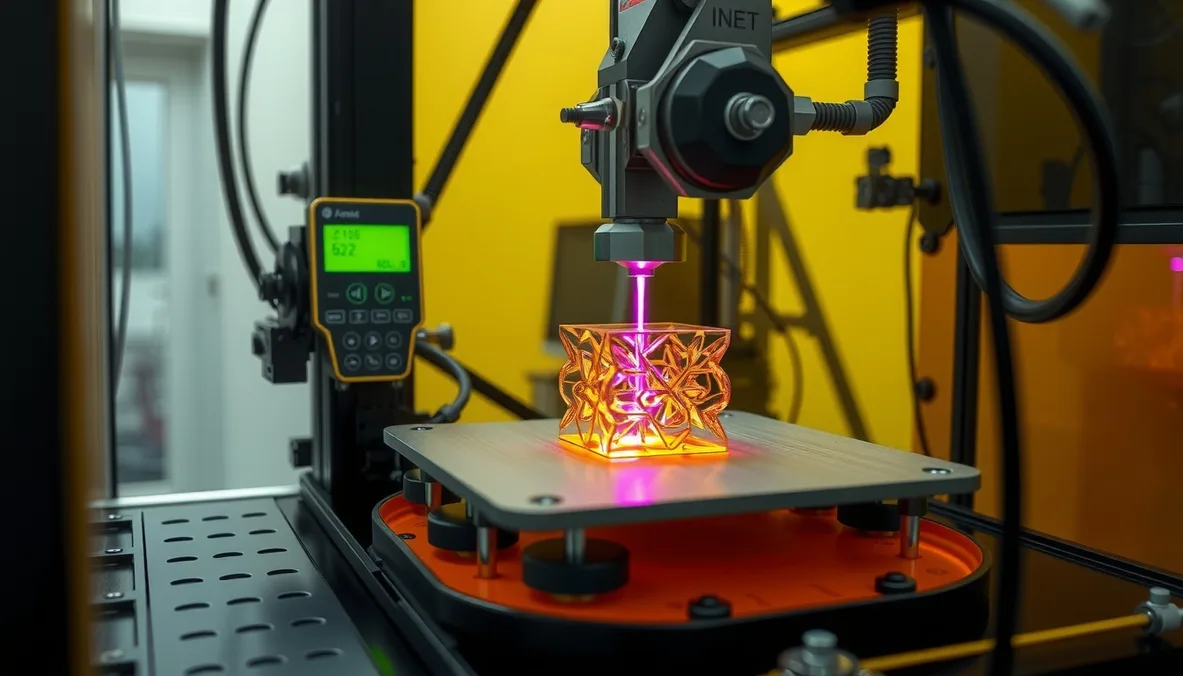
The stereolithography process initiates at the precise intersection where a liquid-phase photopolymer meets a meticulously dosed electromagnetic flux. This is no mystical transmutation, but a rigorous exothermic reaction in which a resin—maintaining a viscosity of 100–150 centipoise—must preserve absolute homogeneity. The system’s primary existential challenge lies in the degradation of the resin under prolonged thermal stress and its constant exposure to oxygen, which acts as a potent inhibitor of radical polymerization. To ensure the integrity of each layer, the system must dynamically compensate for viscosity fluctuations arising from pigment sedimentation or the scission of monomer chains; consequently, the microcontroller adjusts laser exposure duration in real-time, governed by the cold, empirical data streaming from fluid temperature sensors.
The 405-nanometer beam emitted by the laser diode, operating at a power of 100–200 milliwatts, is far more than a mere light source; it is a concentrated stream of photons whose energy density must be tuned with surgical precision to the sensitivity of the photoinitiator. The optical system contends with the inherent limits of diffraction and lens aberrations, which manifest as geometric distortions at the periphery of the print field. To mitigate these errors, galvanometer scanners execute dynamic focus corrections, compensating for the beam’s propagation angle. Should this calibration falter, energy losses along the optical path result in uneven polymerization depth, manifesting as micro-fractures between layers that compromise the structural fatigue limit of the final component.
The borosilicate glass vat serves as the foundational support, yet its optical transparency is hostage to the purity of its surface. Any residual resin or microscopic abrasion on the glass induces light scattering, which deforms the profile of the laser spot. The refractive index of 1.5–1.6 remains constant only so long as the glass maintains its structural integrity against the heat of the exothermic reaction. Thermal expansion introduces mechanical stresses capable of skewing the laser’s focus, necessitating engineering solutions that incorporate active heat dissipation to ensure the vat temperature fluctuates by no more than 0.5 degrees.
The build platform, forged from low-alloy steel, must withstand stresses of 500–700 megapascals, yet the true engineering crux lies in the management of adhesion forces. As the polymer cures, it undergoes shrinkage, generating internal stresses that threaten to peel the part from the platform or warp its geometry. A Young’s modulus of 200–250 gigapascals ensures the platform remains rigid, yet a surface roughness of 0.1–0.5 micrometers is essential to facilitate sufficient mechanical interlocking. If the surface is too smooth, the part detaches; if too coarse, the subsequent removal of the part becomes impossible without catastrophic damage to its base layer.
The kinetic system, utilizing a ball screw with a 2–5 millimeter pitch, must overcome the viscous resistance of the fluid during every cycle. As the platform descends, a vacuum effect forms between it and the vat floor, a force capable of tearing the nascent, uncured polymer layer. To circumvent this mechanical load, a controlled separation angle is employed, allowing the resin to flow evenly and fill the interstitial space. This process demands a repeatability of 0.1–1 micrometers, maintained by stepper motors governed by a 32-bit microcontroller that monitors every movement at millisecond intervals.
SLA technology has transcended the confines of the laboratory to become an industrial standard, yet its boundaries remain strictly defined by material chemistry. We cannot print objects whose internal stress exceeds the tensile strength of the polymer, forcing engineers to design sacrificial support structures that must later be mechanically excised. This process necessitates a constant compromise between geometric precision and structural integrity. The optical distortion caused by light refraction within the resin layer is a primary reason why large-scale components often lose dimensional accuracy, requiring algorithms to continuously adjust the laser trajectory in anticipation of polymerization depth.
Resin aging and chemical stability are the critical variables dictating the longevity of the final product. Prolonged storage in the vat triggers spontaneous polymerization, particularly if the environment is not shielded from ambient light. This alters the material’s viscosity and reaction sensitivity, compelling operators to perform regular calibration tests. These tests measure the “critical exposure energy”—the minimum photon count required to initiate curing. Precise knowledge of this parameter is the only defense against “over-curing,” where the laser inadvertently solidifies excess material surrounding the intended focal point.
The objective of modern engineering is not merely to manifest a complex form, but to ensure its isotropic properties. Because the SLA process is inherently layered, vertical strength often lags behind horizontal integrity. This is an engineering hurdle we overcome by optimizing interlayer adhesion through a controlled degree of polymerization. Each layer must be “injected” into the previous one, ensuring molecular fusion. This is achieved only when laser power and descent velocity are perfectly synchronized with the resin’s polymerization kinetics.
Future advancements in this field will be centered on material engineering, where resin composition is tailored to the specific functional requirements of the object. We are already capable of incorporating ceramic particles to enhance rigidity, yet this introduces new challenges regarding light scattering within the vat. Every technical refinement—be it a superior light source or a more precise motor—is merely a tool to master the laws of physics operating within this small, contained volume. We no longer simply create objects; we govern the transition of states of matter, transmuting liquid chaos into engineered order.
This system stands as a testament to an engineering discipline where there is no room for the accidental. Every 100–200 megahertz clock pulse, every 405-nanometer photon, and every micrometer of the steel platform operates in absolute synchronicity. This is not a revolution, but a methodical synthesis of physics and digital control, allowing us to manufacture components unattainable by any other means. We will continue to refine this technology, striving to minimize optical distortion and maximize polymer stability, for it is these technical barriers that separate us from a future of fully autonomous manufacturing, where human intervention is rendered obsolete.