Nanovacuum Chamber: Realm of the Artificial Void
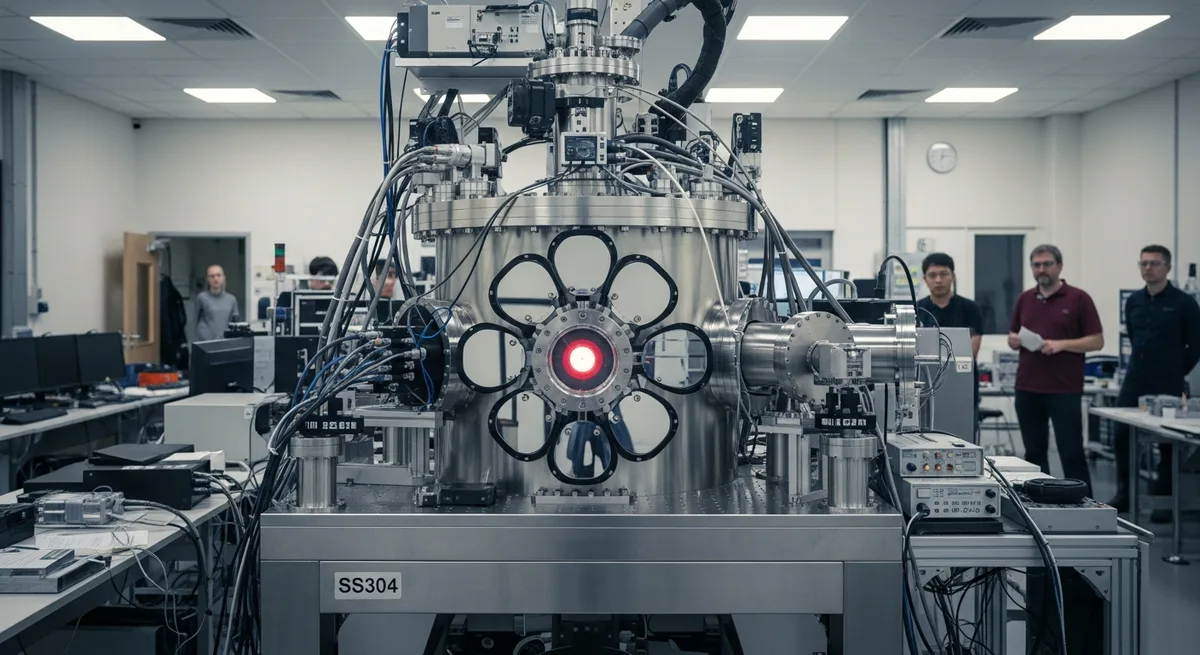
The stainless steel cylinder, spanning two and a half meters in diameter with walls engineered to withstand a tensile stress of 285 megapascals, is far more than a mere containment vessel; it is a pressurized metallic cage harboring a brutal, suffocating silence. Within this 1.8-meter-high vault, a vacuum of 10⁻⁶ millibars forces atoms into an unnatural state, as if they have been violently excised from the fabric of ordinary existence. The hum of cryogenic pumps transmutes into a persistent, low-frequency vibration—a phantom tectonic tremor—while turbomolecular mechanisms ruthlessly excise every stray molecule to ensure the unimpeded flight of photons. This is not a void, but an artificially curated non-existence, where gas density is attenuated to such a radical minimum that space itself is rendered a fragile, nearly invisible instrument.
At the system’s core lurks a laser-generated plasma focus—a miniature, caged lightning bolt with its power concentrated upon a tantalum target five millimeters in diameter. Fifty thousand times per second, a carbon dioxide laser discharges a 20-joule pulse lasting a mere 10 nanoseconds; this impact instantaneously transmutes the solid metal surface into a searing, volatile plasma. Tantalum, possessing a melting point of 3017°C, exhibits a stoic defiance in this infernal environment, while a constant rotation of 100 revolutions per minute serves as the only defense against a localized thermal runaway that would otherwise liquefy the target base into a shapeless, molten ruin.
This process unfolds within an aluminum oxide ceramic housing, selected for its exceptional resistance to thermal shock and an ultra-low outgassing coefficient of 10⁻⁹ millibar-liters per second. As 13.5-nanometer extreme ultraviolet radiation rages within, the ceramic absorbs staggering thermal loads, maintaining structural integrity where any other metal would have buckled—a triumph of material fabric over entropy, ensuring the plasma source does not succumb to the very energy it radiates.
Along the light’s trajectory stand six mirrors, each half a meter in diameter, their 1.2-meter radius of curvature forming a labyrinthine path of reflections. Their surfaces, coated in alternating layers of molybdenum and silicon, create an interference structure with a 10.5-nanometer periodicity, reflecting 70 percent of the incident radiation. Through ion-beam deposition, bombarding the target with 5 keV particles, a layer with a density of 9.8 grams per cubic centimeter is forged—a physical tool capable of corralling light of such infinitesimal wavelength.
This molecular matrix mirrors the natural principles observed in the iridescent patterns of butterfly wings, where periodic nanostructural elements compel light to behave in defiance of classical optics. Engineers, having co-opted this biological response to optical chaos, have transformed these mirrors into more than reflective surfaces; they are now high-precision wavelength filters. Each atomic layer must endure not only the relentless bombardment of photons but also constant thermal expansion, maintaining a 13.5-nanometer tolerance without the slightest deviation.
The system’s foundation and axis of motion—the wafer stage—is constructed from Ti-6Al-4V titanium alloy. Its 900-megapascal yield strength permits a positioning accuracy within a 10-nanometer threshold. This metallic architecture, characterized by an exceptionally low coefficient of thermal expansion, is designed so that even the most microscopic thermal oscillation cannot perturb the stage, demonstrating an engineering resilience where the hardness of metal becomes the ultimate guarantor that every circuit trace aligns with the algorithmic mandate.
The soul of this motion mechanism resides in a PID controller that, utilizing interferometers and photodiodes, continuously adjusts the wafer’s position in real-time, as if balancing on a razor’s edge where every fluctuation in the laser pulse triggers an instantaneous logical response. The control algorithm, processing sensor data, stabilizes the radiation pattern, preventing it from dissipating or drifting from its target trajectory, even as the entire system is subjected to microscopic vibrations.
The carbon dioxide laser housing, forged from SS304 stainless steel, provides a rigid frame for the generation of these high-intensity light pulses. The optimized weight-to-strength ratio ensures that the laser chamber walls remain impervious to internal pressure or thermal fluctuations. It is the technical fulcrum where the entire process commences, transmuting electrical potential into a 20-joule stream of photons.
The entire 12-ton apparatus is balanced so that its center of mass rests a mere 0.8 meters from the base, ensuring maximum operational stability. Every bolt and centimeter of weld is calculated to withstand the compressive force exerted by the 10⁻⁶ millibar vacuum. This is not merely a metal structure; it is a controlled equilibrium of forces, where structural rigidity converges with molecular-level precision.
Within the system’s optical chamber, the six-mirror array gathers the radiation emitted by the plasma and directs it toward the silicon wafer, where the photolithography process occurs. Each packet of photons, reflected by the Mo-Si layers, acts as a sculptor’s chisel, etching microscopic patterns. The process is so exacting that the slightest speck of dust or a temperature shift of half a degree would compromise the entire cycle, rendering the silicon a worthless slab of inert matter.
Tantalum, serving as the plasma source target, is subjected not only to the laser but to a continuous process of atomic erosion. Its density of 16.69 grams per cubic centimeter is essential to ensure the plasma formation is sufficiently intense to generate 13.5-nanometer radiation. When the laser beam strikes the metal, an instantaneous phase transition occurs; the target surface, rotating at 100 RPM, protects itself from localized evaporation, preserving its physical form through thousands of hours of operation.
Maintaining vacuum integrity remains a struggle against the anomaly of material fatigue induced by constant cyclic heating. The aluminum oxide ceramic, though resilient, eventually accumulates micro-fractures that act as latent outgassing channels. Each such nanometric defect increases the pressure within the chamber, degrading the purity of the photon stream and forcing the entire system to contend not only with external entropy but with internal, material degradation. It is an engineering dead-end where even the most perfect metal alloy eventually yields to the flow of time and energy, leaving us at the threshold where the laws of physics cease to obey our calculations.