Nanotopography: The Art of Sculpting Infinity
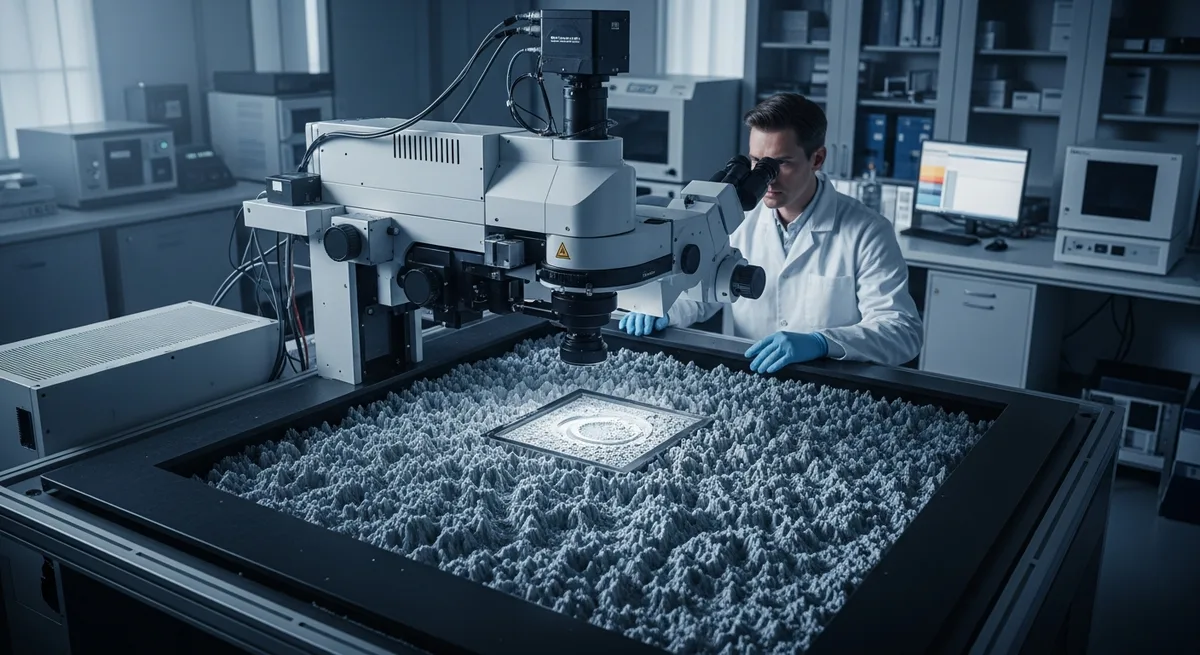
Within the laboratory’s sterile expanse, where the air is scrubbed to an absolute, clinical purity, the nano-imprint lithography system commands the room—not through sheer scale, but through the way it warps the surrounding environment. This is a ton-and-a-half of stainless steel, a 1200 mm x 800 mm x 1800 mm volume that defies the conventional definition of manufacturing. It is, in essence, a laboratory of solid-state physics manifested in a base of FC-25 alloy cast iron. Possessing a compressive strength of 170 MPa, this foundation serves as an inert anchor. When the internal mechanism exerts a 100 kN load, the base absorbs the vibrations that would otherwise shatter the nanostructures into incoherence. This is no static repose; it is a dynamic equilibrium, a state where the metal’s crystalline lattice perpetually battles mechanical stress to maintain its structural integrity.
The mold, a four-millimeter-thick wafer of silicon, serves as the axis of this process. Its surface is cloaked in a two-nanometer layer of octadecyltrichlorosilane. This molecular film is far more than a mere protectant; it is a chemical barrier that recalibrates surface energy, preventing silicon atoms from fusing with the polymer substrate. As the mold descends, 10 MPa of pressure is concentrated into an area smaller than a human palm. This force is sufficient to compel matter to flow at the nanometric scale, forcing it into every microscopic recess of the mold. Yet, the peril is constant: should the pressure distribution falter, the mold may fracture. This is not the brittle shattering of common glass, but a violent, instantaneous release of stored energy capable of annihilating the entire lithography cycle, reducing the silicon wafer to thousands of useless, jagged shards.
The voice coil motor (VCM) governing the imprint head executes a 10-millimeter stroke with a precision of one nanometer. It is a challenge of extreme accuracy, complicated by the relentless reality of mechanical resistance. The friction generated during movement, however infinitesimal, manifests as thermal energy—the machine’s natural antagonist. Should the motor’s temperature rise by even a single degree, the thermal expansion of the metallic components could shift the mold off-axis. Consequently, every VCM movement is synchronized with a PID controller, which adjusts current pulses at a 100 Hz frequency to compensate for the slightest thermal drift. It is a process of perpetual correction, a machine attempting to anticipate its own physical expansion.
Inside the chamber, the temperature is maintained at 20°C with a tolerance of 0.1°C—a critical threshold. In the 10^-3 mbar vacuum, the process is hypersensitive to the movement of even the most sparse gas molecules. The thermoelectric cooler operates in cycles that mimic a slow, pulsing rhythm. As the vacuum pump evacuates the chamber, the pressure drops, and with it, the thermal conductivity of the gas. This creates a precarious condition: heat from the components can no longer dissipate via convection, causing it to accumulate within the metal itself. If the control system fails to precisely meter the nitrogen flow, the device risks localized overheating, which would warp the nanostructures before they have the chance to solidify.
The substrate holder is a masterpiece of engineering isolation. It employs both passive and active vibration-damping systems to suppress noise to an amplitude of 10^-6 meters. At this scale, the structural vibrations of the surrounding building—induced by wind or the distant, heavy thrum of street traffic—become signals that the system must actively reject. A laser alignment system continuously scans the gap between the mold and the substrate. Should the beam detect even the most microscopic angular deviation, the PLC controller halts the process instantly. It is a defensive mechanism, shielding not only the product but the machine itself from a mechanical collision that would destroy the prohibitively expensive mold.
The Programmable Logic Controller (PLC), operating at a 100 MHz processing speed, functions as the machine’s nervous system. It monitors thousands of parameters, from valve actuation timing to the voltage of pressure sensors. Yet, the true power of the system lies in its feedback loop. When the 100 Hz PID controller detects metal stress, it does not merely adjust the pressure; it recalibrates the entire operational algorithm. This is not a rote execution of commands; it is a continuous adaptation to the volatility of the physical environment. If the material behaves unexpectedly—if the polymer exhibits a viscosity slightly higher than predicted—the PLC adjusts the imprint duration to prevent structural collapse.
This technology reflects our attempt to co-opt the efficiency of nature. The hydrophobic properties of a lotus leaf or the adhesive principles of a gecko’s foot are encoded into the silicon wafer via nano-imprinting. This is not mere manufacturing; it is the translation of biological function into inorganic matter. As the machine enters the demolding phase, the pressure slowly recedes. It is a delicate moment, the separation of mold from substrate. If the detachment occurs too rapidly, the resulting tension could tear the nanostructures apart. The machine "sighs"—or more accurately, the hydraulic system vents excess pressure, and the chamber temperature stabilizes, concluding a cycle that shapes the technological landscape of our tomorrow.
Every component, every sensor, and every valve in this device is integrated into a seamless system that exists solely to master chaos. This is no technological utopia; it is a daily, relentless struggle for precision, where every nanometer is calculated and every second is weighted with consequence. In this room, where the air is pure and cold, technology ceases to be a mere tool. It becomes an expression of physical law, where human will meets the stubborn resistance of matter. We no longer craft tools by hand; we build systems that shape reality itself, forging a silent, powerful, and impossibly precise future where our biological limitations become irrelevant.
This device is a bridge between our desires and physical reality, constructed of cast iron, silicon, and infinite precision. When the process concludes and the wafer is extracted, it appears to be nothing more than a simple sliver of silicon. Yet, the structures etched upon its surface are more complex than any edifice built by human hands. It is the pinnacle of technological mastery, achieved through immense tension and exactitude. Observing this process, one begins to understand that this block of metal is what separates us from the past. We are no longer toolmakers; we are architects of processes that define our future, creating a reality where every nanometer matters.
In the final stage, as the demolding process reaches its climax, the machine demonstrates its true potency. This is not merely a mechanical action; it is the subjugation of the laws of physics. As the pressure drops to zero and the temperature returns to its baseline, the silicon wafer is released, bearing its newly formed nanostructures. This is the threshold where human-engineered technology meets the fundamental laws of the universe, creating something that transcends our biological capacity. This device is the zenith of contemporary engineering, where every second is measured against universal constants, and every component functions as a unified organism, proving that the greatest achievement is not the result itself, but the incredible control imposed upon chaos.
In this room, where the air is as pure as the calculations performed within, technology ceases to be a tool and becomes our extension. Watching the hydraulic system perform its silent, rhythmic labor, one realizes that this block of metal is the divide between us and the past. We no longer craft tools by hand; we build systems that shape our future, forging a silent, powerful, and impossibly precise reality. This is the pinnacle of modern engineering, where every nanometer is significant and every second is calculated according to the laws of the universe, proving that we are capable of mastering even the most infinitesimal particles of matter.