Nanometer Precision: Conquering Phase Latency in Piezoelectric Actuators
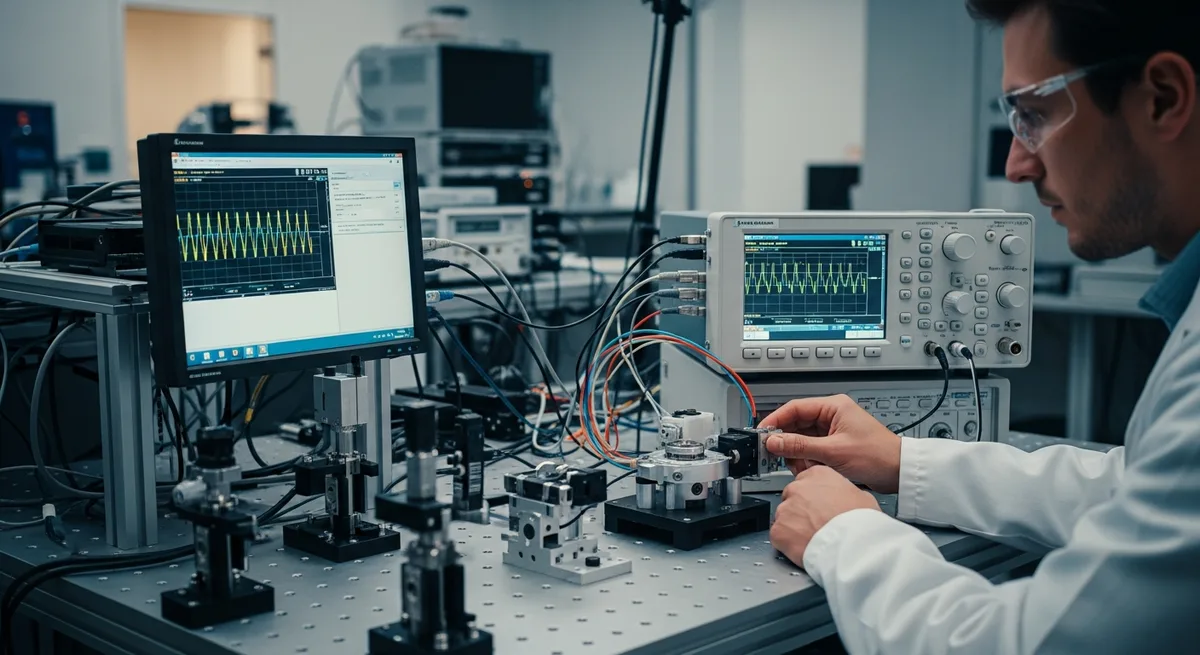
The laboratory atmosphere is saturated with a high-frequency acoustic hum, generated by piezoelectric actuators responding to 100-volt impulses. These components operate at a current intensity of 10 amperes, inducing linear displacement with a precision of a single nanometer. Unlike conventional mechanical systems, these motors are plagued by persistent phase latency; the response time of the piezo crystals fails to synchronize perfectly with the duty cycle of the 405-nanometer light source, manifesting as microscopic inaccuracies along every curve of the trajectory.
The Al 6061-T6 alloy platform, bearing the full weight of the assembly, boasts a yield strength of 285 MPa—yet this physical metric remains a static abstraction, failing to account for the dynamic oscillations born of inertial forces. At a velocity of 100 millimeters per second, the frame undergoes micro-deformations that, while sub-wavelength, function as harmonic interference. This phenomenon triggers an unwanted resonance, which, through transmitted vibrations, destabilizes the meniscus of the fluid at the nozzle exit.
The tungsten carbide component, with a hardness of 89 HRc, is engineered to withstand a polymer flow with a viscosity of 1000 mPa·s, yet this very hardness presents a profound engineering challenge. Due to its exceptionally low coefficient of thermal expansion, the nozzle cannot adapt to the thermal gradient induced by the exothermic reaction, resulting in localized stress at the 20-micrometer walls. This temperature differential between metal and polymer promotes premature resin polymerization within the orifice, leading to erratic fluctuations in flow velocity.
Fluid dynamics within the channel are governed by surface tension forces of 30 mN/m, which must be precisely balanced against external pressure. The crisis arises from the shifting Reynolds number, as the polymer transitions from laminar flow to turbulence during the abrupt directional reversals of the piezo motors. Each such transition triggers an instantaneous pressure spike; colliding with the ongoing polymerization process, these spikes leave microscopic pores in the structure, compromising the mechanical integrity of the final product.
During photocuring, a 100-milliwatt LED light source induces the decomposition of camphorquinone, initiating chain reactions in triethylene glycol dimethacrylate. This process is not instantaneous; because the monomer diffusion rate lags behind the photon flux density, radical concentration gradients emerge. These gradients yield an uneven polymer network where density varies spatially, creating internal stresses that manifest as geometric dimensional deviations once the structure is liberated from the working environment.
Algorithmic control, tasked with optical synchronization, must adjust the Péclet number in real-time to prevent material accumulation at the nozzle edges. However, the fundamental technical constraint lies in the latency between sensor data processing and the mechanical response of the piezo motors. This millisecond-scale delay means the light beam frequently strikes coordinates the nozzle has already vacated, creating "shadow" polymerization points that violate the intended geometry of the layers.
Each printing cycle demands absolute stability from the 100V circuit, as even the slightest voltage fluctuation alters the amplitude of the piezo motors. When the motor fails to reach its precise coordinate due to electrical grid noise, the curing process occurs in an unintended spatial locus. This generates a cumulative error that becomes critical after several hundred layers, forcing the system to perform constant parameter recalculations—a process that further increases computational load and systemic latency.
In the fabrication of biomedical implants, this process confronts the issue of material compatibility, where biomineralized structures must be formed with nanometric precision. While individual layers may be formed successfully, the overall structural stability is constrained by the elastic modulus of the polymer binder, which is ill-equipped to withstand significant mechanical loads. The engineering barrier persists: how to ensure that large-scale objects retain their precision when production time exceeds the stability threshold of the polymer in the ambient environment.
In optics manufacturing, minimizing surface roughness is only achievable when the polymerization rate is perfectly tuned to the nozzle's travel speed. Yet, the 100-micrometer orifice of the tungsten carbide nozzle imposes a physical limit on detail that cannot be overcome by software algorithms alone. Each new layer introduces additional risk due to material shrinkage, rendering the compensatory coefficients injected into the control system increasingly complex and unpredictable.
In the production of supercapacitors, the lattices formed from photocurable polymer must ensure maximum ion exchange rates, yet the electrical properties of these structures depend on the uniformity of their porosity. When the printing speed reaches 100 millimeters per second, the capillary number becomes highly unstable, leading to the entrapment of microscopic air bubbles. These defects act as insulators, drastically reducing the device's total capacitance and energy storage efficiency.
The engineering paradox of this system is that the greater the computational power dedicated to piezo motor control, the higher the thermal emission within the control unit, which in turn distorts the optical components. This creates a closed loop where the pursuit of precision directly contradicts the system's stable operation. Every attempt to increase resolution requires a smaller nozzle, which increases hydraulic resistance and demands higher pressure, thereby escalating the risk of material degradation.
The ultimate stability of the product remains precarious, as the polymer network is subjected to constant thermal expansion cycles that induce micro-cracks over time. These fractures appear precisely at the interfaces where two distinct layers were joined, as the degree of polymerization at the junction is never perfectly identical to the bulk structure. This molecular heterogeneity is an unavoidable consequence of this manufacturing method—a flaw engineers continue to attempt to mitigate through complex post-process thermal treatments.
At the end of the system's operation, when the LED light pulses cease to pierce the darkness, the nozzle freezes in its initial coordinate system, and the cooling sounds of metal parts mark the relaxation of mechanical stress. Yet, the primary engineering boundary remains uncrossed: the rate of the polymerization reaction is a fixed chemical constant that can never fully align with the dynamic response latency of the piezo motors, leaving the system with a permanent, inescapable discrepancy in microscopic precision.