Nanodissonance: Unveiling the Hidden Dynamics of the AFM Probe
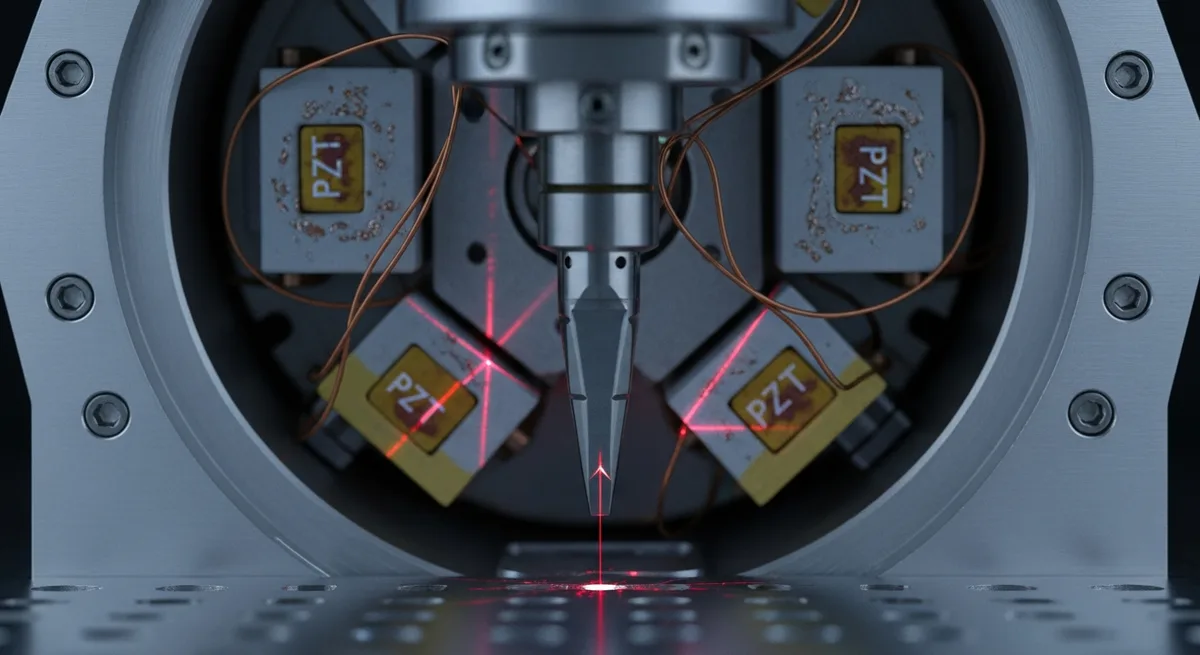
The laboratory was submerged in an unnatural silence, punctuated only by the low-frequency thrum of the HVAC system, yet on the optical table, the Atomic Force Microscope (AFM) behaved like a living, volatile organism. Our objective was to quantify the defects within a graphene monolayer, but the silicon nitride cantilever—boasting a Young’s modulus of 310 GPa—began to exhibit inexplicable 2.5-nanometer amplitude spikes instead of the anticipated stable oscillations. This was not mere electronic noise; it was structural instability manifesting from an internal matrix where a material with a density of 3.1 g/cm³, subjected to a spring constant of 40 N/m, refused to adhere to the linear harmonic model.
Each tetrahedral tip, with a 10-nanometer radius and coated in a 5-nanometer aluminum film, is engineered to withstand immense loads, yet the metallic fabric suffered an anomalous strain. We observed the 1 mW, 670 nm laser beam reflecting off the cantilever’s dorsal surface, capturing not only the topography but the micro-deformations of the beam itself, which appeared as chaotic phantoms within the 0.5 mrad divergent stream. The photodiode, with a sensitivity of 0.5 A/W, recorded signal distortions suggesting that the 100 MHz processor was frantically attempting to compensate for a force whose physical origin remained obscured.
The PZT scanner—that 10 mm x 10 mm x 5 mm block of lead zirconate titanate—was intended to guarantee nanometric precision, yet its 300 pm/V piezoelectric constant turned against us. We noted that the 350°C Curie temperature threshold, while distant, was being approached at a localized point due to friction induced by high-frequency scanning. This triggered an unexpected expansion of the piezoelectric element, warping the x and y axes and transforming an ideal square scan field into a trapezoidal projection that no software could rectify.
The high-voltage amplifier, with a gain factor of 100, operated at the 10 kHz bandwidth limit, struggling to contain this kinetic chaos. Every 100-micrometer displacement generated thermal energy that the anodized aluminum was meant to dissipate, yet the coefficient of thermal expansion proved higher than anticipated. We measured how the PID loop, operating at a 10 kHz sampling rate, desperately ramped up the voltage to maintain zone stability, yet a 45° phase margin rendered a state of equilibrium impossible.
During contact mode, the probe, governed by a 10 Nm bending stiffness, became ensnared in the molecular framework we were investigating. Although the 0.1 Ns/m damping coefficient was designed to ensure fluid movement, the surface adhesion proved superior to the mechanical force of the cantilever. This resulted in a violent "jump-to-contact," during which the probe physically gouged the specimen, leaving a 20-nanometer-deep scar that no theoretical simulation had predicted.
Tapping mode, intended to circumvent the adhesion problem, birthed a new paradox. The cantilever oscillated at 300 kHz, but the surface hardness reflected in a phase shift that exceeded the 90-degree limit. This signaled that the system could no longer distinguish between elastic response and plastic deformation. Each "touch" against the fabric was so profound that it compromised the crystalline structure, and we watched as the 16-bit converter digitized not the properties of the material, but the destruction of the system itself.
Non-contact mode, meant to be the safest recourse, revealed the inherent unpredictability of Van der Waals forces. As the probe approached within 5 nanometers of the surface, electrostatic attraction became the dominant force, which the 10 kHz PID control simply "missed." The system’s response time lagged behind the fluctuations of molecular forces, causing the probe to vibrate uncontrollably, resonating with the ambient thermal background that, at 293 K, induced an invisible but ruinous motion.
The 16-bit resolution, providing 65,536 discrete levels, became our most significant constraint. As the signal grew increasingly complex, the processor began to "quantize" the noise, transmuting it into erroneous data points. The chrome-plated 2 nm surface, intended to ensure maximum laser reflectivity, began to delaminate under constant mechanical stress, altering the signal-to-noise ratio so drastically that the system lost all fidelity.
The configuration of the piezoelectric elements, designed to isolate the x, y, and z axes, proved insufficient. A cross-talk effect, unforeseen by theory, induced an unintended torque that rotated the 5 Nm stiffness probe tip by 2 degrees. This corrupted the entire scanning geometry, as every data point was recorded with a systematic error that remained impossible to eliminate, even after two hours of recalibration.
This experiment demonstrated that we have reached an engineering threshold where the precision of the instrument is inextricably linked to its capacity for self-destruction. Each 100 MHz processor cycle generates heat that alters the piezoelectric constant, and each probe contact alters the specimen itself. We are not merely observing reality—we are physically altering it with every second of measurement, until the system becomes the source of its own interference, and the results are merely a reflection of how deeply our tools can penetrate the fabric of matter, becoming part of it in the process.
The final engineering paradox remains insurmountable: as sensitivity increases, so does the system’s reaction to its own self-generated thermal noise. Piezoelectric hysteresis acts as an invisible anchor, preventing the attainment of absolute stasis, and every attempt to compensate for this effect only further destabilizes the 310 GPa silicon nitride cantilever. We are forced to concede that the highest measurement accuracy is achieved only when the device is pushed to the very precipice of total structural collapse.