Mastering the Microcosm: ASML TWINSCAN NXE:36
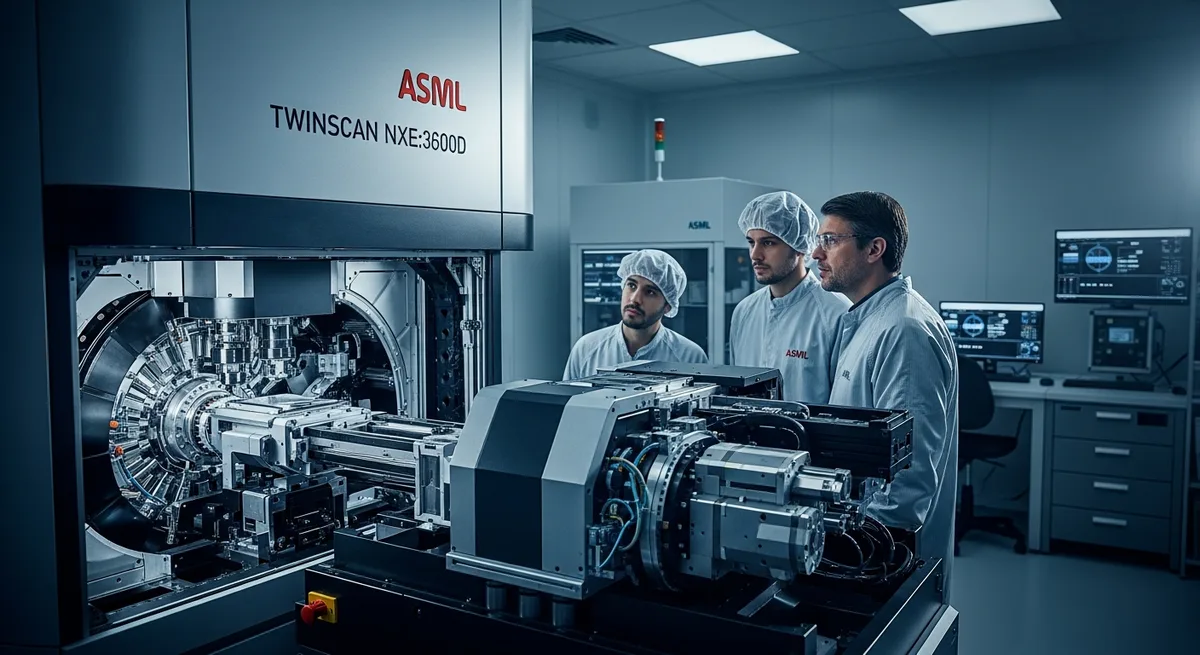
The ASML TWINSCAN NXE:3600D is less a machine than an engineering leviathan—a 180-ton monolith occupying a cleanroom the size of a football pitch, where thermodynamic chaos is shackled by near-mathematical precision. Designed to etch the architecture of 2-nanometer transistors, this apparatus serves as a bridge between the physics of raw matter and the abstraction of pure information. Its operational principle relies on extreme ultraviolet (EUV) light at a wavelength of 13.5 nanometers—a spectrum absorbed by virtually all known matter, necessitating an optical system composed entirely of mirrors rather than lenses. Within its 316L stainless steel vacuum chamber, walls polished to a roughness of 0.2 micrometers, a plasma furnace burns at 300,000 K, containing a microscopic war waged behind impenetrable barriers.
The heart of this light-generating engine is a 25-kilowatt CO2 laser, which delivers a high-energy pulse to 27-micrometer droplets of molten tin. The resulting explosion mimics the birth of a miniature star, driving temperatures to 300,000 K. As the tin droplet, traveling at 70 meters per second, instantly transmutes into plasma, it emits a torrent of 13.5 nm photons. These are reflected by a series of Mo/Si multilayer mirrors and focused onto a silicon wafer. This process, repeated 50,000 times per second, demands that every droplet be targeted with absolute accuracy to prevent the debris that would instantly vaporize the machine’s most precious optics.
The projection optics, forged from Zerodur glass-ceramic, possess a near-zero coefficient of thermal expansion. With a stiffness of 90 GPa, the system ensures that even under microscopic thermal fluctuations, the optical geometry remains immutable. Each of the six mirrors is coated with 80 alternating layers of molybdenum and silicon, measured in atomic units, acting as Bragg reflectors that force constructive interference upon the photons. This is no mere mirror, but a sophisticated quantum filter; its surface roughness, less than 0.1 nanometers, approaches the scale of individual atoms. A protective ruthenium capping layer, engineered to withstand the relentless bombardment of hydrogen radicals, allows the optics to maintain stability for thousands of operational hours.
The mechanical stage governing the 300 mm silicon wafer is a study in kinetic extremity, subjecting the substrate to 10 g accelerations—forces that would reduce a human body to dust, yet here, they are merely routine. An aluminum oxide ceramic chuck, embedded with copper cooling capillaries 400 micrometers in diameter, dissipates 2.5 kilowatts of heat to prevent wafer distortion, while electromagnetic levitation motors adjust the position with 0.3-nanometer precision. It is a 300-millimeter dance in a vacuum where every micron is worth a fortune, and any vibration exceeding the 10 nm/s² RMS threshold would result in catastrophic failure.
The system’s soul—a synthesis of artificial intelligence and Kalman filters—monitors every pulse of light. 1,200 hexagonal mirrors, manipulated by piezoelectric actuators, continuously adjust their angles to compensate for optical distortions induced by the slightest thermal expansion. The algorithm, trained on 10,000 Zernike coefficients, operates in real-time, rewriting the optical correction map every 10 milliseconds. It is a ceaseless battle against entropy, a machine perpetually self-calibrating to maintain a wavefront accuracy of 0.25 nm RMS.
This entire architecture exists because the 2-nanometer node represents the threshold where classical physics yields to quantum tunneling, and light diffraction renders traditional lithography obsolete. The NXE:3600D bypasses these natural constraints using extreme ultraviolet light and a stack of technological layers that function like a perfectly tuned orchestra, consuming 2.5 megawatts of power. Though the process efficiency hovers at a mere 0.01%, it remains the only viable path to forging the processors that will serve as the engines of our future.
This machine is an expression of human will, manifested in metal, ceramic, and photons. It stands in sterile chambers where the air is filtered to such a degree that a single speck of dust would be a catastrophe. The silence here is profound, broken only by the faint hum of cryogenic pumps and the rhythmic, nearly inaudible clicking of plasma ignition—a testament to a vision of the future that has already become our reality. By harnessing the 300,000 K heat of a captive star, we are engraving the future of information onto silicon, forcing atoms to obey our logic and constructing the technological foundation that will define the limits of human possibility for decades to come.