Quantum Fixation: IMX989 Photonic Precision
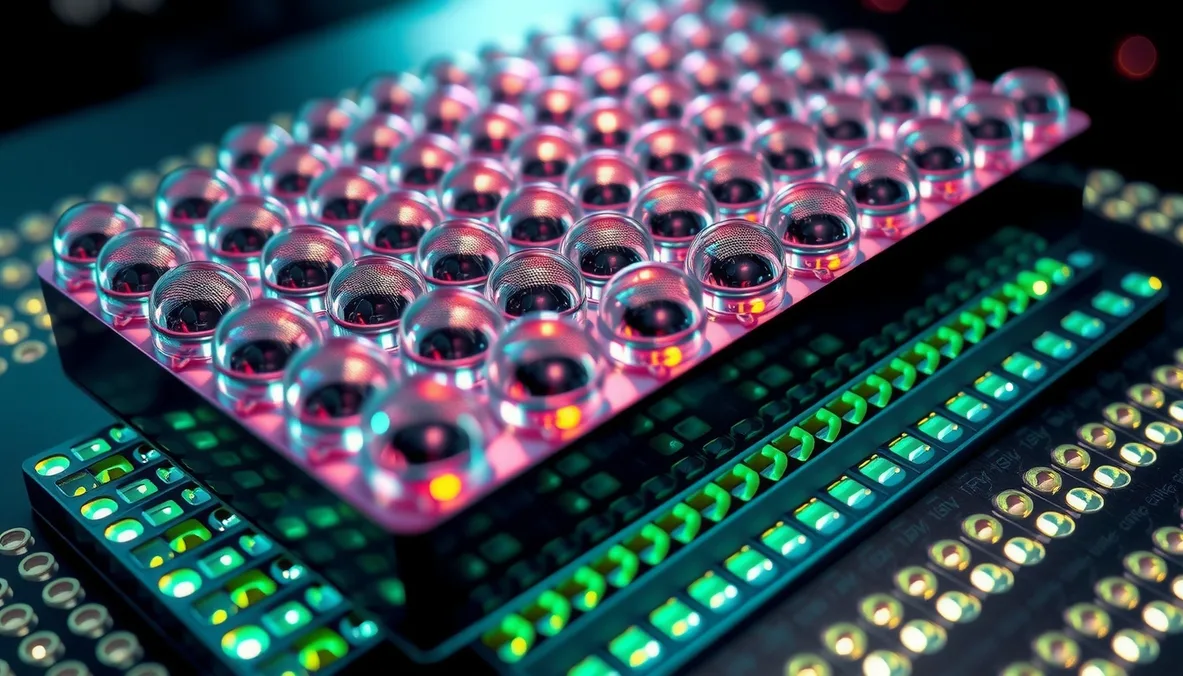
Deep within the chassis of a contemporary smartphone, beneath layers of glass and polymer, lies a marvel of engineering: the Sony IMX989. It is best understood not as a mere electronic component, but as a precisely calibrated mechanism for capturing light—a device whose internal operations mirror the subtle, yet seismic, shifts of tectonic movement. The moment the shutter is triggered, a torrent of photons floods its 129.1-square-millimeter surface, and the sensor, acting as a vigilant sentinel, instantaneously transmutes this ephemeral radiance into digital reality.
At the core of this mechanism, the Pinned Photodiode (PPD) functions as a microscopic reservoir, harvesting a yield of electrons. Arsenic ion implantation defines an n-type region at a depth of 1.2 micrometers, where a p-type boron layer serves as a "pinning" barrier, preventing electrons from wandering beyond their designated confines. Within this 0.8-micrometer depletion layer, a 0.7 V reverse bias generates an electric field of 1.5×10⁴ V/cm, whose invisible, iron-fisted grip compels every photon-liberated electron to obey the system’s will, settling into strictly defined coordinates.
The thermal nature of these processes is no less profound. Each electron transfer through the Transfer Gate (TX) transistor, initiated by a 5 V pulse, occurs in under 0.5 nanoseconds; during this incredible velocity spike, the released energy manifests as microscopic heat. Though this thermal signature is minimal, it is relentless, demanding absolute structural integrity: the silicon lattice, subjected to constant charge, remains stable due to precise doping, preventing thermal vibration from compromising the delicate 0.4 V potential barrier.
The sensor’s structural majesty is revealed in its Deep Trench Isolation (DTI) technology—abyssal chasms 2.5 micrometers deep, etched into the silicon wafer to insulate each pixel from its neighbors. These trenches, filled with high-density plasma silicon dioxide and coated with a 50-nanometer layer of aluminum and titanium nitride, act as an engineering bulkhead, reflecting light back into the photodiode and preventing "crosstalk" from corrupting the image. Even under 120 MPa of compressive stress following 400°C annealing, these structures remain unyielding, ensuring that no photon strays into adjacent pixels.
The physical bridge between the pixel array and the logic layer is forged via Cu-Cu hybrid bonding—not a simple solder, but copper interconnects fused at the atomic level, capable of withstanding 200 MPa of shear stress. A 30-minute annealing process at 350°C allows copper atoms to coalesce into a monolithic organism, ensuring a contact resistance of less than 0.1 ohms, as if connecting the sensor’s "eyes" to its "brain" via a hyper-conductive neural network.
Crowning this complex silicon sandwich is a color filter and microlens array, where each glass dome—with a 2.4-micrometer radius and a fill factor exceeding 96 percent—acts as one of thousands of eyes turned toward the world. The polymer forming these lenses undergoes a 2 percent linear contraction during curing, inducing 5–10 MPa of stress within the color filter; yet, this delicate equilibrium ensures that light is directed precisely into the center of the photodiode, even at an incident angle of 20 degrees.
As light strikes the silicon surface, the generation of electron-hole pairs resembles a microscopic lightning strike, instantly overcoming the 3.6 eV energy barrier. The sensor must "breathe" in tandem with the light flux; thus, Dual Conversion Gain (DCG) technology allows for dynamic environmental adaptation. In high-light conditions, an 8 fF MIM capacitor is engaged, increasing capacity to 8,000 electrons, while in twilight, it is disengaged, leaving a mere 2 fF capacitance to achieve maximum sensitivity.
A massive data stream, reaching 9.6 gigabits per second, flows through four MIPI D-PHY 2.0 lanes—a digital river where every bit is meticulously shaped by a 14-bit ADC converter. Each of the 4,096 columns possesses its own analog-to-digital converter operating at an 800 MHz clock frequency. This intensive process generates 1.2 W of power, which the sensor housing must efficiently dissipate through microscopic wiring and the substrate.
The entire process is a perpetual struggle against noise, where Shockley-Read-Hall generation at the silicon-dioxide interface creates dark current. Engineers, employing Correlated Double Sampling (CDS) methods, suppress this "breathing noise" to a level of 0.5 electrons RMS. It is a technology approaching the absolute limits of physical law, where the image becomes little more than a statistical calculation of probability.
The Sony IMX989 is not merely a collection of technical specifications; it is a synthesis of biology and physics, where Deep Trench Isolation performs the function of Müller cells in the retina, and Dual Conversion Gain mimics the adaptation of rods and cones. It is a machine that co-opts human visual perception and transposes it onto a silicon wafer, where every atom has a purpose and every electron leap is orchestrated with divine precision.
Looking toward the horizon, these sensors will only grow more perfect, as engineers already envision smaller pixels, higher quantum efficiency, and faster readouts. Today’s IMX989 is the foundation upon which all modern mobile photography is built—a silent, powerful manifesto of engineering, proving that even at the smallest scales, it is possible to master the laws of physics and compel them to serve the human creative gaze.