Ion-Induced Turbulence: Unveiling the Hidden Dynamics of Electrochemical Interactions
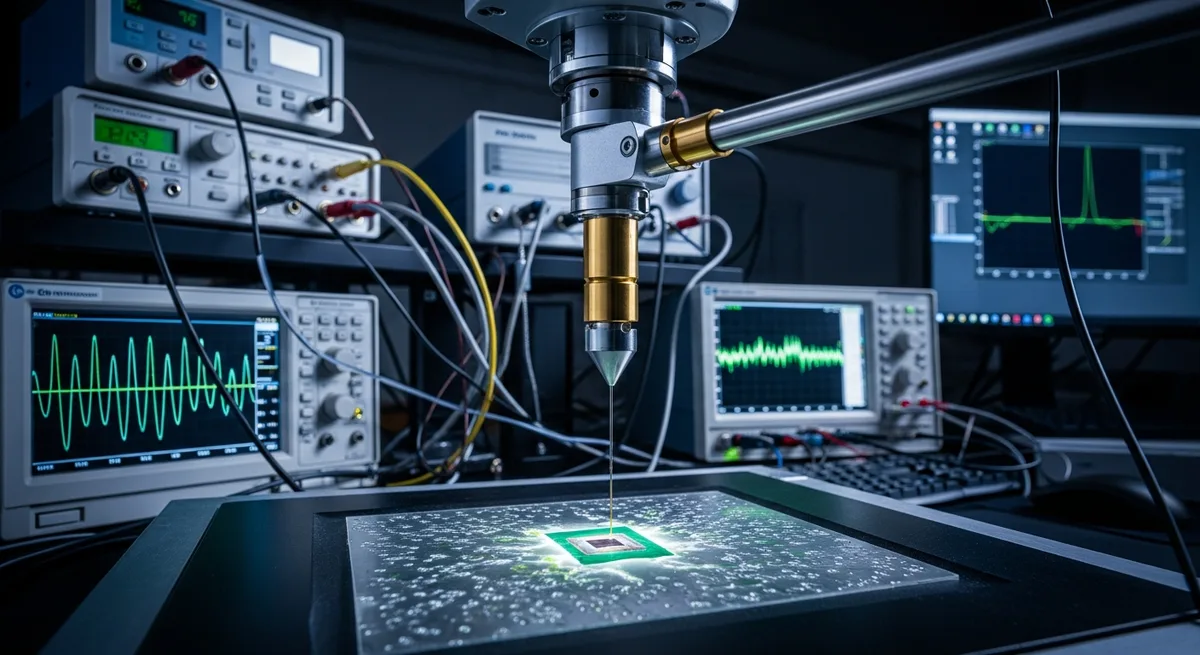
Within the liquid-phase interface, where the scanning probe microscope is submerged in an electrolytic solution, an unsettling physical transformation unfolds: quantum tunneling ceases to occur in a vacuum, becoming instead a hostage to the velocity of ion migration across the diffusion layer. Here, in a solution with a concentration of 0.1 mol/l, every infinitesimal movement of the probe triggers a localized shift in electric potential, restructuring the electrical double layer and inducing an erratic electrochemical noise that surges beyond the 50 picoampere threshold. This is no longer a standard measurement; it is a relentless struggle against ionic currents that, like invisible vortices, labor to displace the probe from its equilibrium.
The probe tip encounters a hydrodynamic drag described by Stokes’ Law, yet at this microscopic scale, the force becomes volatile, governed by viscosity gradients that manifest near the charged surface. As the cantilever traverses at 100 micrometers per second, a 20-nanometer-thick hydraulic “cushion” forms, insulating the probe from true surface contact and forcing the control systems to compensate with an additional 15 nanonewtons of pressure just to reach the zone of atomic force interaction.
This process precipitates a distinct failure mode—the “adhesion jump”—where capillary forces and the formation of ionic bridges cause the cantilever to snap abruptly against the specimen. It sustains an instantaneous mechanical stress of 500 MPa, a load that defies conventional material fatigue calculations. This is not a mechanical fracture, but a molecular entanglement; the solution molecules, trapped between the probe and the sample, coalesce into a transient, semi-solid structure that can only be dismantled by a 2-nanometer amplitude piezoelectric oscillation at a frequency of 20 kHz.
The piezoelectric actuator, stable in a vacuum, becomes thermally erratic in a liquid medium. The electrolyte acts as a heat sink, cooling the ceramic surface while simultaneously conducting heat generated by ionic currents into sensitive components. This thermal exchange induces temperature fluctuations of 0.05 degrees Celsius, which, when sampled at 10 nanoseconds per second (S/s), generate “thermal drift” artifacts that distort the digital image, necessitating a sophisticated, real-time temperature compensation algorithm.
At the system’s core, the silicon nitride molecular framework suffers from persistent corrosion in this aggressive environment. Though slow, it alters the probe tip’s geometry over 48 hours, expanding its radius from 10 nanometers to 15 nanometers. This geometric evolution is an irreversible process, monitored by the scattering of an intensity-reflecting laser beam; each nanometer of change shifts the photodiode signal by 2.4 percent, effectively turning the measurement instrument into a witness to its own degradation.
A more profound complication arises from the “ion hopping” effect, where the intense electric field surrounding the probe forces cations to leap from their hydration shells directly onto the tip’s surface, forging a temporary chemical bond that alters the probe’s conductivity. This phenomenon generates a 5-millivolt potential spike, which the FPGA processor misinterprets as a topographical irregularity. The system then attempts to “level” a non-existent peak, carving a 1-nanometer-deep crater into a surface that is, in reality, perfectly flat.
To master this chaos, the system employs a magnetostrictive Terfenol-D material, its magnetic field modulated at 50 Hz to generate a counter-resonance that dampens the mechanical waves induced by the electrolyte. Yet, this solution births a secondary crisis: the magnetic field interacts with the ions in the solution, exerting a Lorentz force that pushes the fluid across the probe, creating an additional 0.3-micronewton lateral load that must be countered by a platform tilt adjustment accurate to 0.01 degrees.
Within the digital processing circuit, wavelet transforms are utilized to isolate these “ion hops” from the true relief signal, but only when the processor can successfully extract the 1/f noise spectrum characteristic of electrochemical processes. This demands that a 2-gigabyte-per-second data stream be analyzed with zero latency; a mere 10-microsecond delay means the probe has already drifted by the distance of a single atomic diameter, rendering the entire calculation a historical archive rather than a real-time correction.
The experimental limit is reached when the rate of ion exchange outpaces the probe’s response time, plunging the system into an “uncertainty zone” where the measurement no longer captures the surface, but rather the dynamics of the interaction between the probe and the solution. At this juncture, the engineering task becomes paradoxical: to measure the surface with precision, one must halt ionic diffusion entirely, yet the movement of ions is the very condition of the system’s existence in a liquid medium. Thus, the ultimate accuracy is constrained not by the quality of the electronics, but by the physical nature of the solution itself, which forbids the reduction of error below the 0.05-nanometer threshold.