Atomic Sentinel: A Tungsten Probe for Quantum Field Detection
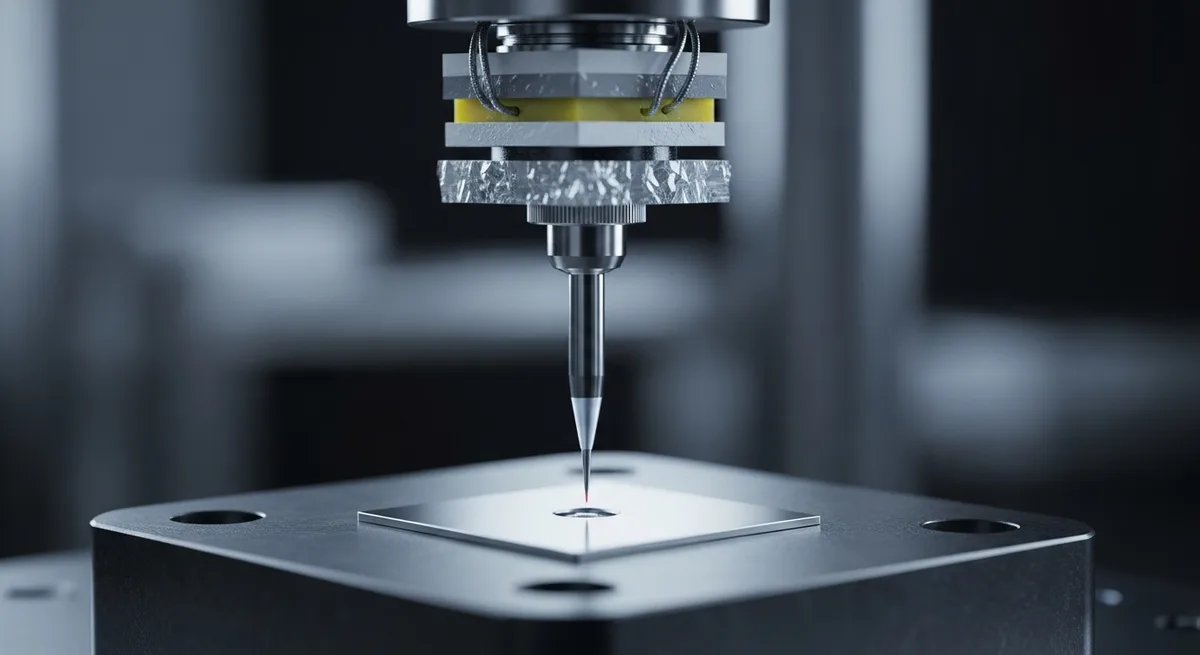
The tungsten needle, its apex honed to a radius of 10–20 nanometers, is far more than a mere instrument; it is a quantum field detector whose 3,422°C melting point preserves structural integrity in regimes where electron density reaches critical thresholds. This metal, possessing a density of 19.3 g/cm³, functions as a rigid conductor whose molecular framework withstands the oscillations dictated by a thermal expansion coefficient of 4.5 × 10⁻⁶ K⁻¹, maintaining geometric stability even as electrostatic forces conspire to distort the needle’s profile. It is not simply a shard of metal, but a precisely articulated atomic sensor whose structural fabric ensures that the tunneling process occurs across strictly defined spatial coordinates.
Deposited upon this tungsten substrate, a 1–2 nanometer layer of platinum acts as a conductivity amplifier, optimizing the electron leap across the potential barrier. Here, platinum serves as a chemical mediator; its inherent inertness precludes the formation of oxidation products that might otherwise interrupt the 10⁻¹¹ ampere current flow. This flux, comparable to the most subtle energetic pulsation, is under constant surveillance, with the platinum layer serving as an interface membrane through which information regarding atomic positioning is transformed into electrical potential, all without compromising the integrity of the specimen under scrutiny.
The internal matrix of the tungsten, subjected to forces ranging from 10⁻⁹ to 10⁻⁶ newtons, functions as a mechanical shock absorber capable of maintaining equilibrium between atomic repulsion and the pressure generated by the scanner. At this microscopic scale, the material’s fabric does not merely withstand loads; it becomes a dynamic conductor of information, its crystalline structure required to remain pristine to avoid any signal distortion. This is a form of engineering asceticism, where every atomic collision is governed, and the stiffness of the material serves as a guarantee that measurement precision will not be surrendered to unwanted vibrations.
Lead zirconate titanate (PZT) elements serve as the system’s engine, their piezoelectric constant of 300–400 pC/N allowing for the conversion of electrical signals into displacements with 0.1-nanometer accuracy. When the 1–2 millimeter thick ceramic plate receives voltage, its internal geometry reconfigures with a force capable of manipulating the needle like a massive lever, maintaining a mechanical Q-factor of 100–200. This process is a continuous transformation of energy, where electrical tension becomes precise mechanical motion, ensuring the needle remains at the optimal distance from the surface under investigation.
The internal architecture of the PZT elements functions as an artificial nervous system, where the 350–400°C Curie temperature threshold defines the limits of system stability. As the heat of reaction acts upon these components, the PZT lattices respond to every voltage fluctuation, reconfiguring themselves to maintain constant pressure on the needle. This is no static construction, but an active system in which ceramic elements continuously calibrate their form, ensuring that even the slightest thermal oscillation is compensated for in real-time, thereby preserving the system’s total integrity.
The scanner’s resonant frequency, reaching 10–20 kHz, is tuned to eliminate any unwanted vibrational noise that might corrupt measurements at the 10⁻¹¹ newton scale. Within this frequency range, the piezoelectric frame acts as a filtration medium, ensuring that every structural element contributes to the maintenance of image resolution. This is an engineering harmony where the ceramic cell system operates synchronously, preventing lateral vibrations from distorting topographic data, thus rendering every measurement a reliable representation of the atomic surface.
The cast-iron base, with a total mass of 10 kilograms, creates an inertial anchor point whose 250–300 MPa compressive strength allows it to absorb all environmental mechanical disturbances. The 5–10 millimeter thick plates serve as a massive platform where a density of 7.9 g/cm³ ensures that the 10⁻⁹ mbar vacuum environment remains stable. This is not merely heavy metal, but the essential anchor of the system, which, through its inertia and density, isolates the sensitive scanning head from the noise of the macro-world, allowing quantum tunneling to occur without external interference.
Thermal stability, ensured by a 10.5 × 10⁻⁶ K⁻¹ expansion coefficient, allows the cast-iron platform to maintain its form even when the turbomolecular pump operates at a capacity of 200 l/s. In this vacuum, where molecular concentration is minimal, the cast-iron surface acts as a thermally inert foundation, shielding the optical and mechanical systems from any undulation. This guarantees that during measurements, the device remains absolutely motionless, providing the stable foundation necessary to capture atomic topography.
The cast-iron structural frame acts as a systemic stabilizer, its mass absorbing all environmental turbulence and allowing the entire mechanism to function without deviation. This passive component becomes the fundamental reason we are able to observe atoms, as its inertial force acts as a shield, protecting quantum tunneling from the chaos of the macroscopic world. It is the bedrock of the system, where every molecule of metal works in concert to ensure the absolute stillness required for atomic measurement.
The digital signal processor (DSP), operating at a 100 MHz clock frequency, becomes the brain that translates the chaos of electron flux into intelligible information. 16-bit ADC data, processed at a 100 kHz frequency, allows for the formation of an image where every bit corresponds to a fraction of a nanometer. This is a constant symbiosis of mathematics and physics, where the 10⁻⁵ V resolution in the DAC converter allows for the control of the scanner with incredible precision, transforming ephemeral signals into a visually clear structure of matter.
Control algorithms, including Fourier transforms, continuously filter the signal-to-noise ratio, adjusting the needle in real-time. This feedback loop operates with such velocity that it resembles a neural impulse transmitted across a synapse, adapting to surface topography that can only be described in the terminology of quantum mechanics. Here, the DSP acts as a translator, converting chaotic electron tunneling data into orderly information while maintaining the delicate balance between signal accuracy and system stability.
The software performs the systemic function of a translator, taking 10⁻¹¹ ampere current readings and converting them into a topographic map. This logic is capable of recognizing electron tunneling patterns and transforming them into orderly information, as if charting a map of a territory that is in constant flux due to thermal motion. The DSP maintains order in this ephemeral system, turning a continuous stream of data into a visual representation of atomic structure, regardless of constant environmental variability.
The sensor network at the heart of the microscope provides the device with its senses, as the tunneling current sensor, with a sensitivity of 10⁻¹¹ A, records every electron leap. The deflection sensor measures needle oscillations with 10⁻⁹ meter accuracy, while the temperature sensor, possessing a 10⁻³ K sensitivity, monitors every thermal shift. These sensors become active participants in the feedback loop, preventing the system from deviating from its objective, as every sensor signal is essential to maintaining measurement accuracy.
The data acquisition method requires that every sensor be calibrated with absolute precision, for if the temperature rises by even a thousandth of a degree, materials expand, and the needle may lose contact with the atomic surface. Sensor sensitivity becomes the boundary that defines the scale of structures we are capable of observing, reflecting the engineering balance between what we wish to know and what the laws of physics permit us to measure.
The measurement process becomes a continuous dialogue between the needle and the fabric of matter, as the needle scans the surface at a speed of 1–10 nm/s, gathering information about every individual atom. This non-invasive reading requires incredible stability, as any unexpected motion could destroy the needle or damage the specimen under study. It becomes a subtle process between electrical current and mechanical force, aimed at obtaining the most accurate image possible, wherein every atom is identified.
The principle of quantum tunneling remains the engine of this device, where electrons, unable to overcome the potential barrier according to classical laws, tunnel through it, creating a current dependent on distance. This phenomenon is so sensitive that even a 0.1-nanometer change triggers an exponential shift in current, granting the microscope the ability to view surfaces with a resolution unattainable by any optical device. It is a fundamental tool, allowing for the exploration of nanomaterial properties and atomic diffusion.
Although this technology has remained relevant due to its ability to manipulate matter at the atomic level, the core principle—maintaining the distance between probe and sample via quantum tunneling—remains unchanged. It is an instrument that allows for the observation of molecular bonds, and every improvement, such as the use of carbon nanotubes in needle fabrication, only further expands the capabilities of this device, even as engineering challenges remain tethered to the limits of physical law.
There exist boundaries that engineers find increasingly difficult to cross; for while we can observe atoms, we cannot entirely eliminate the quantum noise arising from the Heisenberg uncertainty principle. Even in the most perfect vacuum, at a pressure of 10⁻⁹ mbar, the electron flux undergoes statistical fluctuations that limit image resolution. This creates an engineering dead-end: the more precisely we attempt to measure position, the more we disturb the system, creating an uncertainty that is impossible to avoid using the current technological base, as the measurement process inevitably alters the object being observed.