angos geležiniai plaučiai -> Iron Lungs of Progress (
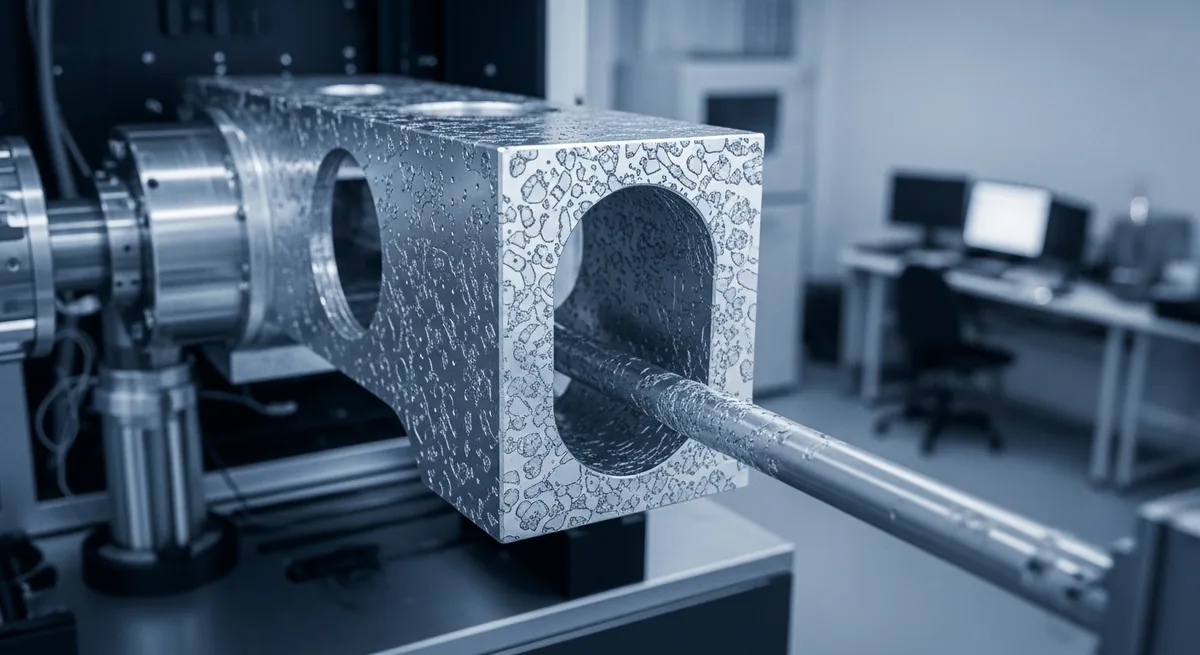
Deep within the laboratory, where isolation foundations dampen even the most infinitesimal seismic pulse, the Atomic Force Microscope (AFM) stands as a taut, omniscient sentinel. Its 6061-T6 aluminum alloy chassis is far more than a passive frame; it is an engineering fortress, its internal molecular lattice engineered to resist the slightest thermal expansion. As ambient temperatures fluctuate by mere degrees, this metal—possessing a Young’s modulus of 69 GPa—endures internal stresses that, if left unchecked, would warp the axes of measurement. Every atom in this construction serves as an anchor, preventing microscopic "noise" from metastasizing into erroneous data. It is a passive resistance against the laws of entropy, where the rigidity of metal becomes the sole barrier between precision and chaos.
Within this monolith lies the piezoelectric scanner—a block of lead zirconate titanate (PZT) ceramic whose existence is a state of perpetual metamorphosis. When an electrical current is applied, the ceramic’s crystalline lattice distorts, forcing the entire structure into physical deformation. This is no delicate movement; it is a brutal exertion of force, governing a 100-micrometer amplitude with nanometric precision. This ceramic is under constant, immense internal strain, which, if the control algorithm falters for even a microsecond, risks triggering microscopic fractures. It is an incessant, high-frequency "respiration," where every cycle demands that the material withstand repeated mechanical deformation without sacrificing its structural integrity.
The "soul" of the scanner is its capacity for stability even when the system encounters unforeseen resonance. When the quality factor (Q-factor) of 100–1000 suddenly plummets due to poor sample fixation, the PZT scanner begins to oscillate at its natural frequency, reminiscent of a taut, serrated string. At this juncture, engineering collides with the limits of physics: if the scanner fails to dampen these vibrations within fractions of a millisecond, the entire system goes blind. This is not merely a computational error; it is a mechanical dissonance where the fragility of ceramic meets the raw power of electrical current, rendering a precision instrument a worthless heap of metal and ceramic debris.
The cantilever—a silicon nitride spear—is the system’s most sensitive nexus, acting as a bridge between macroscopic control and the domain of atomic forces. Its stiffness, ranging from 0.01 to 100 N/m, is no arbitrary figure; it is a physical threshold that determines whether the tip will "sense" the interatomic attraction or simply bounce off the surface like a stone wall. As the tip, with a radius of a mere 10–50 nanometers, approaches the sample, Van der Waals forces emerge, manifesting at the microscopic scale as a powerful magnetic pull. This is the moment when matter begins to "converse" with the sensor through physical tension, and the silicon nitride’s molecular bonds undergo constant, microscopic flexion.
This cantilever is perpetually subjected to thermal drift, which, though measured in nanometers, is sufficient to compromise the entire experiment. When a 1 mW laser beam is directed at the back of the cantilever, it does more than reflect information; it locally heats the silicon nitride. In this microscopic focal point, the temperature gradient creates internal stresses that force the cantilever to "drift" above the surface. It is a subtle, nearly invisible thermal expansion that engineers must compensate for in real-time, lest the image dissolve into a blurred, illegible mass of data. It is a war against thermodynamics, where every photon is simultaneously a tool of observation and a source of interference.
At the digital level, a 1 GHz DSP processor performs a task impossible for the human brain. Upon receiving a signal from the photodetector, the processor parses it through a feedback algorithm where the equation e = r - y acts as a digital guardian. An FPGA chip, housing 10,000 logic elements, executes this equation thousands of times per second, continuously recalibrating the PZT scanner’s position. There is no room for latency; if the signal lags by even a few microseconds, the system "punches through" the sample, physically destroying both the probe and the surface of the material under study. It is a collision of the digital and physical worlds, where software code becomes the master of physical force.
Occasionally, this dialogue is severed by the unexpected accumulation of electrostatic charges. When the sample and the probe become electrified, an additional force emerges between them—a variable the algorithm did not anticipate. This "electrostatic error zone" can cause the scanner to jump abruptly, triggering a mechanical shock that propagates through the scanner housing to the entire system. This is not merely a loss of data; it is a physical "startle" response of the instrument, as the electronic system attempts to compensate for a force whose nature is entirely stochastic. In such moments, it becomes clear that the AFM is not merely an observational device—it is a living, sensitive mechanism struggling to maintain equilibrium between atomic attraction and the rules imposed by man.
During the scanning process, as a 1024 x 768 pixel image slowly coalesces on the screen, the observer sees not only the material but its "resistance." Each pixel is encoded information regarding atomic arrangement, obtained through a force resolution of 1 pN. This is the frontier where physics becomes imagery and engineering becomes art. We watch as the silicon nitride spear traces invisible paths, "reading" the structure of matter with every movement. It is a process in which a human-made tool becomes an extended sense, allowing us to perceive that everything around us is but an incessant play of forces and vibrations, governed by the algorithms of our own design.
This system is akin to the nervous system of modern civilization, woven from metal, ceramic, and silicon. We are not merely exploring the world—we are constructing it from the foundation up, using instruments that operate at the extreme limits of physics. Every AFM cycle is proof that the human mind can master atoms, despite their chaotic nature. When the laser beam reflects off the back of the cantilever, we receive an answer from the depths of matter, and that answer is precise, cold, and ruthlessly truthful. It is a reflection of our efforts to comprehend the universe, where every micronanometric detail becomes a part of our victory over the unknown.
Ultimately, the AFM remains the backbone of the infrastructure upon which the future of nanotechnology rests. Though it appears to be static laboratory equipment, a constant struggle rages within: the resistance of metal against thermal expansion, the flexibility of ceramic against mechanical fatigue, and the logic of code against random noise. It is not merely a device; it is a bridge connecting our perception to a reality too small to see, yet too powerful to ignore. We inhabit a world that the AFM helps us not only to see but to understand as a totality of engineering, where everything depends on the precision with which we can command force and light.