The Edge of Certainty: A Journey to the Nanoscale Frontiers
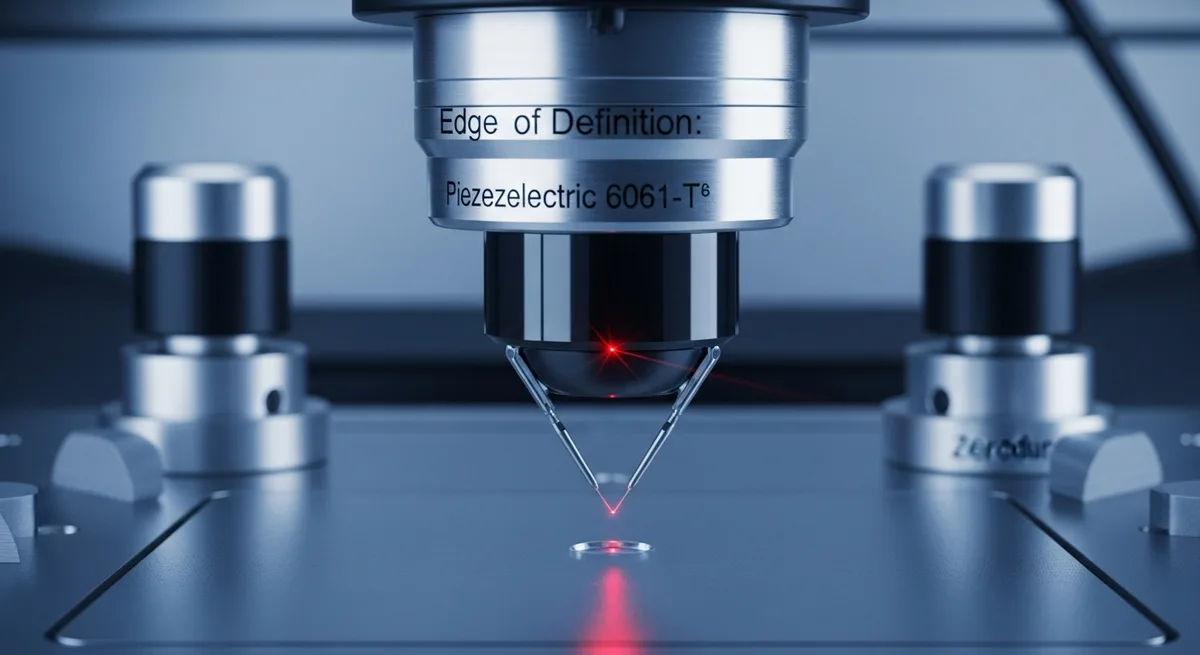
At the nanometer scale, matter ceases to be a coherent entity. It dissolves into a dynamic, pulsating field of probabilities, where the Atomic Force Microscope (AFM) functions less like an observer and more like a blind topographer navigating a landscape of ghosts. Here, the intuition forged by macro-world experience is rendered obsolete. We enter a thermodynamic theater of war, where every unit of measurement is violently extracted from the ambient noise, and every data point is the hard-won result of a complex, high-stakes interaction between probe and surface—a process demanding a mathematical precision that brushes against the very limits of physical possibility.
The silicon nitride cantilever at the heart of the system is no mere tool; it is a mechanical oscillator whose 310 GPa Young’s modulus provides the structural rigidity required to resist fatigue under the duress of high-frequency oscillation. As the probe descends, it enters a zone where van der Waals forces become the dominant sovereign. At this distance, measured in mere angstroms, the cantilever endures a constant, agonizing strain that forces its crystalline lattice to behave like a tensioned spring. This is no passive observation: every surface irregularity triggers fluctuations in the cantilever’s amplitude, which the detection system must convert into a digital stream faster than entropy can dissipate the signal into the void.
Thermal kinetics are the primary antagonist here. Each photon striking the back of the cantilever induces a microscopic thermal expansion—measured in picometers—that manifests as a critical source of noise. Engineers must master this energy dissipation, as the structure, a mere 0.5–1.5 micrometers thick, is exquisitely sensitive to temperature gradients. During operation, the system grapples incessantly with Brownian motion, which seeks to corrupt the measurement’s fidelity. It is akin to attempting to map the texture of individual grains of sand during a hurricane, where the wind gusts are the very atoms bombarding the probe’s surface.
Beneath the cantilever, the piezoelectric scanner—crafted from lead zirconate titanate—represents the zenith of precise control. Its mandate is to guide the probe across the surface at a velocity of 0.1–10 micrometers per second. This is achieved via a piezoelectric coefficient of 300–500 pC/N, allowing for the transformation of electrical voltage into mechanical displacement with sub-nanometer accuracy. The scanner’s housing, forged from 6061-T6 aluminum alloy, must absorb internal stresses, ensuring that its 310 MPa compressive strength prevents the system’s resonance from fracturing. It is a perpetual equilibrium between the motion dictated by the electric field and the mechanical resistance of the metal, where every micro-movement is synchronized to the heartbeat of the control electronics.
Within the signal processing chain, a DSP processor operating at 100–500 MHz plays the critical role of filtering the data deluge. Its task, mediated by a PID controller, is to adjust the probe’s height in real-time to maintain a constant deflection force of 1–10 nanometers. This is not mere computation; it is an unbroken feedback loop where the algorithm must decide, in fractions of a millisecond, whether the probe is sensing true surface topography or merely the chaotic murmur of environmental noise. In this crucible, mathematics becomes the only barrier between a chaotic physical reality and a coherent model of data.
The base, constructed from Zerodur or ULE glass, provides the stability essential to mitigating thermal expansion. With a coefficient of thermal expansion near zero, it serves as the absolute reference point for the entire optical and mechanical assembly. Without this anchor, measurement would lose all meaning, as ambient temperature fluctuations would warp the entire geometric space. It is a triumph of engineering: the material properties themselves become the guarantor of accuracy, maintaining a stable position even when, at the microscopic level, everything is in flux.
The detection system, utilizing a laser beam with a wavelength of 630–780 nm, transmutes the cantilever’s mechanical oscillations into electrical voltage. A sensitivity of 10–100 mV/nm allows for the capture of even the most infinitesimal surface variations. This process is a synthesis of optics and electronics, where light serves as the carrier of information. The laser reflects off the cantilever’s back and strikes a split photodetector; the differential between the two signal channels instantly reveals the probe’s displacement. It is a cold, calculated methodology where there is no room for error, as every millivolt corresponds to a physical reality.
The data-filtering algorithms embedded in AFM processors are designed to isolate the signal from the background noise generated by mechanical vibrations and electronic "white" noise. These are sophisticated Fourier-transform-based processes that decompose the gathered information into its constituent parts within milliseconds. Every pixel the user observes on the screen is the result of thousands of such transformations, where artifacts are purged to reveal the true topography. This is not a direct image; it is a mathematical construct forged from the interaction of forces.
Modern AFM infrastructure demands not only mechanical precision but total isolation from the external world. Vibration-damping tables, active noise-cancellation systems, and vacuum chambers are all instruments of a controlled environment where the laws of physics operate without interference. It is an engineering secession from the noise of the macro-world, allowing for a singular focus on the nanometer scale. Every component, every bolt, and every circuit is engineered to maintain this sanctuary of silence.
This entire process—from the movement of the piezoelectric scanner to the calculations of the DSP—is a constant struggle against inaccuracy. We exploit the limits of material strength to create a tool capable of "feeling" atoms, yet behind this power lies the perpetual necessity of calibration. The metal sighs under constant tension, the ceramic reacts to every electrical impulse, and the silicon nitride withstands forces that would annihilate any other structure. This is a technological reality where we are not merely observing, but forging a new interface with matter itself.
Today, the AFM is no longer a mere laboratory curiosity; it is an industrial standard, utilized in everything from semiconductor fabrication to the analysis of biological molecules. Its ability to provide precise data on surface properties—hardness, adhesion, conductivity—is invaluable. We no longer ask if we can see atoms; we ask how quickly and accurately we can measure their interactions. We have reached a stage of technological development where we transcend the limits of sight to manipulate the very nature of matter.
Each scan cycle is a new data array that, when properly processed, unveils a world we could once only model. It is a symbiosis of engineering and mathematics, with the AFM playing the lead role. While we remain far from total control over every individual atom, we possess the tool to understand the rules by which they operate. And this is our greatest achievement: the ability to create a system more precise than our own senses, allowing us to perceive through force rather than light.
In the future, AFM systems will become increasingly integrated with artificial intelligence, capable of predicting probe behavior in real-time to further suppress noise. This will be a new epoch, where the system learns to adapt to the surface under investigation, optimizing scanning parameters without human intervention. This is not merely a technological upgrade; it is the evolution of a tool that is already fundamentally altering our understanding of the physical world. We are moving toward the total mastery of atoms, and the AFM is our point of departure on this journey.
The final result—a color-coded, nanometer-accurate image—is but the tip of the iceberg. Beneath it lies a vast stratum of computation, materials science, and engineering patience. It is proof that humanity can master even the smallest particles of the universe, provided we possess sufficient precision and the will to understand their mechanics. The AFM remains the heart of our technology, the foundation of our science, and the guarantee that in the future, we will not only observe the world but shape it at the atomic level.