The Observatory's Taut Nerve
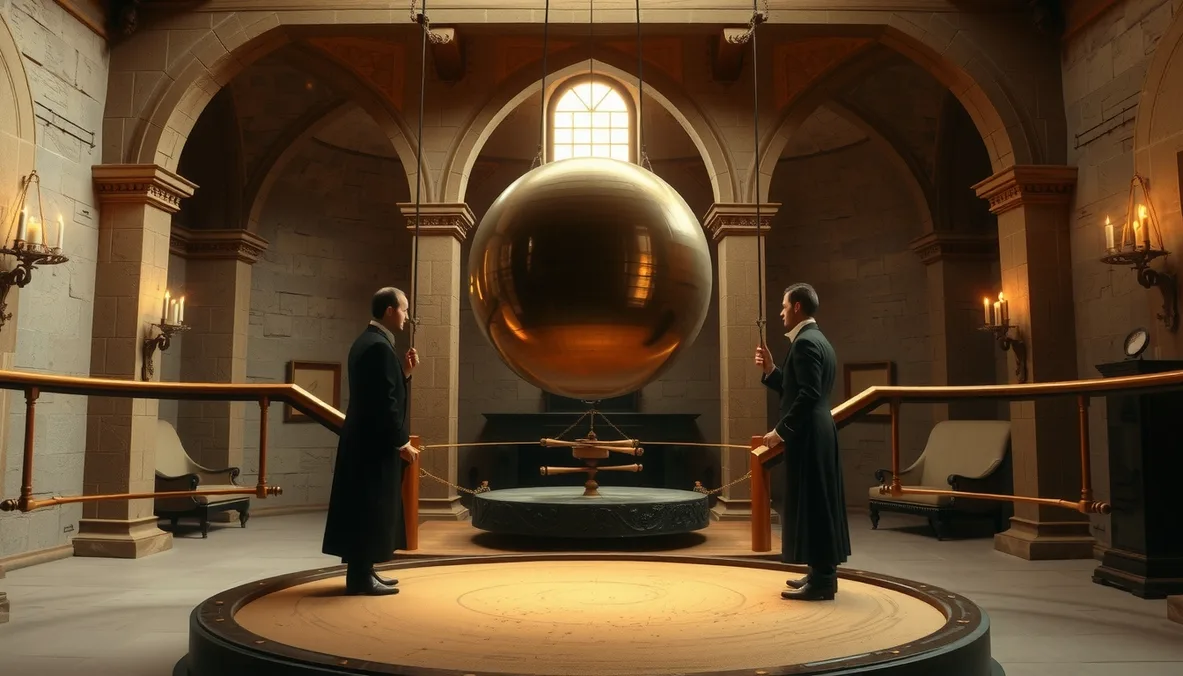
In the spring of 1851, the vaulted ceilings of the Paris Observatory were far more than mere architectural enclosure; they functioned as a colossal resonator, a concave vessel within which Léon Foucault sought to cage the very dynamics of the cosmos. The air hung heavy with a damp, oppressive premonition, and the engineers stationed at the central mounting assembly felt not the comfort of discovery, but the visceral dread of encroachment. They understood that this apparatus was no mere curiosity, but a brutal, unforgiving machine engineered to extract the secret of the Earth’s rotation from its own bedrock. Every movement they made was calibrated and cautious, as if they were handling a dormant predator, poised to erupt from the shackles of its own inertia at any heartbeat.
The steel cable sustaining the entire system served as the ultimate test of endurance. It was not merely a metallic filament; it was a taut nerve, bridging the observatory’s rafters with the planet’s own essence. As the engineers tensioned the line, they felt the wire sing—not with melody, but with the strained, piercing shriek of metal under duress, a sound that resonated deep within the marrow. Each fiber of the cable waged a war against the pull of gravity, and the 210 GPa modulus of elasticity became the threshold where matter refused to yield further to the strain. It was a confrontation between the structural integrity of the metal and the universe’s relentless urge to dismantle all things into their constituent atoms.
Yet, the true engineering nightmare manifested when the observatory’s ambient temperature began to fluctuate. Steel, so seemingly immutable and rigid, responded to every thermal shift with agonizing sensitivity. In the cool of the morning, the wire contracted, driving the tension toward a critical limit and forcing the engineers to monitor every microscopic millimeter of elongation or retraction. They grasped the stakes: should the wire expand by even the thickness of a hair, the experiment’s precision would dissolve, rendering the Coriolis effect invisible. It was a silent, invisible struggle against thermodynamics, where victory was measured not by triumph, but by the ability to maintain a precarious equilibrium between metallic expansion and astronomical accuracy.
The brass sphere suspended at the terminus of this wire was the soul of inertia. It appeared as a frozen planet, its 28-kilogram mass indifferent to the chaos surrounding it. As the sphere commenced its slow, inexorable journey through the air, it did not merely move; it carved through the environment, transforming every air molecule into a tangible obstacle. Its surface, polished to a mirror finish, registered every vibration of the air currents, every imperceptible thermal gradient. This was no graceful dance; it was a heavy, labored push through a dense, resistant atmosphere, where every joule of kinetic energy felt like a physical burden imposed upon the entire structure.
The coupling assembly between the wire and the sphere became a focal point of engineering anxiety. Here, two disparate states of matter collided: the steel, prone to tension, and the brass, defined by its inertia. The steel pin securing this junction endured loads so extreme it seemed it might liquefy from internal friction. Each time the sphere reached the apex of its amplitude, the metal emitted a distinct, dull groan—not a sign of life, but a cry of material fatigue. The engineers listened to this sound, attempting to discern whether the structure would survive another cycle or shatter into shrapnel, unable to withstand the constant confrontation of forces.
The limestone column supporting the entire construction stood like an ancient crag, rooted deep into the building’s foundations. It was more than a pedestal; it was a dampening element, absorbing the vibrations radiating from the sphere. As the pendulum swung, invisible waves traveled through the column into the floor, felt by the engineers through the soles of their boots. It was as if the Earth itself were attempting to resist this proof, trying to shake off this mechanical observer. The limestone, with its 50 MPa compressive strength, held firm, yet it seemed to grow weary under the weight of this rhythmic, unrelenting pressure.
The cast-iron plate upon which the traces were inscribed became the witness to the truth. Its density of 7.9 grams per cubic centimeter granted the system a stability that bordered on the supernatural. As the sphere etched its path into the sand, the engineers saw more than a geometric diagram; they saw proof that their world was fundamentally unstable. Each line was distinct, rotated, as if the Earth beneath their feet had shifted in the seconds it took for the sphere to complete its arc. It was a harrowing yet sublime experience: to observe the ground beneath one’s feet become a moving object, while the mechanical device remained the only fixed point in the universe.
Air currents within the observatory were the primary adversary. Even the slightest draft, born of an opened door or the thermal gradient between floor and ceiling, threatened to compromise the entire experiment. The engineers were forced to seal the chamber, transforming it into a vacuum-like state where the only motion was that of Foucault’s pendulum. They felt the air around the sphere grow heavy, as if saturated with tension. Each molecule colliding with the brass induced a microscopic deceleration, which the engineers attempted to compensate for with mathematical rigor, though reality always diverged slightly from the page.
This machine was not designed for beauty; it was forged for ruthless precision. Every detail—from the tensile strength of the steel to the density of the brass—served a singular purpose: to unveil the truth of the planet’s rotation. The engineers who stood in that observatory in 1851 felt as though they had unearthed something that was meant to remain hidden. As the sphere slid slowly through the sand, leaving its mark, they felt their own perception of their place in space shift. They were no longer mere residents of Paris; they had become passengers, hurtling through infinity on a spinning sphere.
The metallic sigh emitted by the pendulum became the defining symbol of that era. It was a time when humanity decided it could master forces greater than itself and compel them to speak. Steel, brass, limestone—all were pressed into the service of science, and each "played" its own unique note. It was a brutal, mechanical symphony that left no room for error or doubt. There was only precision, only tension, and only the merciless truth of physics, which Léon Foucault embodied in his metallic creation.
Now, gazing at this exhibit, it is difficult to grasp the primal tension felt by those engineers. Yet, if we listen closely, perhaps we can still hear that same metallic sigh, that same strain of steel that bore witness to the courage required to look beyond the limits of our perception. It was a mastery born of the struggle with matter, of the attempt to harness inertia, and of the desire to understand why we exist precisely as we do. Foucault’s pendulum remains a monument to those who did not fear confronting reality, even when that reality was so vast it forced the very metal they had fashioned to weep under the strain.