Turbine Pulse: The Symphony of Steel and Steam
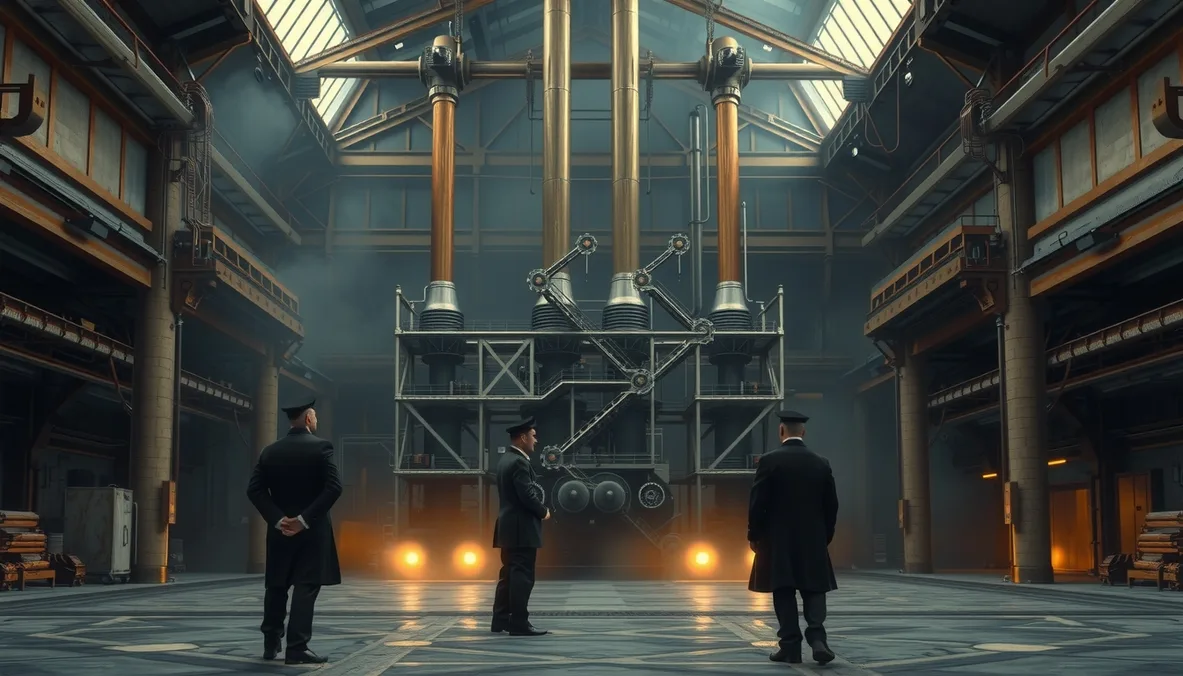
When the engineers of the past first gazed upon the steam turbine, they did not see a mere heap of metal, but a gauntlet thrown down to master chaos itself. It was an epoch where the industrial pulse beat in the rhythm of iron and coal, and every constructed device was mandated to serve as an extension of the human will. This machine, with its 1.2-meter diameter rotor, stood not merely as an engineering triumph, but as the physical embodiment of natural law, where an internal pressure of 10 MPa mimicked the tectonic strain of shifting plates, waiting for the singular moment to erupt into kinetic majesty.
The rotor shaft, cast from ASTM A225 grade steel, served as the system’s spine; its resistance to 250 MPa of tensile stress was not merely a figure on a blueprint, but a metallurgical defiance of fate. Each time the turbine accelerated to 3000 revolutions per minute, this shaft endured a colossal centrifugal force, as if suspended between two worlds—the stillness of inertia and the total, destructive velocity—its physical presence as resolute as the silence that preceded the introduction of steam.
The heat permeating the turbine’s interior altered everything; as steam at 500°C surged into the system through a 0.3-meter diameter inlet pipe, the metal began to "breathe." This was no mere metaphor, for the cast-iron housing, with its 0.1-meter thick walls, expanded and contracted in response to thermal fluctuations like a living organism, wherein the ASTM A48 grade cast iron took on a near-sacred significance, containing a raging inferno that threatened to breach every seal.
The turbine blades, forged from AISI 1095 carbon steel, became the machine’s true soul; their 0.15-meter long profiles, curved like the wing of a bird, were engineered to absorb the steam’s impact and transmute it into kinetic energy. When the steam jet struck these blades, one heard not just a whistle, but a deep, low-frequency metallic sigh—a testament to the mediation between chaotic expansion and orderly rotation, as they withstood a 1000-newton force constantly striving to tear them from their moorings.
The bearings, creations of AISI 52100 steel, were the silent observers of this drama, their 0.001-meter clearance serving as a critical zone where precision collided with friction. Here, a perpetual struggle unfolded: a 100 kN load pressed against the metal, yet the oil film and the perfection of manufacturing tolerances prevented the machine from consuming itself, defining the very boundaries of engineering—beyond which the turbine would collapse into a ruin of scrap, its metallic shriek the final cry of a failed system.
The gearbox, with its 3:1 gear ratio, acted as a bridge between the turbine’s lightning-fast rotation and the generator’s requirements, accepting 1000 Nm of torque and passing it forward like a relay through the generations. Engineers felt the true grandeur of power here, as the gear teeth meshed and the machine’s housing shuddered under the force of transmission, turning theoretical calculations into labor and an 80 percent efficiency rating into a hallmark of industrial success.
The steam’s path through the turbine resembled the flow of a mountain river; having surged through the high-pressure section, the steam surrendered its internal energy to the blades until, cooled to 100°C, it exited through a 0.4-meter diameter discharge pipe. It was a thermodynamic metamorphosis, during which the chaotic movement of steam molecules was harnessed and compelled to serve human ends, with engineers observing the process in reverence, knowing that every bar of pressure had to be exploited to the final drop.
The creation of this machine relied not only on mathematics but on the observation of nature; the turbine blades, designed according to the principles of avian wings or fish fins, sought maximum efficiency where nature had already found a solution. It was an attempt to imprison an elemental force within an iron cage, and as the turbine operated at full capacity with a 10 kg/s steam flow, a singular atmosphere permeated the space, where the vibration of the air, radiating from the spinning rotor, could be felt even through the concrete floor.
Metal fatigue and structural resilience became constant companions, for the ASTM A529 grade steel used in shafts and gearboxes had to withstand not only static loads but relentless vibration. Engineers understood that every hour of operation was a battle against entropy; thus, every bolt and sealing gasket was crafted with the conviction that this machine must endure longer than the men who conceived it.
The engineers of the past understood that the turbine was not merely a tool, but a monument to the human intellect—a mind capable of transforming the expansion of steam into a force that turned factories, illuminated cities, and propelled vessels across the oceans. Hearing the turbine’s hum, they did not hear noise; they heard the progress of civilization, where every MPa of pressure and every revolution per minute became proof that humanity had found a way to bridle the elements.
Looking back at these ancient blueprints and specifications, one can feel the weight of an era when machines possessed substance, and their construction was visible and tangible. Nothing was hidden behind digital screens or microchips, for everything was real: metal, steam, pressure, and fire. This was the true majesty of engineering, captured in cast-iron housings and steel rotors that, to this day, recall that powerful, thrumming heartbeat of the industrial past.