ine Awakening: The 1911 Parsons Masterpiece Thunders to Life or Turb
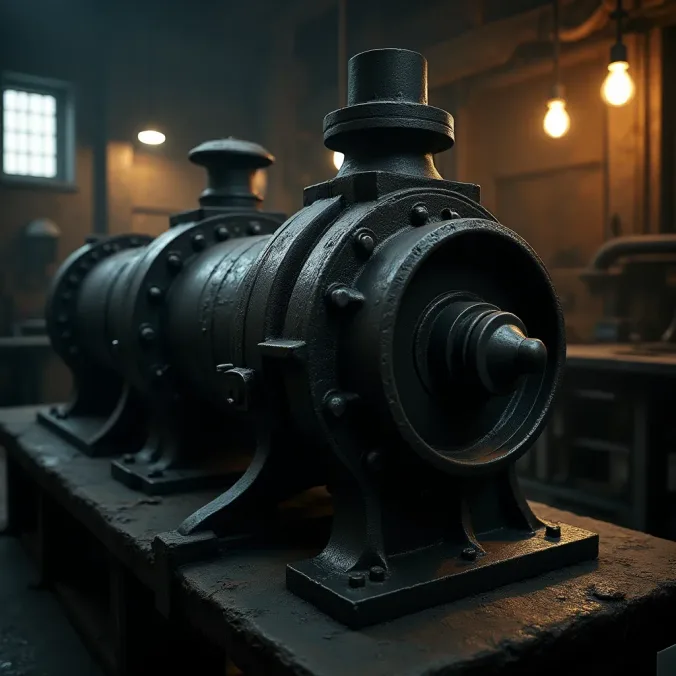
On a winter night in 1911, amidst the shadows of the Newcastle workshop, Charles Parsons’ creation drew its first breath. It was no silent genesis; it was a metallic roar, as the ASTM A48 cast-iron casing—a 2.44-meter monolith—began to shudder under the force gestating within. Engineers watched as a compressive stress of 170 MPa, like an invisible, tightening grip, constricted the turbine walls, straining to push them beyond their equilibrium. The air hung heavy not merely with the stench of scorched oil, but with the sharp, ozone tang born of static electricity as steam friction surged against the internal baffles.
This apparatus defied conventional laws, for the 35-bar pressure at the inlet acted not as a fluid, but as a solid, near-impenetrable body. When the steam flow, superheated to 320°C, slammed into the first row of blades, the 25-millimeter-thick cast-iron shell absorbed an impact whose dynamics mirrored the sudden, violent fracturing of subterranean rock. The metal groaned, emitting a low-frequency vibration that traveled through the factory foundations into the soles of the workers, a visceral reminder that they were commanding an elemental force whose boundaries remained uncharted.
The AISI 4140 steel rotor, machined with surgical precision, served as the rotating axis, its 655 MPa yield strength the only shield against catastrophic disintegration. As the rhythm of 3,600 revolutions per minute stabilized, a 2,350-newton centrifugal force clawed at the blades, attempting to tear them from their seats and turning the entire mechanism into a taut, screaming wire. It was an engineering war against inertia, where metal with a density of 7.9 g/cm³ had to withstand the 13.6 kg/s barrage of steam without allowing the rotor to deflect by even a single micron.
The blade joints, fashioned with complex dovetail geometry, endured 250 MPa of stress, preventing kinetic energy from rupturing the shaft’s containment. Each element, mated with a 0.2 coefficient of friction, acted as an anchor holding the system’s integrity together. As steam, slicing through at 244 m/s, battered the aerodynamic surfaces, the metallic fabric endured profound thermal stress; yet, the dovetail joints, expanding under the heat, only seated themselves more firmly within their cradles.
The bearings, cast from a soft lead-tin alloy, provided the only source of gentleness in this brutal mechanism. The 45 kN load borne by these supports forced the lubricant into a hot, viscous film, where a 0.05 coefficient of friction stood as the thin line between operation and ruin. When the metal began to emit a dull, rhythmic thrum at 120°C, the engineers knew the system was operating at the edge; the 12.5 kg·m² moment of inertia demanded constant vigilance, for the slightest leakage of lubricant could instantly liquefy the entire support structure.
The sealing system, designed as a labyrinth of ten graphite teeth, served as the final line of defense against steam egress. Each 10-millimeter tooth, crafted from ASTM D3840-grade material, functioned as a microscopic pressure dampener. Here, where a 0.1 coefficient of friction allowed the steam to shed its enthalpy, pressure plummeted to a mere 0.1 bar, and the temperature subsided to 40°C. It was a molecular framework that managed the chaotic expansion of gas, transmuting it into a controlled, laminar flow.
The low-pressure section, expanding to a diameter of 1.2 meters, was engineered to extract the residual energy. Here, the flow velocity slowed to 55 m/s, and the metal structure, though under lower stress, was tasked with containing a gargantuan volume. Engineers observed as the 13.6 kg/s flow finally surrendered its potential, converting it into a steady electrical load, while the turbine casing, radiating heat, seemed like a living, breathing organism.
The bearing housings, cast from massive 20-millimeter-thick iron, acted as a structural frame, dampening the vibrations induced by the 5.5 kg·m² moment of inertia. Every nut, torqued to the metal’s yield point, ensured that a machine operating at 3,600 RPM would not succumb to its own torque. It was an engineering triumph over chaos, where every bolt was calculated to withstand even the most minute pulsation of steam pressure.
The turbine’s internal matrix relied on the enthalpy change equation P = ṁ (h1 - h2), which became the engineers' Bible. Every calculation was executed with surgical precision, harmonizing steam density with blade surface area. This was not mere theory, but a daily attempt to approach perfection, where energy conversion occurred with minimal loss and every joule was harvested into useful power.
Parsons, observing the flight of birds, realized that the geometry of the turbine blades had to replicate the curve of a wing to minimize vortex losses. This biomimetic solution allowed for a reduction in the device’s weight while maintaining the power previously generated only by massive, tonnage-heavy piston engines. It was a revolution rooted not just in mathematical modeling, but in a profound understanding of materials physics—a wisdom earned through failed experiments and shattered metal castings.
Yet, even the most perfectly constructed turbine inevitably collided with physical limitations. While the material strength allowed for 3,600 RPM, the heating of the bearings remained the primary engineering obstacle, limiting the duration of continuous operation. When the turbine reached peak output, the 35-bar inlet pressure and 0.1-bar vacuum created a thermal gradient so severe that even the finest cast iron began to show signs of structural fatigue, and the turbine’s duty cycle inevitably struck the threshold of material endurance.
Ultimately, the central engineering paradox remained unresolved: the greater the turbine’s power, the more it relied upon a lubrication system that was, itself, the weakest link in the entire assembly. The engineers understood that even at maximum efficiency, metal fatigue from constant vibration and thermal cycling was inescapable. Every hour spent spinning at 3,600 RPM was not merely the generation of electricity, but a slow, relentless erosion of the casing and blades—a decay held at bay only by increasingly frequent maintenance and ever-more precise metallurgical selection. Here, engineering collided with the physics wall of its own making: the extraction of energy always demanded a mechanical sacrifice.