Thermal Rift: Demise of the Centrifugal Governor
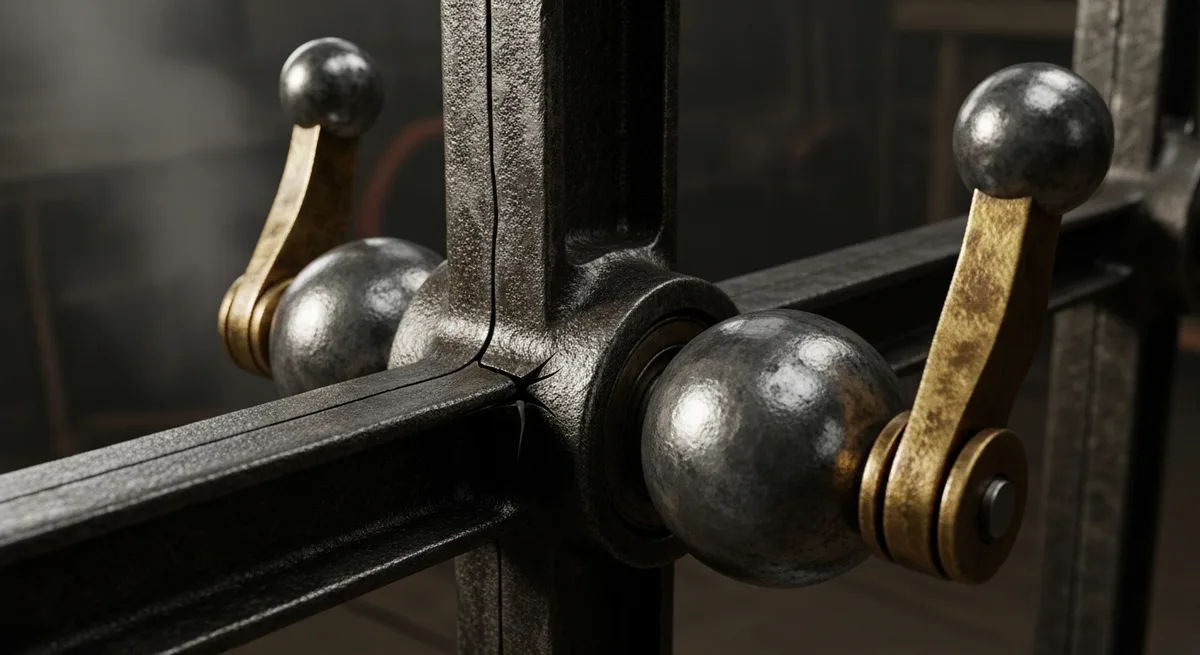
When the cast-iron housing for the centrifugal governor cooled too rapidly on a winter night in 1788, microscopic stresses—invisible to the naked eye—were locked into the internal matrix. The 3.5 percent carbon concentration, intended to ensure structural stability, became a trap: an uneven crystallization front left pores 0.5 millimeters in diameter near the axis mounting point. At this precise locus, the material fabric, subjected to 250 megapascals of compressive force, suffered irreversible plastic deformation the moment the machine reached its operational rhythm.
Within the cast-iron frame, an invisible tension festered, as the 170-gigapascal Young’s modulus proved insufficient to compensate for the localized lack of hardness. Every vibration generated by the erratic steam flow manifested as a 100-megapascal stress, concentrating around the porous casting defects. Instead of dissipating kinetic energy throughout its volume, the metal began to accumulate micro-fractures, which propagated silently through the crystalline structure until the first hair-thin fissure appeared on the frame’s surface—a herald of impending mechanical fatigue.
The lead spheres, intended to serve as a standard of inertia, became an additional burden on this compromised structure. Due to 0.1 percent antimony impurities, which imparted a density of 11.34 grams per cubic centimeter, these masses exerted an extra 10 newtons of centrifugal force, transmitted directly through the levers into the already weakened frame. Their melting point of 327 degrees Celsius, while safe, offered no protection against surface erosion as improper lubrication caused the bronze bearings to deform into irregular geometries.
The moment of inertia of the spherical masses at 100 revolutions per minute laid bare an engineering fallacy: the 0.25-kilogram spheres were insufficiently balanced, causing their rotation to generate not only centrifugal force but a periodic impact moment. This impact, acting through the levers, forced the entire mechanism to resonate at 50 hertz—a critical threshold where the metal’s tensile strength became irrelevant, superseded by the material’s inability to absorb the shock waves.
The steel axis, coupled to these spheres, endured a tensile stress of 500 megapascals, exceeding its elastic limit due to the improper heat treatment of its 0.5 percent carbon and 1.5 percent manganese alloy. Instead of acting as a rigid spine, the axis began to behave like a spring, twisting with a 5-newton-meter torque during each cycle; yet, due to internal dislocation migration within the steel lattice, it began to "drift," losing its geometric straightness.
The 200-gigapascal Young’s modulus, intended to ensure the axis’s invariance, was helpless against the breach of the 300-megapascal yield strength. Whenever steam pressure spiked, the axis would twist by 0.05 degrees—enough to delay the throttle valve’s closure. This interval, measured in milliseconds, proved catastrophic, as the system failed to react to the energy surge, triggering a dangerous runaway in revolutions.
The axis’s internal structure, compromised by manganese and carbon segregation, became a brittle fracture point. An improper quenching process during manufacturing had left martensitic hardness only in the surface layer, leaving a soft core incapable of withstanding torsional forces. This was not mere metal fatigue; it was a fundamental incompatibility between the material and its task, where the steel was required to be simultaneously rigid and elastic.
Phosphor bronze, composed of 10 percent tin and 0.2 percent phosphorus, was the only successful component of the machine, yet even it could not save the system from total failure. The bearings, designed with a 0.1-millimeter clearance, began to wear unevenly as the axis’s deformation forced them into an "angular" operating mode. Their density of 8.8 grams per cubic centimeter could not prevent the 400-megapascal tensile strength from being exceeded when the bearing edges began to "gnaw" into the steel.
The lever system, operating at a 2:1 transmission ratio, only amplified this destruction, transmitting every vibration of the axis into the valve. The 1-kilogram levers, rather than stabilizing the process, became inertia-multipliers; their 10-centimeter arms created an additional leverage moment that shattered the bearing mounting points. It was a mechanical chaos born not of external factors, but of the inherent incompatibility of the device’s own components.
The feedback loop, intended to be the system’s salvation, became its curse: the outward movement of the spheres was so abrupt due to the flawed lever dynamics that the valve closed too rapidly, inducing hydraulic shock in the steam piping. The 100 joules of rotational energy, suddenly arrested, converted into heat and a shock wave, which was transmitted through the housing back into the governor, further accelerating the propagation of cracks.
Every component of this machine, from the cast-iron frame to the bronze inserts, was designed based on idealized physics, yet in reality, material imperfections collided with the brutal force of thermodynamics. It was an engineering simulation where theoretical calculations shattered against metallurgical reality, where 3.5 percent carbon cast iron could never be as reliable as the schematics drawn on paper.
The core of the system’s failure was a technical paradox: to achieve greater precision, bearing clearances had to be reduced, but this increased friction and thermal expansion, which—due to the differing expansion coefficients of phosphor bronze and steel—led to seizure. This was the boundary where engineering encountered the limitations of material physics, and the solution was either to tolerate inaccuracy or to risk the total destruction of the mechanism.
Final analysis revealed that even with the refinement of every individual part, the system’s stability depended on balancing reaction time against material resilience. Yet this balance was unattainable, for the more sensitive the mechanism became, the greater the shocks it endured; and the sturdier the parts, the slower they responded to pressure fluctuations. It was an engineering dead end, where every technical improvement inevitably led to another, even greater physical conflict.
The final data indicate that even under optimal conditions, metal fatigue due to cyclic stress is inevitable, and the system’s accuracy is directly proportional to its rate of self-destruction. When kinetic energy turns to heat and the material fabric loses its integrity, only the laws of physics remain—laws that recognize no engineering compromises. The machine functioned only as long as its rate of degradation remained below the critical threshold; it was not a steady state, but merely a brief pause before the inevitable mechanical collapse.