Foreign Body in the Machine
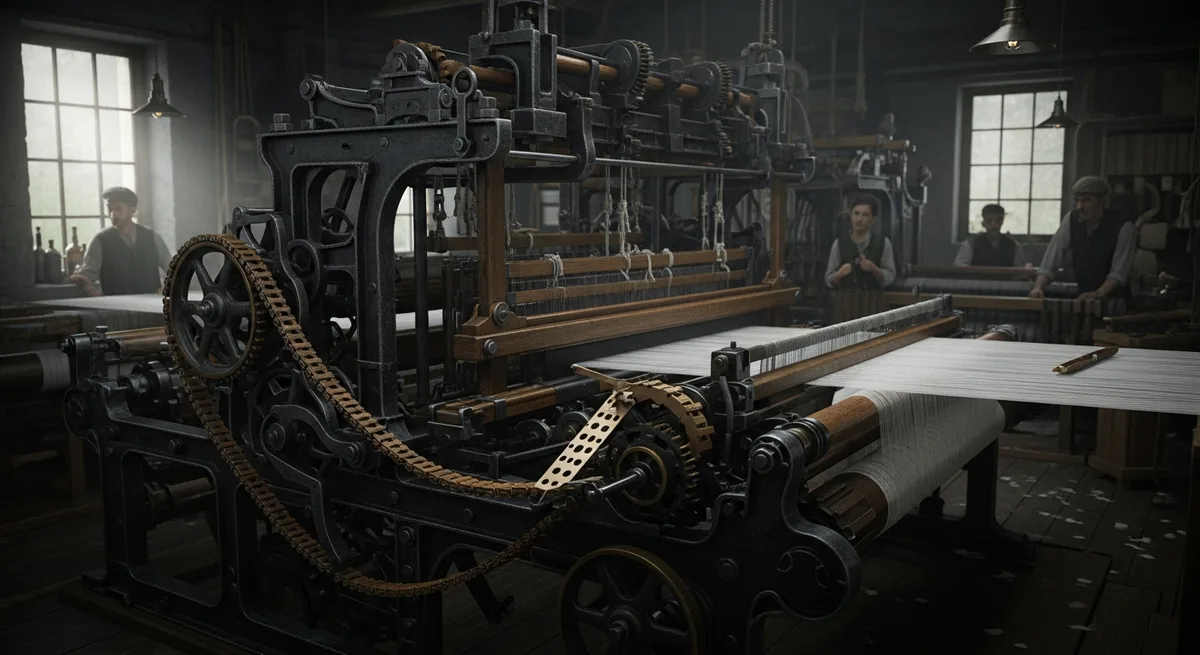
In the winter of 1801, the air within the Lyon workshop was so saturated with wool dust and humidity that light itself seemed to permeate the windows with a viscous, labored resistance. Joseph Marie Jacquard’s loom did not stand there as a mere tool, but as a foreign body, erupting from the floorboards like a black, oxidized coral. It was not simply a machine; it was a silent, transformative challenge to the entire weavers’ guild, an institution that had relied for centuries solely on the dexterity of fingers and the fallibility of memory. When the master first engaged the mechanism, the vibrations of the cast-iron frame bled into the very foundations of the building, producing a low, almost imperceptible thrum—a sound less like a manufacturing process and more like the respiration of a gargantuan, slumbering beast.
I stood nearby, observing as the oak drive shaft, turned with a precision that shamed every local carpenter, began its slow, ritualistic rotation. The wood, though seemingly inanimate, appeared to groan with every revolution, absorbing the structural fatigue imposed upon it by thousands of cotton threads. It was a visceral struggle between the warmth of organic matter and the cold, indifferent demands of metal. Each time the shaft turned, one could feel the tensioned threads vibrating in the air, emitting a high-pitched, strained resonance—like strings on the verge of snapping, should the master turn the lever by even a single millimeter in the wrong direction.
The bronze bearings, subjected to relentless friction, exuded a distinct, sharp aroma—a synthesis of metal and scorched lubricant that permeated clothing and skin alike. It was the machine’s circulatory system. When I touched the cold bronze, I felt not only the chill of the alloy but an internal tremor generated by kinetic energy transmuting into heat. That thermal oscillation was a reminder that this machine demanded a constant sacrifice—not merely of oil, but of attention; for here, every micron of inaccuracy could manifest as ruined fabric, and ruined fabric meant a lost day, a lost loaf of bread.
The shedding mechanism was the true drama of this construction. Forged steel levers rose and fell with a ruthless, almost sadistic exactitude. Their movements were not fluid; they were staccato, reminiscent of a predator’s strike. Each click of the springs echoed like a gunshot in the void, and the collision of metal against metal left marks that the master cleaned with religious fervor. There, amidst the levers, an invisible war raged between mechanical force and fragile cotton, the latter forced to submit to a rigid, mathematical order.
Yet, it was the card reader that filled me with the deepest dread. Those perforated cardboard strips, linked into an infinite chain, resembled some pagan prayer book where the holes were the only scripture. When the bronze pins pierced the cardboard, a dry, brittle sound emerged—as if something were quietly counting the days of my own life. It was the machine’s brain, possessing no soul, only logic. The men who watched from the corners gazed upon it with terror; they saw not progress, but the end of the world they knew, where the weaver was a creator rather than a mere overseer.
The steel needles, delivering the final, decisive strike into the fabric, were akin to surgical instruments. Their luster in the gloom was almost menacing. As they wove between the threads, forming patterns the human eye could barely track, it seemed as though the machine were generating beauty entirely independent of the weaver’s will. It was a triumph, but also an alienation—man had become redundant to the birth of complex ornament. We stood around, observing that cold, metallic precision, feeling small, almost insignificant before this black, thundering construction.
One afternoon, the machine stopped. Not due to a malfunction, but because the cardboard strip had run its course. That sudden, deafening return of silence to the workshop was more exhausting than the noise itself. We all flinched, as if waking from a trance. The master approached the loom, his hands trembling as he began to swap the cards. He moved as if performing surgery on a living organism. On his face, I saw not pride, but the fatigue of a man who understood he had opened a door that could never again be closed.
That oak shaft, that cast-iron frame, and those infinite strips of perforated cardboard were not merely an engineering solution. They were a social rupture, embodied in the weight of metal. We all understood that tomorrow, there would be less work on the streets of Lyon, and the price of textiles would plummet, for the machine does not sleep, does not eat, and does not require rest. It only demands that we feed it our ideas, which we translate into sequences of holes in cardboard. We had become servants to that which we had created.
Looking back at that era, it seems those looms were not just weaving machines, but a colossal mechanical clock counting down the dawn of the industrial age. Every click, every screech of bronze, was a step toward a world where human handiwork would become a luxury rather than a necessity. And though that 1,500-kilogram monster seems primitive today, back then it was like a deity, demanding total devotion and fear.
We left the workshop late in the evening, when a thick fog had already settled outside. Inside the factory, the loom still radiated heat, and the scent of bronze remained embedded in the walls. Joseph Marie Jacquard stood by the window, staring into the darkness, and no one dared speak to him. He knew what we only sensed: the world had just changed, and irrevocably so. We were witnesses to the moment when logic defeated intuition, and metal overcame human muscle.
It was not merely a technological triumph; it was a melancholy locked within cast-iron frames. Every thread woven by that mechanism was proof that the future would be cold, precise, and merciless. We returned home, feeling that rhythmic thrum still echoing in our heads, a reminder that somewhere out there, in the dark, the machine continued to work, creating patterns we no longer understood.
That oak shaft, which withstood such immense tension, will always remind me of Jacquard himself—a man as sturdy and resilient, yet still feeling every fracture in his own creation. He had crafted something perfect, but that perfection was too heavy for one man to bear. We left him there, with his black beast, which was destined to weave fabric all night long while we tried to sleep, listening to the distant, muffled thud of metal that never ceased.
It was a time when we hoped machines would liberate us from toil, but instead, they enslaved us to their rhythm. We became extensions of those looms, readers of their perforated cards, who planned our lives according to the velocity of the drive shaft. And even now, after all these years, when I recall that Lyon workshop, I feel the same chill emanating from the cast iron, and the same fear we felt then, watching the birth of a new, mechanical world.