Piston Pulse: Rhythm of the Steam Engine
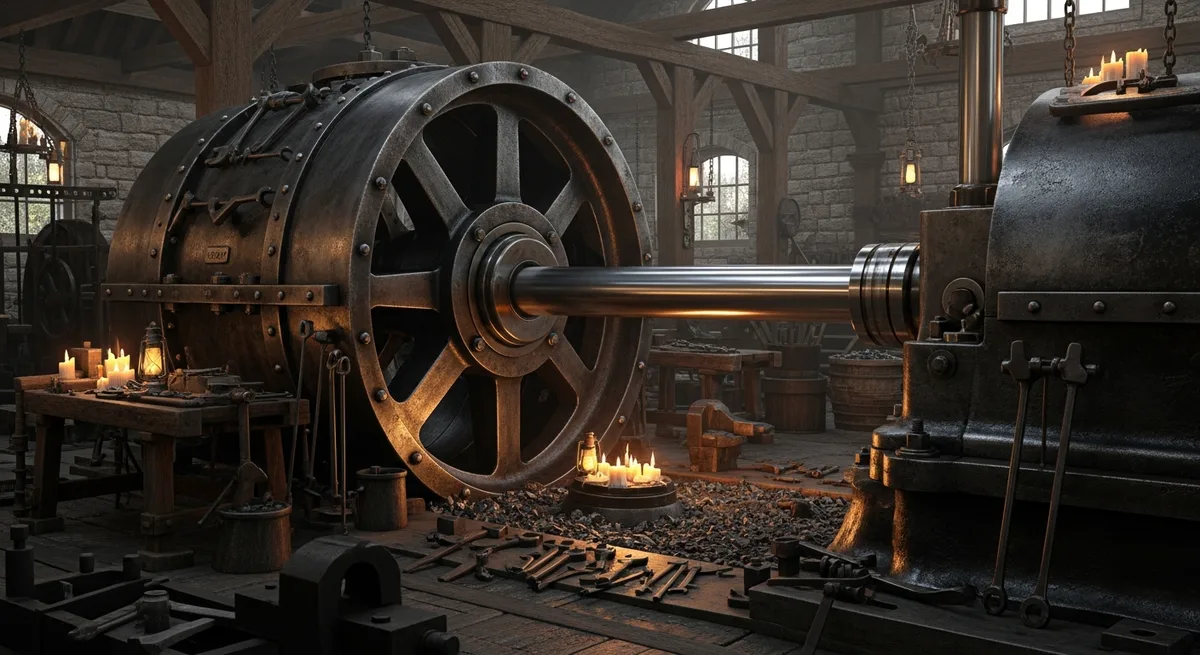
On a frigid morning in 1788, the Birmingham workshop hung heavy with the acrid scent of scorched coal and drying lubricant, while James Watt’s gaze remained locked upon the rotating mechanism tasked with shackling the elemental fury of steam. Before him loomed a gargantuan cast-iron structure, its walls—possessing a density of 7.2 g/cm³—absorbing not merely the vibrations but the very sound itself, transmuting the roar into a subterranean tremor felt through the soles of his boots. Every square centimeter of this massive frame was engineered to withstand compressive loads of 200 MPa generated by the relentless cadence of the steam piston; yet, it was not the static burden that tormented the engineer, but the invisible "respiration" of the materials—a thermal expansion more elusive and treacherous to govern than the pressure itself.
The molecular framework of the AISI 1095 carbon steel rod served as the machine’s spine, its 50-millimeter diameter forced to negotiate a precarious equilibrium between rigidity and elasticity. As the revolutions climbed to one hundred per minute, this metallic tissue endured a stress of 500 MPa, each rotation cycle testing the integrity of atomic bonds and compelling the rod to sing at a low, near-inaudible frequency. This resonance was no mere mechanical noise—it was the steel’s visceral resistance to deformation, a perpetual struggle against the centrifugal force striving to warp a perfect line into a chaotic orbit.
A spherical pendulum bob, cast from CuZn37 alloy, acted as the system’s "brain," its 0.15-meter radius and 8.55 g/cm³ density allowing it to accumulate kinetic energy with startling precision. The internal matrix of copper and zinc atoms absorbed every sudden spike in steam pressure, preventing the system from spiraling into an unmanageable cycle, while the pendulum’s transit through the air was governed by a 0.01 coefficient of friction—a seemingly negligible value that nonetheless stood as a primary engineering barrier. The sphere obeyed the laws of physics like a living organism, straining to break away from its center, yet the 0.01-meter diameter pin—the machine’s nerve—prevented it from drifting into the void.
Phosphor-bronze bearings, their 8.75 g/cm³ density ensuring remarkable wear resistance, functioned as the silent sentinels of the system, yet they remained the greatest source of peril. As temperatures climbed from 20°C to 100°C, the oil coating the bearing surfaces, with a viscosity of 0.083 Pa·s, thinned into a microscopic film tasked with separating the rotating shaft from the static housing. Should this film rupture for even a heartbeat, the metal-on-metal contact would strike with such ferocity that the 0.025-meter diameter bearing would, within seconds, be reduced to a molten scrap of metal, effectively severing the factory’s pulse.
The lever system, operating as a primitive logic circuit, calculated the ratio of mass, velocity, and distance, yet the engineers were perpetually haunted by an unavoidable phase shift. Each movement of the linkage possessed a 0.001-meter radial clearance intended to compensate for thermal expansion, yet this very tolerance introduced inertia—a latency that no mechanical artifice could entirely excise. It was an engineering paradox: the more precisely the engineers attempted to regulate the steam flow, the more sensitive the mechanism became to external disturbances, as if the machine itself resisted perfect governance.
The limits of metallurgy drew a stark boundary beyond which material fatigue became inevitable. Once the phosphor-bronze surface reached a wear rate of 0.01 mm³/m, the machine’s precision began to hemorrhage, and the steel rod, subjected to constant cycles of heating and cooling, accumulated microscopic fissures within its internal matrix. The engineers understood that every hour of operation was not merely productive labor, but an inexorable process of systemic decay that no lubricant or meticulous assembly could forestall.
The centrifugal mechanism, which translated the linear motion of the sphere into a rotary signal, relied on a 5 N·m torque—sufficient to actuate the valve, yet insufficient to overcome the system’s inertia during sudden pressure fluctuations. This structural tension between the shifting fabric of the materials and the demand for constant revolutions became Watt’s central crucible. He watched as the bronze bearings and the steel shaft expanded at disparate rates, realizing that the system would forever teeter on the razor’s edge between efficient operation and catastrophic self-entrapment.
Though the Watt governor appeared to be a masterpiece of balanced mechanics, it was merely a fragile compromise with physics. Every lever, every pin, and every facet of the sphere was designed to absorb resistance, yet the inherent inertia of the mechanism meant the system was never truly, statically stable. It was a perpetual "wrestling" with the laws of nature, where spikes in steam pressure remained one step ahead of the mechanical response, leaving the engineers with nothing but the hope that the 0.001-meter radial clearance would remain sufficient to prevent the metal from kissing the metal.
The final engineering bottleneck lay in the very nature of the materials: the temperature gradient between the core and the outer surface induced uneven expansion, distorting even the most precise geometric forms. When the 1788 machine operated for more than a few days, the bronze bearings would heat to the threshold where oil viscosity plummeted below critical levels, and the steel shaft would begin to vibrate due to a microscopic imbalance in centrifugal force. This was the frontier where engineering genius collided with the impenetrable wall of thermodynamics, leaving the machine to spin within a thermal state of its own making.