Fury of the Piston
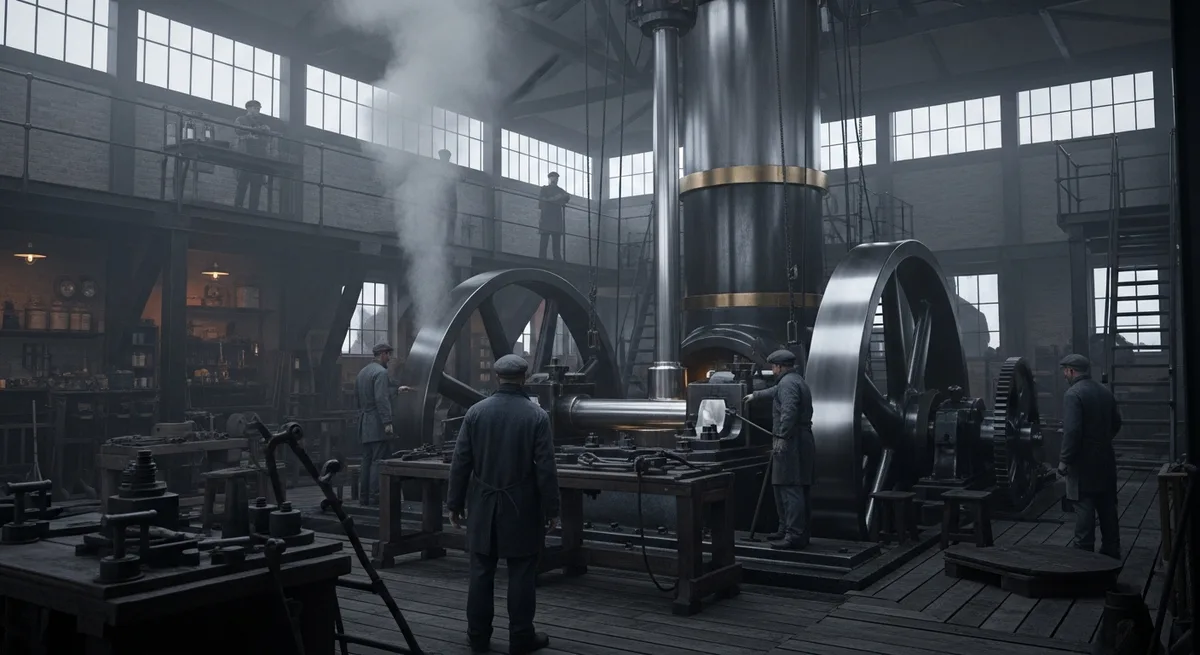
The winter of 1842 in the Birmingham foundries held no romance; it reeked of scorched coal and damp metal, the air thick with a tension radiated by a gargantuan, 12-ton reciprocating engine. Engineers, perched upon shuddering timber scaffolding, watched as the 600-millimeter diameter cast-iron cylinder, subjected to 0.8 MPa of pressure, pulsed like a trapped beast. Each intake of steam into the chamber triggered a thunderous metallic groan that rippled through the entire structural frame, forcing the men to feel the vibration not merely in the soles of their boots, but deep within the marrow of their bones.
The primary piston rod, cast from solid steel ingots, was forced to endure shear stresses that defied intuition, peaking at 450 MPa whenever the steam’s force abruptly reversed the direction of travel. Its surface, polished to a mirror-like sheen, masked microscopic fissures that expanded and contracted under the relentless 300-degree Celsius thermal cycling. It was a perpetual stretching of the material’s fabric to the threshold where steel loses its rigidity and begins to mimic a viscous fluid, creeping ominously toward its yield point.
Within this mechanical anatomy, the piston rings performed a thankless yet critical function, maintaining the seal between the roiling steam and atmospheric pressure. Fabricated from a specialized high-carbon cast-iron alloy, they acted as self-lubricating gaskets, their 200 MPa of compressive force preventing the steam from breaching the gaps. Yet, every cycle completed by the engine abraded a fraction of this protection, scoring the cylinder walls with invisible but fatal scratches that served as conduits for frictional heat.
The main camshaft, coupled to the flywheel via a gear train, acted as the system’s inertial reservoir, its 1,500-kilogram mass hoarding kinetic energy. As the engine reached 40 revolutions per minute, this steel monolith generated such centrifugal force that even the slightest imbalance induced a resonance capable of unseating the foundation’s stone blocks. It was a war between mass inertia and the material’s capacity to retain its form, where every rotation became a defiance of physical law.
The bearings housing this rotating giant were lined with an ultra-soft alloy designed to dampen shock, yet their internal matrix waged a constant battle against overheating. The lubricating oil, thick and dark, barely reached the friction zones where temperatures spiked to 90 degrees, forcing the metal to expand and constrict against the bearing walls. Engineers would manually probe this hot, pulsing heart, terrified that a single seized bearing might instantly arrest the factory’s rhythm, triggering a cascading mechanical collapse.
The valve train, governed by a complex web of levers and cams, operated with a precision of 0.05 millimeters—a feat of staggering audacity given the manufacturing limitations of the era. Each bronze lever had to withstand immense bending moments as steam pressure violently forced the valve open, the sudden motion producing a metallic snap that echoed through the hall. It was the mechanism of a precision watch transplanted into the belly of a superheated boiler, where every component was required to maintain its geometry despite the volatile thermal fluctuations.
The boiler walls, 25 millimeters thick, absorbed the full 1.2 MPa of internal steam pressure, their internal crystalline structure slowly evolving under the relentless assault of thermal cycling. Each time the stokers shoveled coal, the pressure surged, and the metal, while appearing inert, underwent microscopic deformation. It was a slow, invisible fatigue that accumulated over years until it culminated in a sudden, catastrophic rupture—a failure point that no calculation method of the time could have predicted.
The gear mechanisms transmitting power to the looms were forged from hardened steel, their 55 HRC hardness essential to prevent the teeth from eroding within months. Yet even this hardness could not shield them from the 5,000 newtons of force exerted on every contact point, which left behind microscopic pitting. These pits, like scars from a battlefield, deepened with every hour of operation until the gear lost its profile and began to emit an increasingly shrill, metallic shriek.
The fasteners holding the assembly together were torqued with such force that the bolt threads endured a constant tensile stress nearing the 300 MPa limit. The engineers understood that should even one of these elements weaken, the entire structure would lose its equilibrium and begin to "walk" upon its foundations. They employed steel bushings to distribute the load, yet the vibration inevitably found the path of least resistance, perpetually gnawing at the integrity of the joints.
Every component of this machine was designed with the intent of enduring extreme conditions, yet the engineers could never precisely calculate the fatigue limit of their materials. They relied on experience rather than theory, rendering every engine start a gamble with fate. As the machine gathered speed, its low, guttural thrum transformed into a singular, powerful roar that saturated the space, forcing the very walls to tremble in sympathy with the steel frame.
Paradoxically, it was this very pursuit of a perfect, rigid system that became the primary failure, for rigidity denied the material the flexibility required to accommodate thermal expansion. As temperatures climbed, the components, having nowhere to expand, suffered internal stresses that exceeded their ultimate strength. It was an engineering dead end: the more robust the machine they built, the faster it dismantled itself from within, because the metal lacked the freedom of movement that the laws of physics demanded.
Today, we view these metallic skeletons as relics of the past, yet their creators lived in a state of constant tension between power and collapse. Every bolt, every lever was an attempt to cage the force of steam—a force they knew, in their hearts, could never be fully mastered. The ultimate engineering bottleneck remains unchanged: the resistance of materials has limits that constant cyclic loading inevitably violates, reducing even the most formidable mechanism to dust and rust.