Crucible of Pressure: Perfecting Watt's Invention
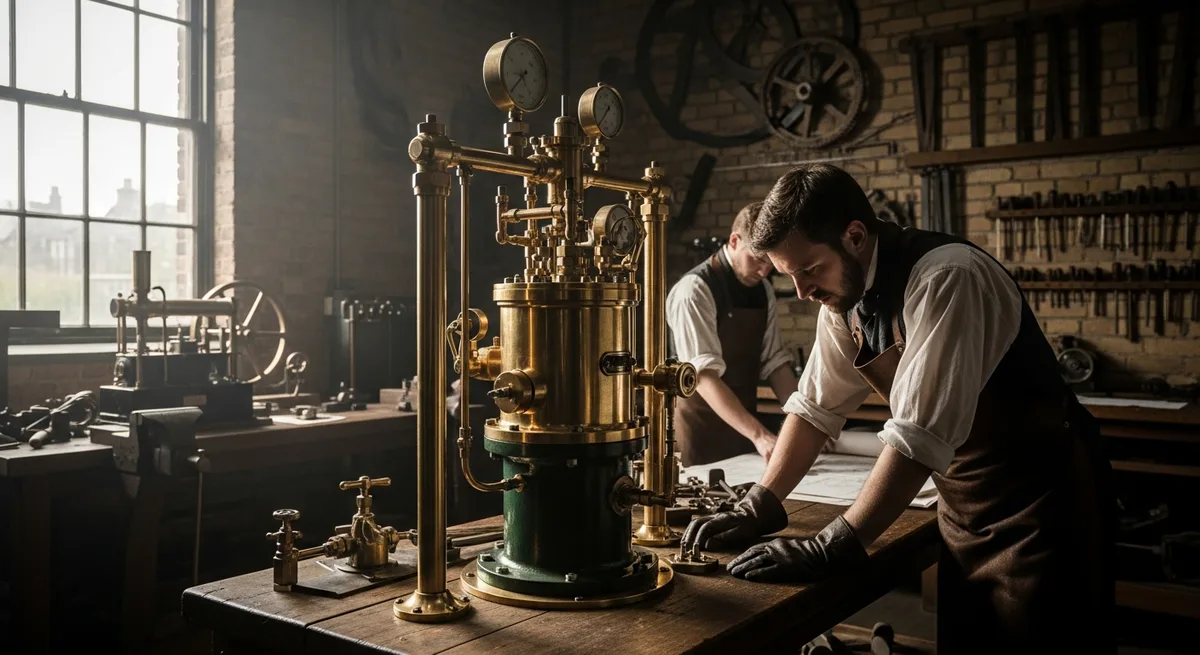
The winter of 1781 within the factory hangar was defined not merely by the cold, but by a suffocating, pervasive dampness. James Watt’s creation stood like an unfinished monolith, its five-ton cast-iron frame anchored into the stone flooring. This structure was never intended for grace; it was engineered to withstand a compressive force of 400 MPa, generated with every violent stroke of the piston. The engineers standing nearby could feel the stone floor tiles shuddering in sympathy with each cycle. This was no living creature, but a precisely formed assembly of matter whose structural integrity was interrogated every second. Impurities of silicon within the cast iron birthed microscopic fissures—cracks that the masters watched with a quiet, visceral dread, knowing that a single, uncalibrated pressure spike could shatter this massive frame into lethal shrapnel.
The wrought-iron cylinder served as the primary theater of this mechanism. Its two-centimeter walls were tasked with containing 10 bars of pressure, which raged within like a shackled elemental force. As steam surged into the chamber, the metal would flash-heat, expanding and straining its molecular framework to the 300 MPa threshold. There was no artifice here, only the brutal, unyielding physics of the machine. Each thermal fluctuation forced the iron to operate at the very edge of its fatigue limit. Over time, the interior of the cylinder became etched with minute, nearly invisible pits—the result of the relentless, high-pressure steam flow eroding the metal surface from within.
The piston, cast from thick, raw iron, was designed to transmit force without compromise. Its head absorbed the direct impact of the steam, a dynamic force reminiscent of a sledgehammer striking an anvil. Because cast iron is inherently brittle, the engineers were forced to monitor the surface constantly for signs of cracking induced by thermal shock. It was a perpetual struggle against the nature of the material: the piston had to remain rigid, yet possess the resilience to absorb impacts that threatened to fracture it into pieces. Every movement was a mechanical fact, the singular boundary between the volatility of steam pressure and the utility of rotary motion.
The steel rod connecting the piston to the broader system was a triumph of engineering calculation. Its tensile strength of 500 MPa was essential to endure the constant, rhythmic cycle of tension and compression. The rod hummed with a persistent vibration, its structural matrix subjected to the high-frequency oscillations propagating through the entire chassis. The steel in this assembly was worked so intensely that, over time, its internal lattice began to accumulate microscopic fatigue damage. The masters understood that the rod was not eternal; it possessed a finite, strictly defined number of operating cycles, after which the metal would inevitably surrender its structural cohesion.
The one-and-a-half-ton crankshaft was engineered to absorb the irregularities arising from the steam’s expansion within the cylinder. Its rotation was accompanied by a dull, heavy resonance emanating from the bronze bearings. These bearings, subjected to immense friction, would heat to dangerous levels, forcing the engineers to continuously douse them in thick lubricant to prevent the metal from reaching its melting point. The flywheel, a two-ton cast-iron disc, functioned as an inertial battery; its moment of inertia of 1200 kgm² ensured the machine would not falter even when steam pressure momentarily waned. It was a massive anchor, stabilizing the entire mechanical system against the chaos of its own power.
The condenser acted as a thermal sink, a site of constant thermodynamic warfare. The metal walls separating the searing steam from the cold condensate were perpetually subjected to temperature gradients that forced the material to expand and contract at disparate rates. This induced internal stresses capable of warping the condenser’s housing. The control mechanisms—levers and valves integrated into a complex architecture—were designed to ensure the precise metering of steam. A centrifugal governor, utilizing rotating weights, provided a direct method of regulating revolutions, preventing the machine from reaching the critical threshold of destructive vibration.
The geometry of the construction relied on a precarious equilibrium of forces. Every bolt, every steel joint, was calculated to distribute the load with absolute uniformity. Steel, iron, and bronze were fused into a system that permitted no margin for error. This machine was not built for aesthetics or comfort; it was built for labor, performed with ruthless, mechanical precision. Each component held a specific purpose, and their collective operation stood as a testament to the engineering stubbornness required to transcend the physical limits of matter.
When the machine was in full operation, the factory walls would groan under the heavy, rhythmic pounding of metal. It was a sound that permeated the environment, a constant reminder of the titanic force lurking within the steam pressure. The workers standing nearby felt the heat radiating from the cylinder walls and inhaled the pungent, scorched scent of heavy lubricant. This was the texture of industrial life—the sounds, the vibrations, and the odors that accompanied every hour of labor. The machine worked without respite, forcing metal to endure loads that, by modern standards, seem almost inconceivable.
Observing this mechanism, it is impossible not to notice its crude perfection. It was a machine designed with a technical precision that far outstripped the metallurgical capabilities of its era. Every detail, every mark left by a master on the cast-iron frame or the steel shaft, bore witness to the effort to harness fire and water. Though these engines are now mere museum artifacts, they remain as monuments to the human capacity to transform the elements of nature into measurable, calculable work.
In the historical context, the Watt engine represented a rupture that fundamentally altered the nature of production. Before this, humanity was tethered to the whims of wind or the flow of water; now, it had acquired the power to command energy at will. It was the dawn of a world where force became accessible and manageable. This machine was not merely a heap of metal; it was a tool that fused engineering curiosity with practical necessity, forever changing transportation, manufacturing, and the human perception of possibility.
Ultimately, every detail of this machine was a separate narrative of resilience. The cast-iron frame became the foundation upon which the Industrial Revolution was built. The wrought-iron cylinder was the arena where the duel between temperature and pressure played out. The steel system was the mechanical nervous system, connecting the heart to the limbs. It was a challenge to nature, proving that even the crudest metals, when properly formed, could generate a force capable of reshaping the face of the world. Today, we still feel the echo of that triumph in every step of our modern lives.