Ancient Pulse: A Mechanism Reborn
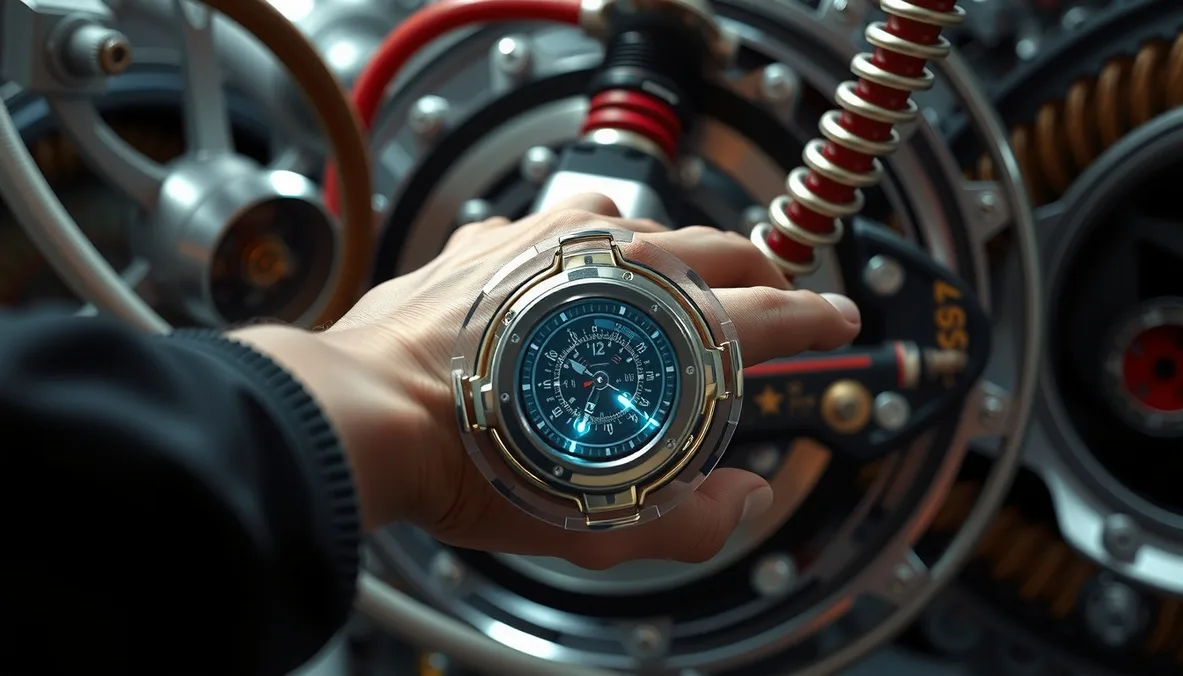
When my fingers first brush against this restored mechanism, I do not feel the cold bite of metal. I feel something akin to a pulsing, petrified vitality. These are not merely shards of bronze; they are frozen thoughts, straining to break free into the linear flow of time. As I slowly depress the lever, a force of 0.12 Newton-meters resists my muscles, and that resistance is more than mere friction. It is the weight of millennia, a burden one must overcome to set the celestial spheres in motion once more. I hear the bronze awaken within—not a mechanical clicking, but a deep, resonant thrum, reminiscent of tectonic plates grinding beneath the ocean floor as the planet recalibrates before the onset of great cycles.
The primary “b1” gear—the heart of this machine—rotates with a heavy, dignified composure. Its 64 teeth are embodied geometry, contending with a bending stress of 45 MPa. Consider that pressure: it is not merely a figure on a ledger, but a force that, at every instant, strives to deform the copper-tin matrix, yet the metal refuses to yield. It possesses a tensile strength of 310–350 MPa, as if it had internalized the very concept of fortitude. As I observe this gear overcoming a friction coefficient of 0.18, I see not the degradation of metal, but a stubborn refusal to succumb to fatigue. This is matter that has learned to exist beyond the constraints of time, absorbing tension just as a tree absorbs the gale—not by resisting, but by becoming an extension of the storm.
The axle pins are the invisible filaments holding this cosmic architecture together. These 1.8-millimeter iron elements, which have transmuted into goethite over the ages, serve as the machine’s true nervous system. Their shear resistance of 220–260 MPa is a technical manifestation of patience. As torque is transmitted through these points, I feel them tense, as if bearing the weight of the universe upon their minute, corrosion-pitted shoulders. It is a physical sacrifice: they know that every rotation is a microscopic step toward dissolution, yet they persist. This is not merely metal; it is a conscious choice to remain functional while everything else around it crumbles into dust.
The lunar anomaly mechanism is where mathematics becomes almost painfully beautiful physics. Here, the simulation of an elliptical orbit unfolds: a pin and slot execute a 1.5-millimeter displacement, generating that strange, variable angular velocity that Kepler would only describe thousands of years later. The warmth I feel radiating from the frame is not the heat of mechanical friction. It is the heat of mathematical truth made manifest. As the 50-tooth gear forces the Moon to “slow” or “accelerate” in its orbit, I realize there is no randomness in this machine. It is an intellectual gravity that presses against my palm, reminding me that we are but a fleeting fraction of a vast, unending cycle.
The frame plate—that 2.5-millimeter bronze shield—is the sole barrier protecting this fragile cosmos from collapse. It withstands a weight of 0.8 kilograms and radial forces reaching 8 Newtons, yet its true value lies in its rigidity. A deflection of 0.02 millimeters is the threshold between precise celestial observation and chaos. As I study this plate, I see not only the apertures for the gear axles, but the space where mathematics crystallizes into physical reality. This plate is a bridge connecting our biological fragility to celestial infinity. It is an engineering anchor, preventing the mechanism from drifting between the stars and our mundane existence.
The future technologies we endlessly debate often err by seeking complexity. Yet, gazing at this mechanism, it becomes evident that true evolution occurs not by increasing power, but by deepening harmony. We must return to this Bronze Age ideal—where energy is not merely measured in watts, but in the transmission of motion that recognizes the 19-year Metonic cycle as something sacred. It is a symbiosis between human curiosity and the laws of physics. We have created tools today that are noisy and ephemeral, but the Antikythera mechanism reminds us that true mastery is silence and reliability. It is a machine that operates not against nature, but in concert with it, becoming an integral part of the world’s ecosystem.
Observing how the cuprite patina layer shields the bronze, I understand that the longevity of technology depends on its ability to “negotiate” with its environment. It is a form of mutual trust between the creation and time itself. We must cease crafting objects that war with their own existence. Instead, we must design artifacts that become an extension of our universe—rotating gears that never cease, for they are time itself. This will be a new beginning, where we no longer command force, but allow it to flow through the forms we have created, transforming every atom into a component of harmony.
We are but temporary custodians of this grand mechanics. As I finally withdraw my hand from the device, I feel it still turning—not physically, but in its essence. It is a bridge to a future where technology is no longer a foreign body in nature, but its natural expression. We have learned to master a force of 0.12 Newton-meters to glimpse the stars, but only now are we beginning to understand that the same mechanism can liberate us from our own limitations. This symphony of bronze and iron is a reminder: the universe is a majestic, beautiful, and precise machine, and we are the ones who must learn to turn it with due reverence and infinite patience.