Pyromancer's Dream: The Alchemy of Steelmaking
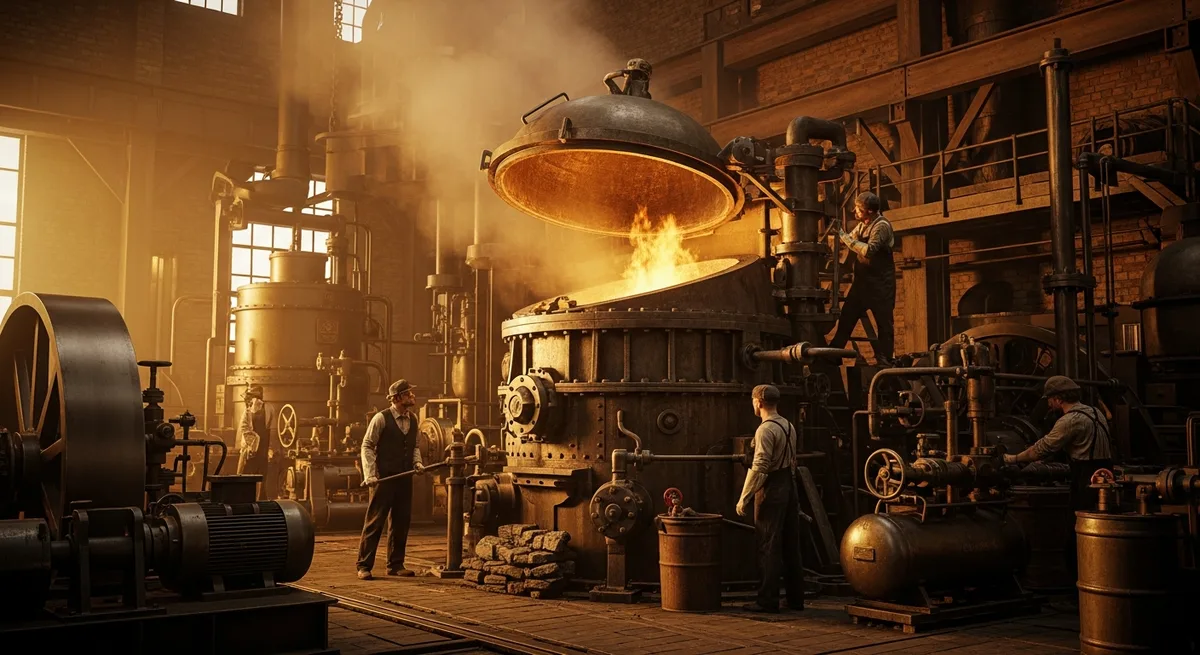
In the industrial crucibles of the nineteenth century, where coal dust settled like a shroud upon every surface, the steelmaking process emerged not as a gentle transition into modernity, but as a brutal, visceral struggle for market hegemony. Henry Bessemer’s converter, rising as a monolithic, five-meter-tall steel vessel, demanded both gargantuan capital investment and a relentless, unbroken cadence of labor. Its architecture, anchored by a rotating axis, granted operators the ability to shift the vessel’s center of gravity in an instant, pouring molten mass into waiting molds. This mechanism was actuated by hydraulic pistons operating at 0.5 MPa, which, through a series of heavy levers, manipulated the multi-ton load to ensure the process never faltered under the crushing weight of its own inertia.
The internal matrix lining the converter’s walls was composed of a dolomite and calcined limestone mixture, a chemical composition engineered specifically to neutralize phosphorus impurities. While this material boasted a compressive strength of 120 MPa, its true utility manifested only at 1600°C, where it functioned as a ceramic bulwark between the inferno and the outer shell. Every centimeter of this lining was subjected to constant chemical erosion, as the carbon-rich liquid metal aggressively sought to strip oxygen from the refractory bricks. Engineers were forced to inspect the integrity of this lining daily, for the slightest fissure threatened a catastrophic breach, where molten metal might erupt through the steel casing.
The air-blast system relied on compressors generating 2.5 bar of pressure, forcing oxygen through copper piping directly into the base of the vessel. This stream, reaching velocities of 85 meters per second, shattered the surface of the liquid pig iron, inducing the turbulence essential for rapid carbon oxidation. The kinetic energy imparted to the metal forced it to boil without the need for additional fuel; the oxidation reaction itself generated sufficient thermal energy to maintain the mass in a fluid state. The process was terrifyingly efficient—in a mere twenty minutes, ten tons of raw pig iron were transmuted into industrial steel, rendering the traditional, week-long puddling method obsolete.
The converter’s roof and removable aperture were designed to withstand the violent pressure fluctuations born of intense gas discharge. As carbon monoxide ignited upon exiting the vessel, a pillar of flame would erupt to heights of several dozen meters, its radiant heat warping metal structures even ten meters away. In this crucible, engineers monitored not only the color of the metal but the character of the sparks, using them to calibrate the precise moment of termination. A delay of even a single second risked ruining the entire alloy, rendering it either too brittle or too ductile—wholly unsuitable for the production of railway tracks.
Following this discovery, the price of steel plummeted more than sixfold, precipitating an economic upheaval within traditional foundries. Nations capable of implementing this technology secured a rapid advantage in infrastructure development, as steel rails could withstand loads five times greater than the cast-iron supports they replaced. Yet, this efficiency was purchased at the cost of human safety; foundry workers risked their lives daily, laboring beside exposed, incandescent converters in an atmosphere so toxic that pulmonary disease became the norm rather than the exception.
The structural frame supporting the converter was required to withstand not only static loads but the dynamic stress inherent in constant tilting. Every steel beam connecting the support columns was calculated with a safety factor of 1.5, yet in practice, the vibrations induced by the air blast gradually compromised the riveted joints. In this era, metallurgy evolved into a discipline grounded in the exact sciences, where empirical observation yielded to thermodynamic calculation; however, even the most rigorous mathematics could not entirely eliminate the specter of structural fatigue.
The atomic lattice forming the converter’s shell was subjected to the relentless cycle of thermal expansion and contraction, an inevitability that birthed microscopic fractures. Each smelting cycle deepened these fissures until the entire vessel reached the end of its operational life. It was a technical dead end that engineers attempted to mitigate through constant repair, yet from an economic perspective, it necessitated that every factory maintain at least one spare vessel while the other underwent maintenance. This logic of production dictated a rigid, unforgiving rhythm, sustained by the steam engines that powered the entire factory infrastructure.
Ultimately, the efficiency of the technology rested not only on chemistry but on logistics—the capacity to feed vast quantities of raw material into the converter’s maw. Each ton of iron ore required a specific ratio of coke to achieve an optimal level of oxidation. Within this balance lay a fundamental engineering constraint: the faster the process, the less control remained over the removal of impurities, particularly sulfur and phosphorus, which persisted in the steel even after intense blowing. The quality of the steel remained tethered to the purity of the ore, rather than the raw power of the converter alone.
The historical paradox remains that the Bessemer converter became a hostage to its own success. The drive to maximize production volumes led engineers to ignore the long-term degradation of their equipment, relying instead on hasty, stopgap repairs. Every ingot of steel cast carried within it an invisible tension, a structural inheritance that would later manifest in the rails or bridges it formed, leading to premature collapse. The final engineering truth is this: the higher the combustion temperature, the faster the refractory lining degrades, creating an inescapable necessity to halt production, regardless of how insatiable the market demand might be.