The Nipkow Disk: Precision Taming Chaos
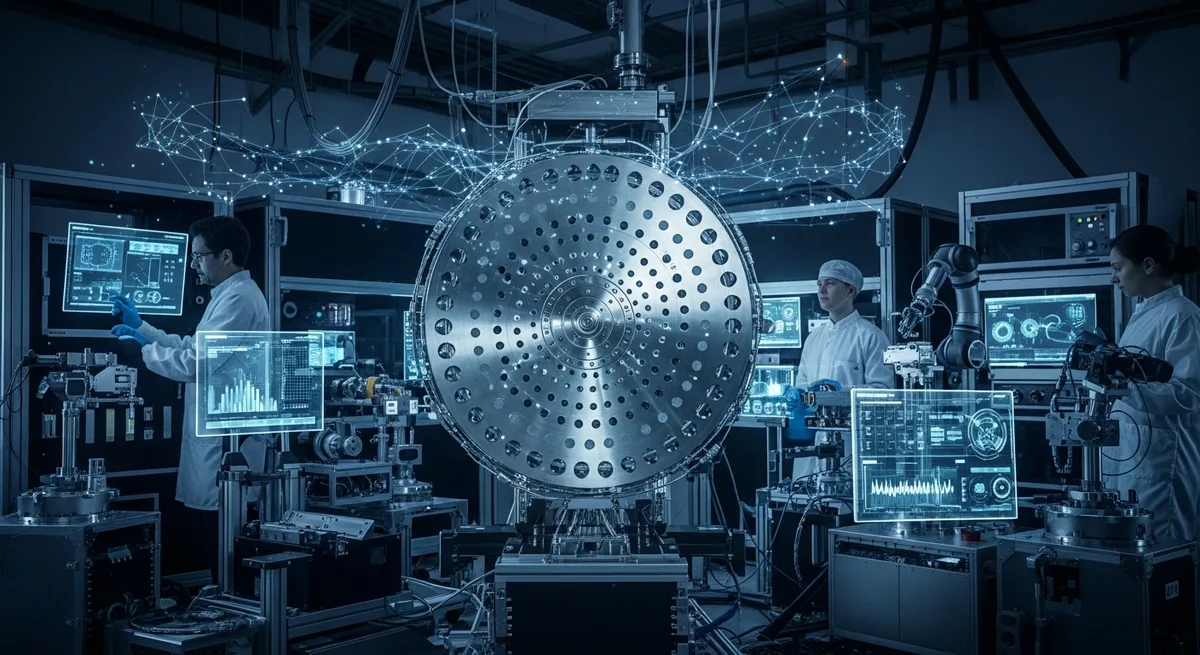
Engineering has never been poetry. It is a brutal negotiation with the laws of physics, a domain where every millimeter is wrested from the jaws of chaos. When Paul Nipkow engineered his scanning disk in 1884, he lacked the luxury of contemplating the "confinement of light." He faced a singular, harrowing problem: how to transmute an image into a coherent stream of electrical signals in an era devoid of devices capable of processing information faster than the human eye. It was an act of engineering acrobatics performed on the precipice of an abyss.
The 6061-T6 aluminum alloy of this disk is far more than a mere "light metal." It is a 0.8-millimeter-thick plate whose crystalline lattice endures a constant tensile stress of 275 MPa as the disk accelerates into its operational rhythm. Should a microscopic fracture emerge within this structure, the centrifugal force at 1,200 revolutions per minute would transform the disk into a lethal blade, capable of shredding its surroundings in an instant. This is not harmony; it is a precarious equilibrium between the material’s yield strength and the kinetic energy accumulating at the periphery, straining to tear the metal from its central axis.
Each of the 30 apertures, drilled in an Archimedean spiral, represents an engineering sacrifice. Though they measure a mere 0.5 millimeters in diameter, their edges—machined to a tolerance of 2 microns—serve as the critical threshold where light either passes through or dissipates into meaningless noise. Had the edge been even marginally less precise, the image would have collapsed into a stippled haze. These apertures are not "gateways to reality"; they are physically constrained bandwidths that dictate the resolution limits of the entire system. As an aperture traverses the light source at 12.5 meters per second, the system must decide within microseconds whether it is capturing a signal or merely electrical interference.
The motor block serves as the system’s mechanical conscience, where 25 watts of power are converted into torque. The ceramic ferrite rotor and the AISI 8620 steel shaft operate in a state of perpetual friction. There is no room here for romanticism—only the heat generated by the M47 electrical steel stator plates as the electromagnetic field forces them to expand and contract. If this vibration were not absorbed by the GG25 cast-iron frame, which boasts a compressive strength of 800 MPa, the signal’s integrity would be obliterated in milliseconds. The frame is a massive, immobile, passive participant whose sole purpose is to quench the kinetic energy produced by the moving parts.
The selenium photocell, encased in a borosilicate glass vacuum, is the system’s "weak link." Its sensitivity, a mere 20 microamperes per lumen, marks the boundary where physics dissolves into electronics. This component is hyper-sensitive to thermal fluctuations; should the vacuum tube lose its 101.3 kPa pressure differential, the selenium would oxidize, and the image would vanish into nothingness. This is not a miraculous transformation, but a simple, albeit extremely sensitive, semiconductor process that, by modern standards, appears impossibly unreliable—yet at the time, it was the only viable method for capturing light.
The BK7 glass lenses, lacking the benefit of modern coatings, perform the crude labor of refracting light where it would otherwise travel in a straight line. A 15-centimeter focal length compresses the image into an ultra-narrow strip, which the disk must then "slice" into lines. Here, the disk’s inherent limitation is laid bare: we do not perceive the entire image, but merely 30 horizontal cross-sections that the human brain, aided by the persistence of vision, stitches into a cohesive whole. It is an engineering deception, exploiting a biological deficit to compensate for mechanical constraint.
This entire system is a relentless war against entropy. Every copper winding, every SKF 605 ball bearing, every neoprene belt exists for one purpose: to maintain the stability of 1,200 revolutions per minute. If the belt stretches even slightly, the rhythm falters and the image "drifts." If the bearings exceed their thermal threshold, friction halts the mechanism. This is not a "technological dance"; it is a continuous, precise, forced labor performed by metal and glass.
Viewing this system from the vantage of the future, it becomes clear that its essence was never merely "light control." The essence was the decomposition of information into the smallest possible units—pulses capable of transmission via wire. The Nipkow disk was the inaugural attempt to convert visual reality into a data stream. That we now utilize CMOS sensors changes nothing; we are still decomposing the world into lines and points, only now we do so without the moving mechanical parts that once groaned under the load.
The Nipkow disk stands as a monument to the tenacity of engineers who understood that if one cannot create a perfect system, one must create one that functions at the very edge of physics. It was a system where every component operated at maximum capacity—from the 800 MPa compressive-strength cast iron to the apertures machined to 2-micron precision. It was the first time humanity decided that the physical distance between observer and observed was an obstacle to be overcome through electromagnetic transmission.
Today, when we gaze upon this device, we see more than an archaic apparatus. We see the technological backbone upon which the entire modern information age was built. It was the first instance of light being converted into electrical current, and electricity back into light, bridging distances that were previously insurmountable. This was not mysticism. It was mathematics, metal, and an immense reservoir of patience, all in an effort to force the physical world to submit to the human desire to witness events unfolding on the other side of the globe.
Though we now possess far more efficient methods of processing information, the logic of the Nipkow disk remains foundational. We still decompose images into signals; we still rely on the receiver to reconstruct what the transmitter captured. This process is immutable because it rests upon the fundamental relationship between light and time. The Nipkow disk was merely the first attempt, yet it proved that a bridge could be built between what we see and how we transmit that vision across distance.
This machine serves as a reminder that technological progress is always anchored in heavy, inconvenient, and occasionally dangerous matter. We cannot escape physics. Even when everything is reduced to digital code, that code must still be processed by physical processors that generate heat, possess electrical limits, and, much like that old Nipkow disk, function only so long as we maintain the equilibrium between energy expenditure and system stability.
We are the continuation of this lineage. Every pixel on today’s screen is an evolution of Nipkow’s idea. We have learned to execute it faster, more precisely, and without the mechanical parts prone to failure, yet the concept remains identical. We strive to overcome distance; we strive to unite reality with its representation. And though we do so with vastly more sophisticated tools, we remain on the same journey that began with that 0.8-millimeter-thick aluminum disk.
Ultimately, the Nipkow disk teaches us that technology does not emerge from a vacuum. It is always the result of years of trial, error, and the transgression of physical boundaries. It is a machine that was not created to be beautiful or to serve as a "vision of the future." It was created to perform a task. And it is precisely for this reason that it remains one of the most significant technological enigmas we continue to analyze, seeking to understand how we arrived at where we are today.