Niobium SQUID Matrix: A Quantum Leap
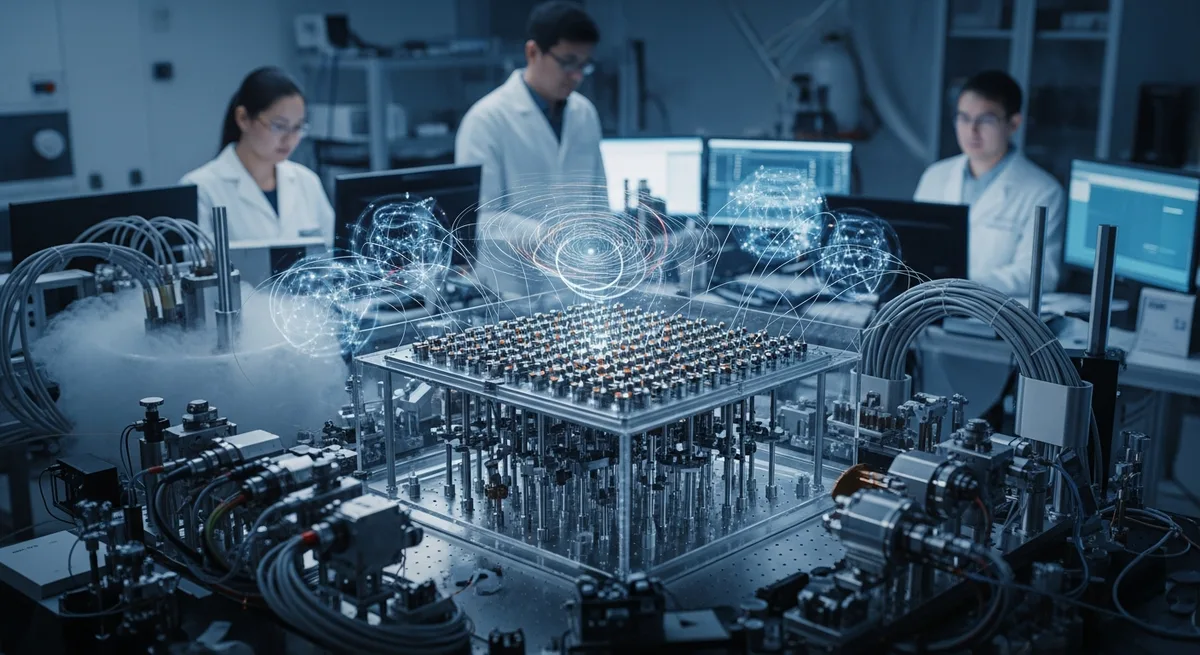
Engineering is not poetry. It is the precise governance of forces, materials, and threshold values. This quantum processor is no metaphysical entity; it is a 10-millimeter-wide crystalline lattice, engineered to resolve computational challenges that classical architectures cannot process due to the binary limitations of bits. We evaluate this device not by its "soul," but by the efficiency with which it isolates qubits from the decoherence triggered by even the most infinitesimal environmental vibration.
The core element of this system—a niobium-alloy SQUID (Superconducting Quantum Interference Device) matrix—is designed to withstand a critical temperature of 9.2 Kelvin. When a current of 10 microamperes is passed through these 100-nanometer-thick conductors, the niobium transitions into a superconducting state. There is no room here for happenstance. The atomic structure of the niobium must be flawless; any 10^-9 meter defect in the crystalline lattice induces a magnetic flux leakage that collapses the qubit’s superposition. A magnetic permeability of 1.00004 ensures the SQUID functions as a precise current sensor, capturing field fluctuations of 10^-4 Tesla. This is a purely technical parameter, ensuring the logical stability of the system.
The structural resilience of the niobium is a direct consequence of how the material reacts to environmental pressure. Although its physical volume is minimal, the thermal contraction during cooling induces internal stresses that could deform the film. Engineers resolved this by employing a film deposition method that allows the niobium to "grow" into the substrate, thereby compensating for forces that would otherwise rupture the circuit. This is not a matter of "lack of air," but the preservation of mechanical integrity amidst the extreme thermal gradients between ambient room conditions and the 4 Kelvin operating environment.
Thermal management is executed via aluminum-alloy gates, whose thermal conductivity of 237 W/mK is a critical factor in the system’s longevity. Each quantum operation generates a fluctuation of 10^-18 Joules. If this energy were not immediately dissipated, it would instantaneously elevate the local temperature above the critical threshold, rendering the entire processor an inert resistive element. The aluminum gates act as thermal shunts. Their 10-micrometer width is optimized to ensure electron tunneling occurs with minimal "noise," maintaining a 10-nanometer-thick barrier that prevents thermal energy from propagating to adjacent qubits.
The silicon substrate upon which all components are mounted serves as a passive support. Its 1-millimeter thickness is selected to ensure maximum rigidity. Under a thermal stress load of 10^6 Pascals, the material must maintain its geometry with micron-level precision. Silicon is utilized here for its low coefficient of thermal expansion, which prevents the substrate from warping when cooled to cryogenic temperatures. This is no "silent observer"; it is a structural foundation that must ensure the lithographically etched traces do not suffer mechanical deformation capable of severing electrical connections.
The tungsten-alloy heat exchanger is a technical solution designed to extract heat from the system’s core. Its melting point of 3695 Kelvin guarantees structural stability even in the event of an unforeseen energy surge within the surrounding system. Utilizing the circulation of 10 liters of liquid helium, the heat exchanger maintains the 4 Kelvin environment essential for superconductivity. This process is entirely utilitarian: heat is transferred from the silicon substrate to the coolant via conduction. There is no mysticism here—only the laws of thermodynamics, applied to ensure the operational lifespan of the quantum computer.
In future industrial manufacturing, these systems will become standardized modules. There will be no talk of "symbiosis"; the discourse will center on cycle time, error-correction rates, and operations per second. The quantum processor will become a tool that assumes the complex molecular modeling we currently perform via inefficient methods. We are witnessing the maturation of this technology, where every component—from the niobium SQUID to the tungsten heat exchanger—is optimized to achieve the highest possible performance.
We are moving toward an architecture where data processing is no longer constrained by the limitations of physical space, as quantum logic allows for the exploitation of the superposition principle for more efficient computation. This is a technical stage of evolution. When 1000 SQUID devices operate synchronously within a 10^-4 Tesla field, it is the result of rigorous engineering control. It is a testament to system reliability. We are building tools that operate with greater precision, speed, and reliability than anything we have created thus far, and every component of this system is designed to serve this singular purpose.