Nanostructured Crucible: Where Heat and Stress Collide
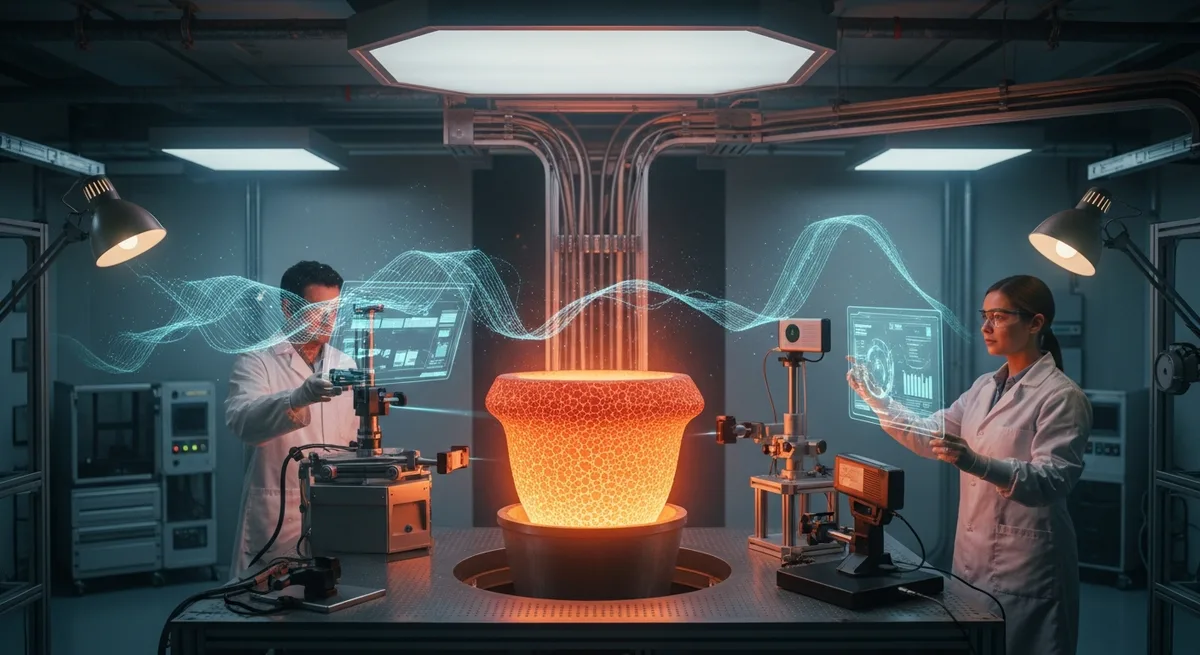
The frontier of modern engineering no longer resides in blueprints or spreadsheets; it lies within the fatigue limits of materials—thresholds we are compelled to breach. When we speak of 1,000 MPa of mechanical stress within piston components, we are no longer merely designing an engine; we are preparing a material for a perpetual, cyclical trial of destruction. Each cycle, as the piston endures this pressure, is a microscopic skirmish against the dislocation of atomic lattices. Should we fail to govern this stress, the material’s structure will simply collapse, surrendering into amorphous dust. This is engineering precision that demands an intimate understanding of how alloyed titanium reacts to billions of repeating deformation waves—waves that act like invisible saws, slowly dismantling the crystalline architecture.
Thermal dynamics here function not as an abstract process, but as a rigorous management of electron transport. When the Seebeck coefficient reaches 500 μV/K, we face the physical necessity of directing heat flow so that it does not devolve into a source of entropy. This is the orchestration of temperature gradients across nanostructured layers, where every single Kelvin is accounted for. If the 500 W/mK thermal conductivity is not precisely calibrated, localized overheating triggers material expansion, which, constrained by rigid junctions, creates internal stress concentrations. These centers become the primary fracture points that, in time, annihilate the component’s integrity.
Electrochemical energy storage, characterized by a density of 19.3 g/cm³, presents an entirely different order of challenge. Within the tungsten matrix, graphite lattices function as a network of ion highways, where a reaction rate of 10⁻¹ s⁻¹ demands absolute conductivity. Here, we battle diffusion barriers. When a power density of 1,000 W/kg attempts to surge through the interface of electrolyte and electrode, any microscopic irregularity triggers spikes in current density. These spikes destabilize chemical equilibrium, forcing us to ensure that ion flow remains uniform throughout the entire volume, thereby avoiding the localized concentrations that invite the growth of dendrites.
Piezoelectric sensors integrated into the system perform not passive monitoring, but active structural diagnostics. Utilizing a 1,000 pC/N coefficient, we record the material’s response to every 100–1000 MPa fluctuation. This is not merely a signal; it is a data array through which algorithms modulate the system’s operating mode to avoid resonant frequencies that could induce catastrophic material fatigue. We exist in a state of constant equilibrium between maximum power extraction and structural longevity, for every micro-crack born of improper load management is a terminal point for the system.
Increasing system efficiency to 50% is a mathematical task where every lost Joule represents an engineering failure. We optimize electron flow through copper and aluminum busbars, observing how current density dictates material temperature. It is a cyclical process: cooling allows for increased current density, while increased density demands even more efficient heat dissipation. We are not seeking harmony; we are seeking a physical optimum where material degradation is minimized and energy conversion efficiency is maximized.
The architecture of the future relies on modular interchangeability, for no material is eternal. Understanding the degradation of 1,000 Wh/kg storage units, we design systems that recognize the wear of their own components. When piezoelectric elements detect a shift in structural rigidity, the system automatically redistributes the load to healthy modules. This is an engineering response to the inescapable law of thermodynamics: everything wears down. We do not fight against time; we program the system’s response to its effects.
This process is a technocratic pursuit of precision. Each layer of carbon fiber is oriented to withstand specific vectors arising from peak mechanical loads. We reject randomness. Every nanometric detail is designed with a clear computational basis that leaves no room for interpretation. This is engineering rooted in hard fact, where physical parameters—pressure, thermal conductivity, charge density—become the sole criteria determining the system’s success or failure.
We observe how materials behave under extreme conditions and translate the results of this surveillance into adaptive algorithms. If the system detects that a 1,000 MPa load is inducing unwanted vibration, it immediately adjusts its response time. This is open-loop control, where the machine corrects its own physical parameters in real-time. This allows us to achieve reliability metrics that were previously impossible due to the fatigue limits of materials.
We no longer build machines that simply function. We build systems that understand their own physical limits and actively manage them. When a 1,000 Wh/kg storage unit powers the grid, the system performs constant internal diagnostics, comparing real-time parameters against modeled ideal indicators. Any deviation triggers a corrective action. This is engineering rationality, where there is no room for philosophy—only for rigorous, atomically optimized functionality.
Ultimately, our goal is to create an infrastructure resilient to its own operation. This requires a profound understanding of material fatigue, heat dissipation, and ion kinetics. We are building a technological foundation that is independent of external maintenance because it diagnoses and corrects itself. This is the pinnacle of engineering precision, where every component, every conductor, and every sensor serves a single purpose: the maximum exploitation of physical laws without systemic collapse.
On this path, we have realized that efficiency is directly proportional to our ability to govern microscopic processes. When a 1,000 MPa load is mastered and 500 W/mK thermal conductivity is utilized with intent, we obtain a system that not only functions but remains stable. This is engineering without compromise. It is a rational, calculation-driven path we walk, creating technologies that transcend current physical limitations not through miracles, but through the precise management of matter.