Microscopic Breath of Metal
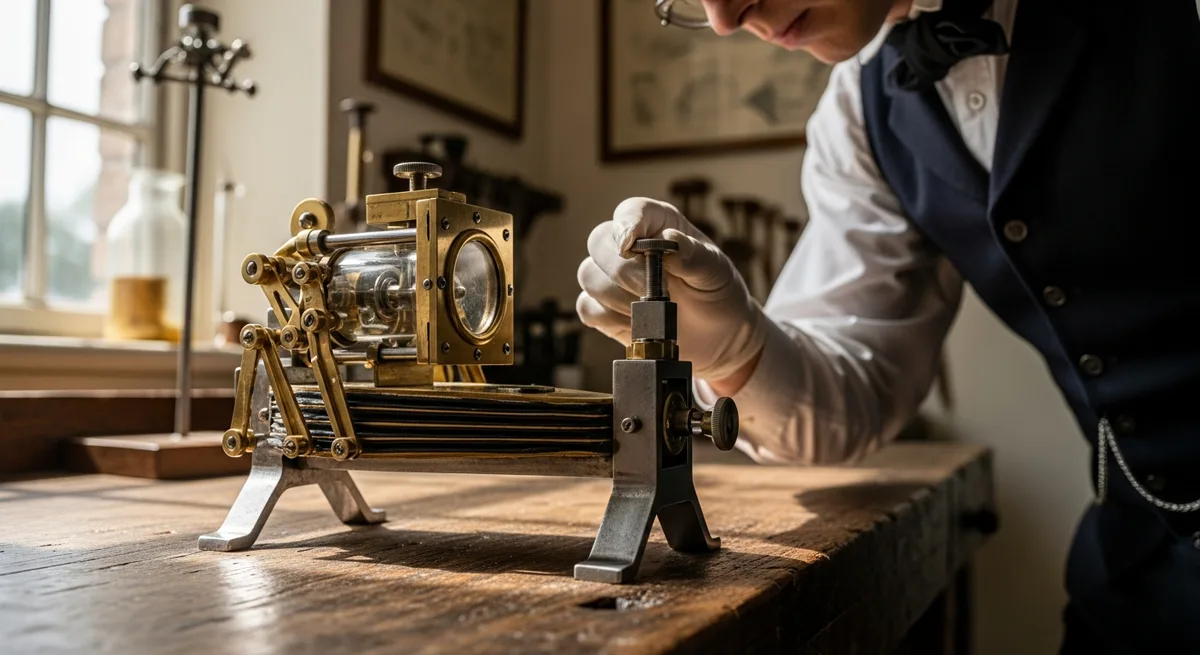
The year 1894 at the Parsons laboratory was devoid of romanticism; it was steeped in the martyrdom of metallurgy. We watched as a 1.37-meter diameter cast-iron housing, forged from an Fe-3.5C-2.5Si alloy, responded not to the majesty of steam, but to the inexorable creep of molecular fatigue. Each time a pressure of 10 bar surged within, the 170 MPa of compressive force acted not upon a monolithic mass, but upon billions of discrete crystalline lattices struggling to maintain their geometric integrity. We measured deformations in microns, observing how the metallic structure, subjected to 300 degrees Celsius, underwent a constant, near-imperceptible "respiration"—a thermal expansion that, over thousands of cycles, birthed micro-fissures invisible to the naked eye, yet terminal to the machine’s operational lifespan.
The stability of the cast-iron casing relied not on its sheer mass, but on a precise equilibrium of cooling. Engineers understood that the 2.13-meter cylinder endured a volatile thermal gradient: the inner wall, in direct contact with the steam, expanded more rapidly than the outer, generating internal stresses that threatened to breach critical thresholds. We were not poets; we were observers documenting the "aging" of metal under the duress of constant thermal cycling. Each heating phase was a slow, structural dismantling, which we sought to arrest through precisely calculated wall thicknesses, ensuring thermal energy dissipated uniformly to prevent local stresses from exceeding the material’s yield point.
The rotor, fashioned from a malleable iron alloy, was an engineering nightmare dictated by centrifugal dynamics. The 0.5-meter diameter shaft, spinning at 3,600 revolutions per minute, functioned as a complex oscillatory system where the 1,500 Nm of torque was not merely a metric of power, but a force actively distorting the iron’s molecular lattice. We watched as the 250 MPa tensile strength became the razor’s edge between functionality and catastrophic shaft deflection. Each rotation generated harmonic oscillations that, if left uncalibrated, could resonate with the machine’s very architecture, inducing vibrations capable of pulverizing a precision bearing into metallic dust within minutes.
The bearings were the system’s weakest link, the point where the harsh reality of tribology collided with theoretical physics. The brass alloy, selected for its 20 percent ductility, was forced to withstand immense specific pressure while maintaining a 0.1 coefficient of friction, even as the lubricating film thinned to a perilous degree. We observed cavitation phenomena where the steam flow, surging through the gaps between blades, created localized low-pressure zones that "gnawed" at the metal. This was no lyrical or spiritual experience; it was erosion, which we analyzed under magnifying lenses, tallying the lost milligrams of material that would eventually compromise the turbine’s balance.
One hundred blades, arranged at 0.1-meter intervals, operated within a 200 m/s steam flow, where every surface was subjected to relentless molecular bombardment. The 0.2-meter blades endured not only thermal stress but also the aerodynamic vibration engineers termed "flutter." We measured how steam at 300 degrees Celsius, possessing an enthalpy of 3,000 kJ/kg, acted upon the metal surface, inducing oxidation and erosion that fundamentally altered the blade profile. It was a perpetual struggle for aerodynamic efficiency, which we attempted to sustain by iterating alloy compositions, seeking that singular balance between hardness and elasticity.
The converging nozzle was the locus where thermodynamics became tangible. The 0.1-meter diameter aperture had to govern steam expansion with such precision that an 80 percent isentropic efficiency was not merely a theoretical abstraction. We measured the pressure drop from 10 bar to 0.1 bar with cold-blooded accuracy, cognizant that every vortex of turbulence represented a loss of energy. This was engineering optimization performed not for aesthetic grace, but out of the necessity to achieve a power density of 10 kW/kg—a figure that, at the time, seemed to brush against the absolute limits of physical possibility.
The condensation process was the final challenge of the system, which we evaluated through the prism of heat exchanger efficiency. As the steam cooled to 50 degrees, we observed how the condensate, governed by surface tension, accumulated on surfaces and impeded heat exchange. It was a problem of fluid dynamics: how to evacuate the water before it became an additional drag on the rotor. Every stage of this cycle was meticulously tuned, for we knew that a system is only as robust as its most vulnerable component, and every deviation from the ideal curve signified a loss in coal tonnage and a degradation of operational output.
We never viewed these machines as living creatures. They were complex, temperamental tools demanding constant surveillance and calibration. Each fluctuation in the manometer readings was a signal of the shifting state of the metal or the degradation of the lubrication system. We spent nights on the shop floor not out of sentiment, but to prevent the overheating of bearings that would have cost weeks of repairs. It was grueling, technical labor, performed with the characteristic suspicion of pioneers toward their own discoveries.
Today, looking at the Parsons turbine, we do not see a monument to history. We see an engineering solution that relied on limited metallurgical resources and nascent thermodynamics. It was an attempt to master entropy using combinations of cast iron, steel, and brass. We knew that these materials would wear, that vibrations would eventually weaken the joints, and that this turbine was not eternal. It was merely a stage, which we completed with the highest possible precision, leaving behind not secrets, but data on how metal behaves under extreme conditions.
We learned that industrial power is not a given; it is a constant struggle against material fatigue. Every bolt we tightened was calculated to withstand a specific number of cycles before losing its properties. We were not composing a symphony; we were constructing a mechanical process that, if maintained without error, operated at 80 percent efficiency. This was our achievement—not mystical, but technical, grounded in cold calculation and the acknowledgment of the laws of physics.
When we recall that period now, what remains in our memory is not the roar, but the sound of tools measuring the clearances between the blades and the casing walls. We remember the scent of lubricant, which was an inextricable part of our work environment, and the constant anxiety regarding bearing temperatures. This was engineering in its purest form—without embellishment, without metaphor, only the reality in which metal constantly resists our attempts to force it to work beyond its natural limits.
We left this turbine as a testament to what it meant to work in 1894, when every millimeter mattered. It was not our "child"; it was our laboratory result, which we optimized to the final possible limit. We understood that technology evolves through the correction of errors and the refinement of materials, not through sudden breakthroughs. This was our contribution to industrial evolution—open, technically grounded, and always oriented toward practical application, devoid of any unnecessary romantic illusions.
The turbine remains an example of how to govern steam expansion using simple, yet precisely integrated components. We knew that future engineers would utilize superior alloys and more precise methods, but we were the ones who charted the course. It was our work, our technical discipline, and our way of understanding the world through mechanical laws which, though merciless, were always predictable, provided one possessed the patience to measure them.