Metronome of Metamorphosis: The Loom of Joseph Marie Jacquard
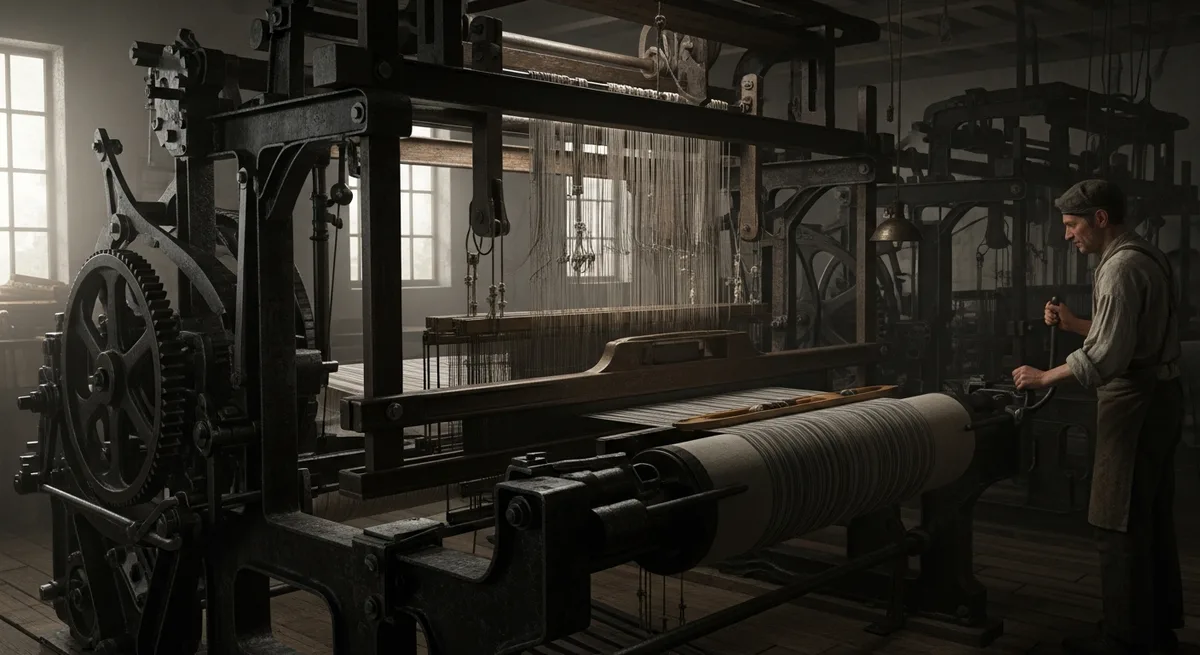
The winter of 1801 in the suburbs of Lyon smelled not merely of damp air, but of an inevitable atmospheric shift, a scent of transition seeping through the uneven masonry of the workshops. At the center of the room stood Joseph Marie Jacquard’s creation—a silent, indifferent observer whose 1,200-kilogram mass of cast iron pressed mercilessly into the wooden floorboards. To the local weavers, who had spent decades guiding looms by hand, this was no instrument of liberation; it was a looming threat, embodied in a frame boasting a compressive strength of 140–170 MPa. This metal was not forged for human comfort; it was engineered to withstand the tectonic loads generated by human will, now transmuted into mechanical coercion.
The warp beam served as the axis upon which not only the fabric turned, but the very fate of the local community. Its 30-centimeter-diameter body, a fusion of cast iron and steel, acted as a ruthless autocrat, maintaining a tension of 100–150 Newtons that forbade a single thread from yielding to freedom. As the weaver turned the crank, he felt more than just the resistance of the metal; he felt the beam absorbing the kinetic energy of his own life, distilling it into a monotonous, hollow drone. The metal would climb to searing temperatures, the friction between the shaft and the bearings evoking the image of a slow, heavy, panting beast—a creature that required constant suppression with thick, pungent lubricants to prevent its raw force from tearing the machine asunder.
The beam was no mere component; it was the machine’s spine, holding the entire weaving process within a rigid, almost sadistic framework. Every warp thread wound upon it was like a tightened bolt, forced to submit to a geometric order dictated not by the human eye, but by the cold, unyielding precision of metal. In this process, the weaver shed his individuality as an artisan, becoming merely another lever exploited by the machine to achieve its ends, while the beam, radiating heat, silently tallied every hour of human freedom surrendered to the cycle.
At the heart of the machine pulsed steel heddles—needles 1.8 meters in length and 1.5 millimeters in diameter, their 0.5% carbon and 1.5% manganese alloy composition suggesting not tools, but cold, indifferent executioners. Each vertical oscillation, driven by 10–20 Newtons of force, functioned like a surgical incision, partitioning the threads into the mandatory positions dictated by the punch cards. Their physical resilience was almost terrifying; they never bent, never fatigued, and never felt a flicker of pity for the fabric they were simultaneously creating and constraining.
In the heat of operation, the surface of the heddles would reach such temperatures that the air around them began to shimmer, while the sound—a sharp, dry, staccato snapping—resembled thousands of minute, unending impacts. This heat bore witness to the immense friction endured by the thin steel filaments every second, transforming the abstract logic of the cards into a physical, impassable barrier. The heddles were the machine’s fingers, which, rather than sensing the softness of the textile, merely interpreted perforations, transmuting human creativity into a mechanically replicated, frigid pattern.
The shuttle, piercing the warp at an acceleration of 2–3 m/s², was the embodiment of velocity and destruction. Its wooden core, with a density of 0.5–0.6 g/cm³ and armored in 0.2% carbon and 1.2% chromium steel, struck like a bullet trapped between two walls of cast iron. When it slammed into the frame, the 5–10 Newton impact sent a vibration through the metal and wood that traveled through the floor and into the weaver’s very marrow. After hours of labor, the shuttle would grow so hot that a touch to its metallic surface left burns, a visceral reminder that this machine was not working with the human, but against him.
The shuttle was the voice of the machine, carrying the weft and binding the threads into a cohesive, yet entirely alien structure. It possessed no empathy for the fabric—it merely executed instructions, flying through the warp with such ferocity that every "utterance" sounded like a warning. This mechanical symphony, governed by a system of gears, was designed so that the 50–70 Newton-meters of torque transmitted by the weaver’s hand was exploited to the last drop, leaving no room for error or respite.
The gears, forged from that same 0.5% carbon and 1.5% manganese steel, acted as the machine’s brain, where gear ratios of 2:1, 3:1, and 4:1 ensured that no human effort was squandered. At their points of contact, the metal ground incessantly, emitting a dull, rhythmic groan—the sonic backdrop to the nightmares of the weavers of Lyon. The gears were a will that never erred and never doubted, for their existence was predicated on mathematics, and their purpose was to reduce human hands to a mere mechanical appendage of this cast-iron monster.
Viewing this system, it becomes evident that the Jacquard loom of 1801 was not merely an engineering triumph, but a social rupture that fundamentally altered the nature of labor. A speed of 100–150 cycles per minute meant the weaver was no longer the master of his craft, but a spectator forced to align himself with the dictates of metal. The cast-iron frame provided stability, the beam provided tension, the heddles provided order, the shuttle provided speed, and the gears provided logic—but together, they formed a system that displaced the human from his own trade.
The punch-card system was a stroke of genius, yet it was also the first step toward what we now call the dictatorship of automation. As the weaver turned the crank, he felt an intimate connection to the machine, yet it was the bond of a slave to a master, where the human provided the energy and the machine provided a precision the human could never attain. This was technology that possessed weight, temperature, and sound, and it demanded unconditional obedience from anyone who dared to touch it.
Today, these looms stand in museums, shrouded in an aura of tranquility and reverence, yet their past was saturated with sweat, burns, and the constant, hollow thrum of metal. They testify to the strength of cast iron and the resilience of steel, but they also serve as a memento of the time when man first sensed that his own hands could be supplanted by a metal construction. Looking at them, one can feel that ancient energy—not digital, but heavy, ominous, and relentless, expressed through the 140–170 MPa strength of the cast-iron frame.
Though we now utilize computers performing billions of operations, the Jacquard loom remains a fundamental reminder of how our dependency on mechanical logic began. We have replaced metal with silicon and steam with electricity, but the essence—the desire to create complex patterns from simple instructions—remains unchanged, only now it has become more invisible and more potent. Remember that 1,200-kilogram monster, that heat, and that metallic groan the next time you watch your device perform a task you can no longer comprehend.
The Jacquard loom was not just an invention; it was a way of perceiving the world, demonstrating that mechanics could become a dominant force if crafted with sufficient precision. It was a time when we first dared to imagine that the objects we created could not only facilitate work but dictate its trajectory. We remain on that same journey today, seeking ways to fuse force and logic, yet now we ourselves have become parts of the very looms we have built.
Though those looms are silent now, their soul remains alive in every algorithm and every automated process weaving our modern world. We still create complex patterns from simple threads, only now those threads are data, and the looms are the networks we have constructed. These were looms that did not merely weave fabric; they wove the future, acting as a bridge between the crafts of the past and a cold, digital future, proving that the human mind can create something that transcends its own limitations—but the price of such transcendence is our freedom.
Therefore, when we contemplate the Jacquard loom, we contemplate the human spirit, which never ceases to search, to create, and to marvel at the monsters of its own making. This is our history, inscribed in cast-iron frames and steel gears, forever remaining as a testament to what we achieved when our hands and our minds ceased to work in concert with nature and began to work with metal—a metal that never stops breathing with its hot, rhythmic force.