Metamaterial Genesis: The Birth of Artificial Neural Tissue
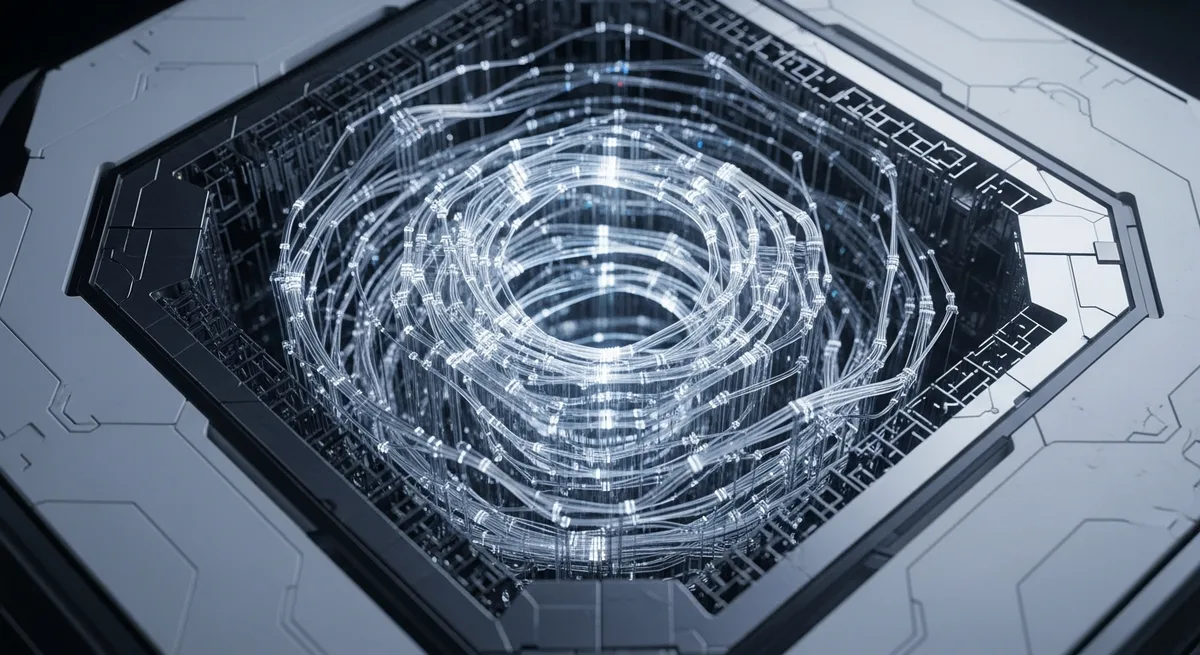
Morning in the laboratory does not begin with the flick of a switch, but with the faint, almost ephemeral respiration of metal, as the AlNiCr alloy substrate awakens to the first influx of photons. This alloy—seventy percent aluminum, twenty percent nickel, and ten percent chromium—functions here not as a static mass, but as a pulsating, living organism, its 4.5 g/cm³ density concealing a 200 GPa Young’s modulus. This 10 cm x 10 cm x 5 cm block is no mere slab of metal; it is an artificial neural tissue where 10,000 discrete units confront 800 MPa of stress, yet remain unnervingly immobile. As the tension reaches a critical threshold, the metallic structure appears to lock itself into a ruthless, perfect equilibrium, where every atomic bond withstands the pressure without the slightest tremor.
Within each 100 μm x 100 μm x 50 μm volumetric element, a deformation of physics occurs that challenges the very foundations of classical optics. Here, 50 μm-thick crystalline layers induce a negative refractive index at a 500 nm wavelength, compelling light to behave as if trapped within a labyrinth where directionality loses its conventional meaning. Photons, rather than simply permeating the medium, are forced to pivot toward trajectories where standard optical behavior would predict their annihilation. This molecular framework becomes a prison of light, where every pulse is programmed and steered with a near-religious precision, rendering all prior optical laws obsolete.
The 10 μm-wide, 5 μm-thick light filaments act as translucent arteries, through which information flows with a loss probability of just 0.1 dB/cm. Observing this movement through a virtual prism, one senses that the 1.5 refractive index creates a unique hydrodynamics, where photons evade chaos even as the intensity of electromagnetic radiation reaches 100 kW/m². This flux is not free—it is strictly regulated, akin to the circulation of a system that cannot permit a single collision of pulses, lest it trigger an unpredictable thermal eruption.
Embedded between these light highways, mirrors perform a selective function, reflecting 99.9% of the 500 nm wavelength with a force reminiscent of tectonic plates colliding deep within the planetary crust. Each moment of reflection induces a microscopic vibration, absorbed by a 100 μm-thick layer of titanium dioxide possessing a hardness of 10 GPa. This protective barrier is the sole mechanism preventing the system from disintegrating under the internal resonance caused by the abrupt redirection of light streams.
The titanium dioxide coating, sheathing the internal matrix, serves as a resilient armor, insulating sensitive nodes from environmental interference. As temperatures fluctuate across a 100°C range, this membrane remains stable, maintaining a 0.1 coefficient of friction that prevents metal fatigue from compromising optical precision. It is a fabric of material that, under 100 MPa of mechanical stress, does not deform but rather tightens, shielding its delicate geometry from the microscopic fractures that could sever the data transmission circuit.
Interfaces between modules are clad in a 10 μm-thick layer of silicon dioxide, acting as a shock absorber that dissipates thermal expansion with an accuracy of 0.5 ppm/°C. This layer, boasting a 1 GPa compressive strength, prevents the material fabric from warping even during extreme thermal spikes. Thus, the system preserves its structural integrity, ensuring that not even the smallest component shifts position when environmental conditions turn hostile.
Genetic algorithms, employed to optimize the circuitry, transform every line in the lattice into a mathematically derived truth where chance has no purchase. Each path is engineered so that optical loss approaches zero, and the material’s throughput is maximized for signal transmission. This is not merely a wiring of connections; it is an organic architecture where geometric form aligns with physical reality to forge the perfect conduit for information propagation.
Digital information within this device is born from the interaction of photons with the metamaterial matrix, where phase shift becomes the basis of computation. A 1 GHz clock frequency, governed by field-programmable gate arrays, allows the system to process data in real-time while consuming a mere 1 W of power. This efficiency reveals the beauty of optical-electrical symbiosis, where the dissipated heat is not merely waste, but a vital diagnostic indicator of the system’s health, warning of impending thermal runaway.
The biomimetic nature of the device, derived from the mechanics of the human eye, allows it to focus light with incredible sensitivity, adjusting its properties in response to external stimuli. It is akin to synthetic vision, where inorganic matter learns to focus photons as nature has done for millions of years, transposing this focusing mechanism into a dead yet programmable structure that becomes an observer of its own environment.
Evolution in this field is trending toward the depths of nanotechnology, where signal latency becomes an almost imperceptible quantity, bringing engineering to the threshold where optical devices will become as ubiquitous as silicon transistors were in the twentieth century. Future computing systems will rely on this architecture, where information travels at the speed of light through a solid yet dynamically controlled medium, fundamentally altering our understanding of physical data transmission.
The error rate, measured at 10^-9 bits, reveals the precision with which the system manages internal noise, as any deviation from the 500 nm signal phase triggers a cascading chain of errors. Consequently, the system’s algorithms must continuously perform self-regulation, adjusting signal paths via FPGA controllers to maintain data integrity, even when the environment attempts to inject chaos into this perfectly tuned structure.
The ultimate engineering paradox lies in the fact that increasing component density irreversibly complicates the management of thermal micro-deformations arising from intense electromagnetic radiation. Although the titanium dioxide coating and silicon dioxide layers provide necessary protection, they increase the system’s mass and complexity, creating a technical bottleneck. A fundamental question arises: is it possible to further increase component integration without compromising the material’s structural fabric, when every additional nanometer becomes a new threat of thermal expansion that no existing shock absorber can compensate?