iant Disc: Birth of the Modern Gyroscope.
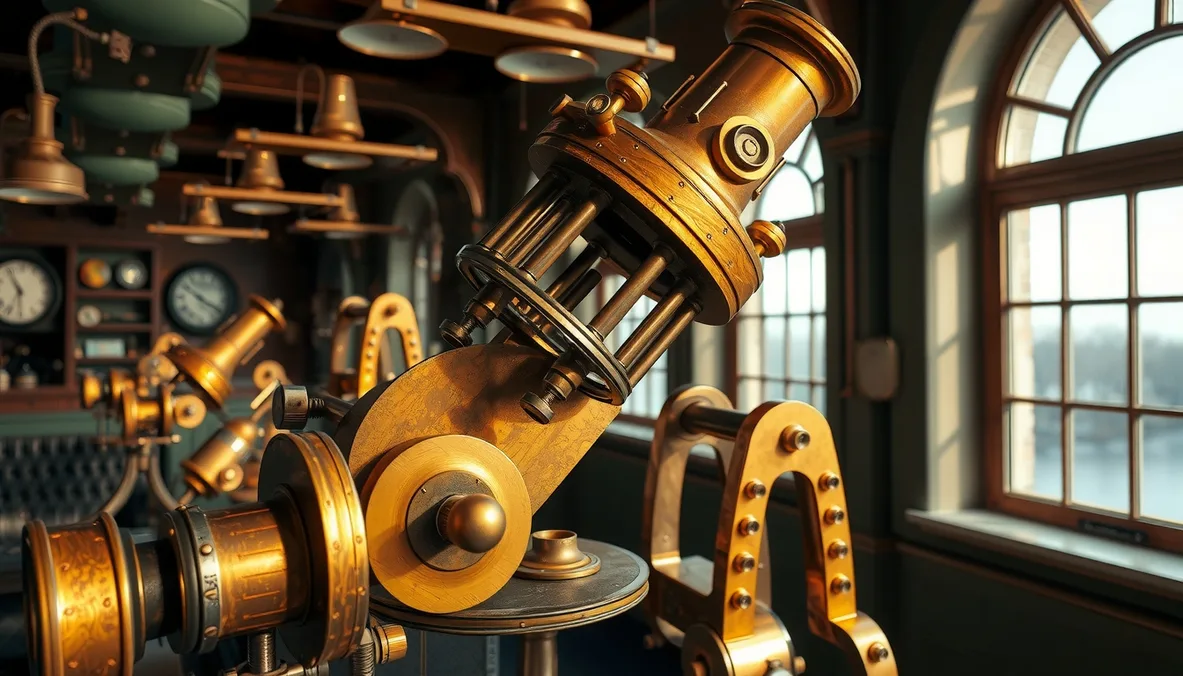
Brooklyn, 1910, was more than a mere date on a calendar; it was an epoch where industrial cacophony became the world’s new vernacular. In Elmer Sperry’s workshop, the air hung heavy with coal smoke and scorched oil, so dense it seemed the very walls were sweating under the tension. There, amidst the gargantuan, shuddering lathes, it stood: the gyroscope. It was not merely a device. It was an engineer’s attempt to imprison the very fabric of space and time within a metallic cage, to compel a chaotic universe to submit to the rigid lines drawn by human hands.
The rotor, that tungsten-alloy disc, appeared in the workshop like a foreign body fallen from a more perfect dimension. Its mass—one kilogram and eight hundred grams—was concentrated persistence. When the ten-watt motor breathed life into it, the disc began its ritual, accelerating to a velocity of twelve thousand revolutions per minute. This was not simple rotation. It was a physical resistance to any attempt to alter its trajectory, an anchor cast into the invisible, all-permeating ether that only Sperry and his cohorts dared to measure.
The heat radiating from this spinning body was almost tactile. It was not merely a byproduct of friction; it was a concentration of energy that the engineers could feel even through thick leather gloves. Every minute spent beside the operating device was a battle against entropy. The rotor radiated warmth, a testament to an internal reaction where kinetic energy transmuted into a guarantee of stability. It was like a tiny, enclosed sun whose rays did not warm the room, but rather held ships on a true course through storm-tossed oceans.
Sperry gazed at this spinning disc and saw not metal, but a soul. It was his answer to the sailor’s dread, to that eternal uncertainty that had plagued travelers since antiquity. The rotor was a stubborn, immutable center around which all navigational logic revolved. While the elements raged outside, it remained calm with a fanaticism bordering on madness. It was a point of truth in the midst of chaos, a reminder that even in the greatest vortex of a storm, immutable laws exist, provided one has the courage to master them.
The bearings, those small, almost imperceptible symbols of engineering triumph, were forged from AISI 52100 alloy. Their surfaces, polished to a roughness of 0.2 micrometers, appeared as mirrors reflecting not only the workshop lights but the very pursuit of perfection. A gap of a mere 0.01 millimeters between the bearing and the shaft was the razor-thin margin separating smooth operation from catastrophic metal-on-metal contact. SAE 30 oil, pumped into this gap at a slow rate of 0.1 milliliters per minute, created an invisible, slick barrier protecting the metal from itself.
Their wear resistance was staggering. Reaching a hardness of 60–65 HRc on the Rockwell scale, these bearings withstood pressures comparable to the shifting of tectonic plates on a microscopic scale. As the rotor spun, the bearings emitted a high-frequency hum—the singing of metal regarding perfect alignment. It acted as the mediator between the static frame and the dynamic rotor, absorbing the entire load and converting it into smooth, almost ethereal motion.
The frame, constructed from AISI 4130 steel, became the backbone of the entire structure. Its yield strength of 435 MPa and ultimate tensile strength of 560 MPa were engineered to withstand forces that would have warped lesser metals into a shapeless mass. Its mass of 3.6 kilograms provided the gyroscope with the necessary ballast, becoming the firm foundation upon which all navigational logic rested. Each time Sperry adjusted the leveling feet, it was a ritual—a search for perfect horizontality in a world that constantly sought to tilt.
This frame was not merely a housing. It was a protective shield, guarding the rotor’s precision from external vibrations. When a ship slammed into a wave, the frame absorbed the kinetic energy, preventing it from reaching the rotor’s core. It resembled ancient fortifications, built not of stone but of modern, resilient steel, capable of enduring nature’s blows without a single creak or moment of weakness.
The motor and gears breathed life into this hunk of metal. When the ten-watt electric motor transmitted 0.1 Newton-meters of torque through a 10:1 gear ratio, the entire device seemed to tremble with internal fervor. The sound of the gears—a rhythmic, metallic ticking—became a heartbeat, signaling the system’s initiation. It was the moment when dead metal became an instrument of navigation.
The resilience of the gears was critical. Crafted from the same AISI 4130 steel, they had to withstand the instantaneous load spike during startup. Each tooth was an engineering masterpiece, designed to transmit force without loss. When the motor engaged, the gears meshed with such intensity that it seemed the device was attempting to break free from its frame, yet it remained faithful to its purpose.
The mechanism was more than the sum of its parts. It was an attempt to master the laws of nature. Precession—that strange, slow oscillation of the rotor around its axis under the influence of an external torque—became proof that the engineers had deciphered the language of the universe. It was not an error; it was the device’s reaction to the world’s motion, its way of affirming its presence and its perception of the horizon. Sperry watched this movement and knew: he had finally found a way to command not just ships, but destiny itself.
Measurement became the final step in this chain of logic. Capacitive and inductive sensors recorded every angular displacement. These were the eyes watching the invisible "will" of the rotor. This data, transmitted to navigation systems, allowed humans to traverse oceans with a precision previously impossible. Sperry’s invention became a bridge between human limitation and the infinity of physics, opening paths where once only blind chance reigned.
Looking at that 1910 engineering marvel, we see not only metal and oil, but the ambition to master chaos. We see engineers who, with their own hands, using only slide rules and blueprints, created a device capable of maintaining orientation despite the storms. It was an era when mechanics became poetry, and every bolt had its place in the grand design of progress. Sperry did not merely construct a tool; he constructed the hope that we might be the masters of our own path.
The gyroscope will remain a monument to the persistence of the human mind. It reminds us that even when the world around us drowns in uncertainty, we can create something that remains unshakable. It was not merely a technical achievement, but a philosophical statement, embodied in tungsten alloy and steel frames, declaring that even in the most complex systems, one can find harmony, provided one has the courage to design it and the strength to sustain it.