The Breakthrough Furnace: The Tale of the 42nd Boulton & Watt Engine
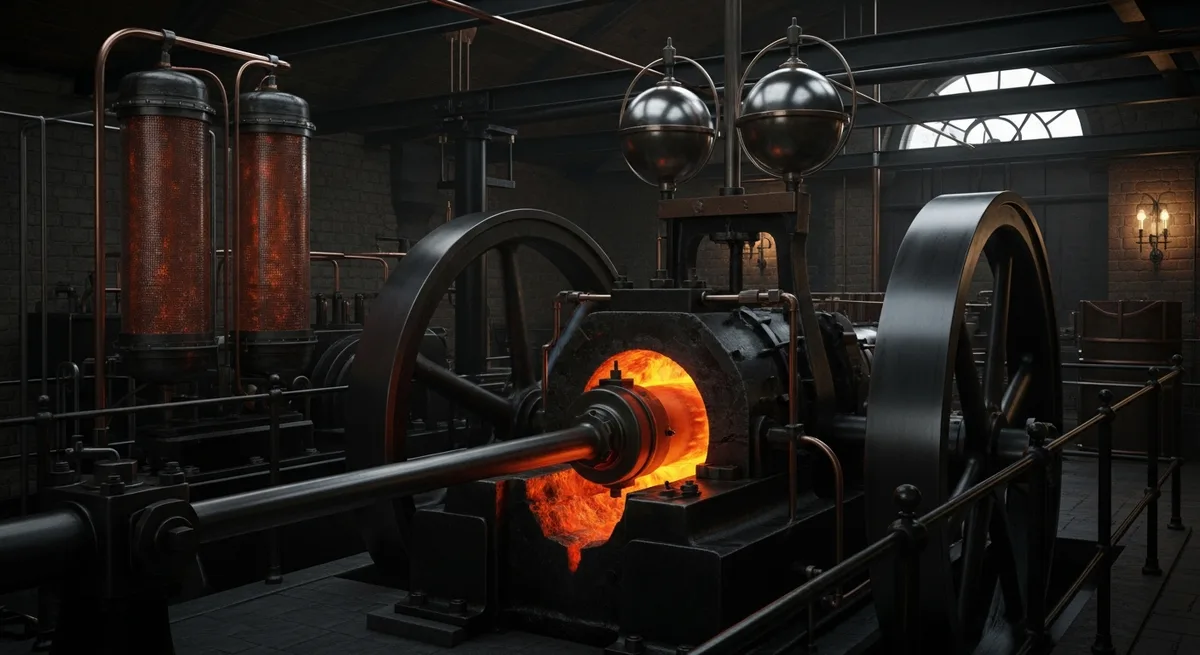
In the subterranean depths of the Whitbread brewery in 1812, the air hung heavy, saturated not merely with the saccharine musk of malt, but with the sharp, acrid stench of scorched lubricant. Here, where light struggled to penetrate the decaying masonry, stood Boulton & Watt No. 42. It was neither a miracle nor a mythic entity; it was a 12,247-kilogram monolith of cast iron, every edge a testament to the brutal dictatorship of physics. As the cylinder, cast from Low Moor iron, climbed to 115°C, its 38.1-millimeter walls endured such profound thermal stress that the metal itself seemed poised to rupture. This was no "living organism"—it was a taut, volatile concentration of force, where a pressure of 1.63 bar acted as an invisible, crushing press, perpetually probing for the slightest fracture in the iron’s structural integrity.
On that fateful Tuesday in November, as the machine operated at the absolute threshold of its capacity, the engineers detected the first harrowing omen: an anomalous, high-frequency metallic shriek. This was not the "language of the machine," but a distress signal indicating that the 1,134-kilogram piston, clearing the cylinder walls by a mere 0.8 millimeters, had begun to seize. The hempen ropes, saturated in beef tallow to ensure a hermetic seal, had overheated and lost their viscosity. The coefficient of friction, having spiked violently, transformed the sealing system from a barrier into an abrasive agent, which began to gouge the cylinder’s internal surface.
The piston’s resistance was unyielding, yet its physical existence was fragile. Forged from massive cast iron, it was required to withstand immense inertia with every stroke. As steam surged into the chamber, the piston absorbed a kinetic impact akin to a solid body colliding with a tectonic plate. Its soul, if one can discern such a thing in metallurgy, was not flexibility, but a stoic capacity to absorb shocks that would have shattered any other alloy. Yet that day, deprived of lubrication, the piston’s surface developed micro-fissures which, under the duress of 12.4 MPa of bending stress, threatened to propagate into a catastrophic breach.
Looming over this hellish chamber was an 18-ton beam, a 7.3-meter lever that rose and fell with agonizing labor, transmitting a force of 328.6 kN. Its movements were devoid of grace; they were heavy, forced, compelling the bronze trunnions to groan under the crushing load. Each cycle exacted a toll on the machine’s metallic cohesion. The engineers standing nearby felt no romanticism, only dread—they knew that should the beam fail under the 12.4 MPa of stress, the 25-ton flywheel, spinning at 22 RPM, would become an uncontrollable engine of demolition, capable of leveling the brewery in a heartbeat.
The separate condenser, fashioned from 6.35-millimeter copper, served as the day’s sole guarantor of stability. As steam entered the 0.85-bar vacuum, it cooled instantaneously, surrendering its latent heat to 121 copper tubes. The 340-liter-per-minute water flow bathing these pipes was the only force tempering the thermal chaos. The copper’s thermal conductivity of 390 W/m·K was the critical factor preventing the system from overheating and losing its vacuum. Had this process faltered, the steam pressure would have instantly compromised the cylinder’s structural integrity.
The machine’s governor—two 14.5-kilogram metal spheres—rotated about its axis, struggling to maintain equilibrium between the surging steam flow and the fluctuating load. This analog logic, operating with a precision of 1.4 percent, appeared utterly impotent against the mechanical seizure induced by the piston’s thermal expansion. The engineers watched as the spheres desperately shifted their position to compensate for the mounting resistance, yet the machine was already living a life of its own, independent of human will, dictated solely by the laws of physics and the fatigue of metal.
The flywheel, that 4.8-meter-diameter metal ring, possessed a moment of inertia of 74,200 kg·m². It functioned as a vast inertial battery that, even amidst the seizure, refused to cease. Its mass and velocity converted every mechanical resistance into an internal force that tore at the machine from within. The tremors generated by this rotating monster were felt through the soles of the feet—not an "industrial symphony," but a warning of imminent structural failure.
When the machine was finally brought to a halt and the cylinder head removed, the engineers beheld the scorched furrows upon the piston’s surface. It was physical proof that even the most precise calculations—the 85 kN of force applied to the bolts or the 8.75 percent thermal efficiency—could not overcome the limitations of material. The carbon- and manganese-rich cast iron had reached its fatigue limit. This incident was not merely a malfunction; it was a reminder that in 1812, human-wrought power was fragile, perpetually balanced between engineering triumph and total mechanical chaos.
Following the event, Boulton & Watt No. 42 was dismantled and meticulously inspected. Every nut, every bolt was re-evaluated. The engineers understood that their system was not eternal. It demanded constant maintenance, relentless observation, and, above all, a reverence for physical laws that were never inclined to yield to human ambition. This machine became not only a symbol of industry but a lesson in the difficulty of mastering a force that, by its very nature, seeks to erupt from its metallic confines.
Gazing into the cooled, dark cylinder, the engineers saw more than a piece of metal; they saw a complex synthesis of effort, error, and persistence. It was an epoch where every successful cycle was deemed a victory, and every failure an inevitable price paid for progress. Boulton & Watt No. 42 remained in the annals of history as a witness to a time when engineering had not yet become a matter of course, and every rise in steam pressure was perceived as a profound challenge to the laws of nature.
Today, looking back at these technical parameters, it is difficult to grasp the tension that permeated that brewery cellar. Yet that 1812 incident—the screech of metal and the fear of a bursting cylinder—best defines that era. It was a time when man first locked horns with the power of steam, and this collision left an indelible mark both on the history of engineering and on the very industrial landscape we call civilization.