The Fabric of Logic: A 19th-Century Miracle
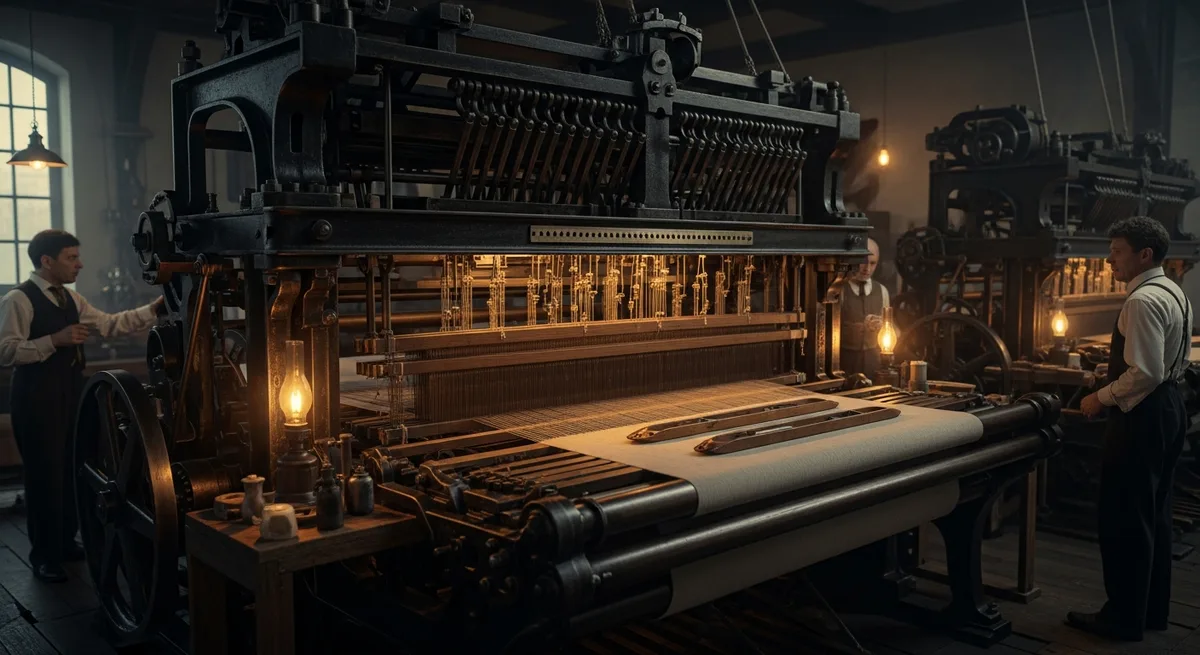
In the workshops of 1801 Lyon, Joseph Marie Jacquard’s loom was far more than a mere instrument of weaving; it was the inaugural physical attempt to imprison logic within a cage of cast iron. Its 1,200-kilogram frame was engineered to absorb a compressive stress of 1,400 MPa during every operational cycle. Occupying 2.5 meters of floor space, the structure functioned as a static engineering riposte to the chaotic variability of human labor, where a 100 Nm torque, transmitted through the primary driveshaft, demanded absolute systemic rigidity to ensure that mechanical logic remained uncorrupted by the dissonance of vibration.
Steel shafts, alloyed with 0.5% carbon, served as the mechanism’s nervous system. Their capacity to withstand 800 MPa of tensile force allowed for millions of cycles without the onset of fatigue, while their internal matrix was required to maintain structural integrity so that the heat generated at contact points would not become a destructive catalyst. The engineers overseeing this system monitored the metal’s visceral response to friction, tempering molecular thermal buildup with meticulously dosed lubricants that prevented the solid body from surrendering its geometric precision.
Bronze bearings, composed of 70% copper and 30% zinc, acted as silent intermediaries. Their 0.1 coefficient of friction allowed the 50 mm diameter shafts to rotate without the accumulation of excessive heat, while a 40% elongation property enabled the bronze to absorb microscopic shocks, preventing them from cascading into the destructive vibrations that threatened to dismantle the entire weaving process.
These bronze components, representing the machine’s joints, were the nexus where immense force met the freedom of movement. Their crystalline structure, designed to dissipate energy throughout their entire volume, allowed the bearings to "breathe" as they heated, maintaining fluid slippage even at a maximum velocity of 100 revolutions per minute—a threshold without which the 1,200-kilogram system would have collapsed into inert scrap metal.
Adjacent to this metallic fortitude, the oak shuttle—possessing a density of 0.7 g/cm³—stood as an engineering paradox. Its lightness allowed for the necessary acceleration without burdening the mechanism with excessive inertia, and its movement, accompanied by the specific, mournful groan of wood striking the terminal points, evoked the machine’s own volition as it darted back and forth, binding disparate threads into a singular, cohesive fabric.
The true cerebral core of the system was the 50-kilogram card-reading unit, where perforated cards measuring 200 mm by 100 mm, each containing 1,000 apertures, dictated the entire process. Every hole functioned as a binary expression, which the reading mechanisms translated into physical action, bridging the chasm between abstract information and heavy, inert matter.
The reader mechanism, subjected to immense stress as hooks moving at an acceleration of 10 m/s² collided with the card surface, performed work of surgical precision. A system of 500 levers and 1,000 hooks converted physical force into abstract order, proving that mechanics could serve not merely as a tool of raw power, but as a medium for information processing, where every movement was encoded within the matrix of the perforation.
The warp beam and the take-up roller, ensuring constant tension, functioned as the machine’s memory, recording the history of the weave and transforming complex processes into a tangible, finite object. Each centimeter of fabric bore witness to the system’s impeccable operation, provided the mechanical tension did not exceed the material’s ultimate resistance.
Nineteenth-century engineers grappled with an insoluble paradox: the more intricate the pattern, the greater the number of cards required, which in turn amplified the friction and mechanical wear across the entire system. This became the fundamental boundary between information density and physical reliability—a limit that could not be breached without a radical advancement in material resilience.
Every moment of card-hole interrogation required the hook to overcome the resistance of the paper; yet this resistance, however minimal, manifested over thousands of cycles as cumulative fatigue. This deformed the reading system itself, forcing engineers to balance on a razor’s edge between informational complexity and the machine’s disintegration. Each additional instruction pushed the system’s friction coefficient toward a critical threshold where the metal could no longer dissipate heat, and the bronze bearings began to lose their structural integrity, effectively closing the information-transmission loop at the very precipice of mechanical failure.