The Breathing Cylinder
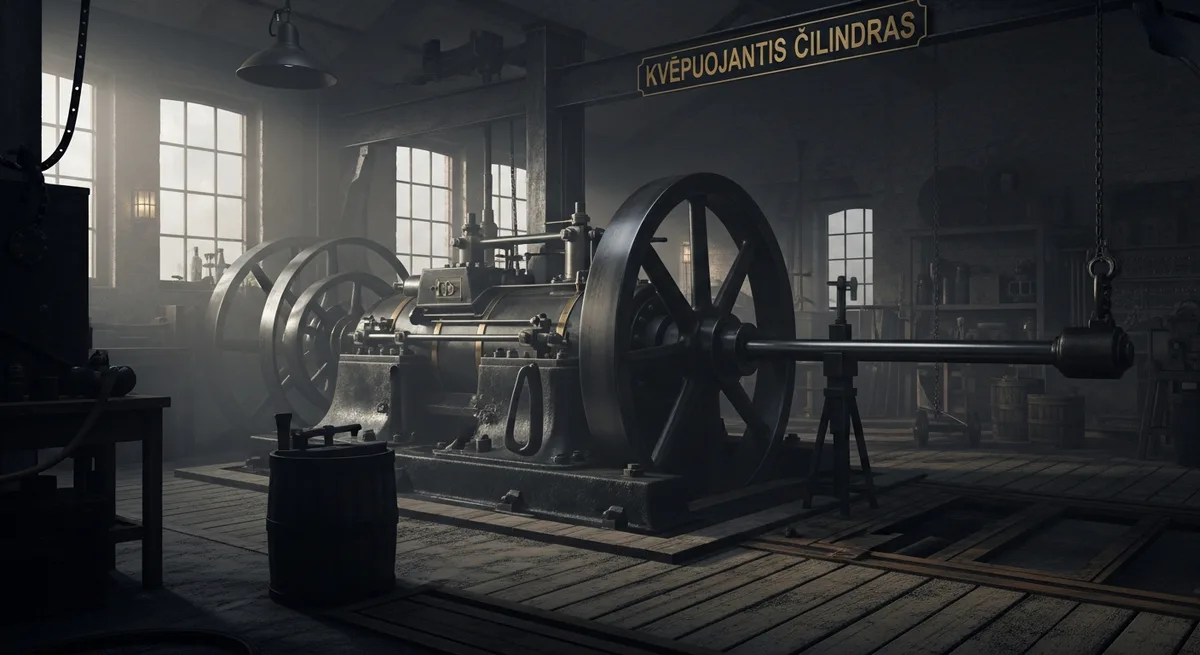
Before the dawn of a December morning in 1781, the air in the Birmingham workshop hung heavy, saturated with the acrid tang of damp coal smoke and the distinct, metallic musk of structural fatigue. James Watt stood at a remove from his creation, watching as condensation—beaded like cold sweat—traced paths down the 12.7-millimeter-thick walls. This was no moment of triumph, but rather a state of hushed, high-tension anticipation. He understood that every square centimeter of the boiler was currently enduring a pressure of 1.4 bar—a force that engineers of that era perceived not as a mere abstraction on parchment, but as a persistent, menacing pulse beneath their very feet. Had a weld seam surrendered, this monster would not have simply ceased; it would have unspooled into shrapnel, transforming the entire workshop into a hellscape of jagged iron and scalding vapor.
One of the primary engineering enigmas, rarely chronicled in the annals of history, was not the generation of power itself, but the "respiration" of the cast-iron cylinder. As coal, with its energy density of 24.9 MJ/kg, transmuted into infernal heat within the furnace, the inner wall of the cylinder expanded at a rate outpacing the outer. That microscopic, near-imperceptible strain of the metal stoked a primal fear that the cast iron, with its compressive strength of 550 MPa, might simply fracture under the duress. Watt recalled one evening, while listening to the machine’s labor, hearing an anomalous, high-frequency shriek—the protest of piston rings against uneven thermal expansion. In that moment, he realized the machine was not merely an assembly of iron components; it was a delicate equilibrium, perpetually undermined by the physical nature of matter itself.
The piston, weighing 45.4 kilograms, was the true protagonist of this drama. It moved not with grace, but with a heavy, stubborn volition. Between it and the cylinder wall lay a mere 0.01-millimeter film of graphite and tallow—a fragile boundary separating fluid operation from catastrophic seizure. Watt knew that should this layer desiccate, the piston would instantly superheat, its molecules—possessing a density of 7.3 g/cm³—interlocking with the cylinder walls, bringing the machine to a permanent, frozen halt. This was no "living organism"; it was a desperate attempt to compel inert matter to perform labor to which it was, by its very nature, fundamentally opposed.
The connecting rod—a 1.52-meter length of forged steel—appeared as a massive, coarse tendon. It endured cycles of tension and compression so severe that the metal seemed to "wear" not only physically, but existentially. Each time the piston reached the terminus of its stroke, the rod shuddered, transmitting a vibration into the very foundations of the workshop. It was a sound engineers termed the "lament of iron"—a deep, hollow thrumming that permeated the floorboards and seeped into the marrow of the workers. They did not merely hear the machine; they felt its mechanical pulse through the soles of their feet, as if the earth beneath them had become a living, restless entity.
The flywheel, that 907-kilogram cast-iron disc, was the sole mechanism preventing the entire system from disintegrating into ruin. Its moment of inertia—234 kg·m²—served as an engineering riposte to the chaotic volatility of steam pressure. When the pressure within the boiler spiked, the flywheel absorbed the excess energy, transmuting it into rotational momentum; when the pressure waned, it surrendered that stored force, smoothing the cycle of labor. It was the embodiment of mechanical stability, forcing the chaotic reaction of fire and water to submit to a rigid, rhythmic cadence. Watt watched the flywheel slowly gather velocity, discerning in it not progress, but the sheer necessity of domesticating an unpredictable element.
The brass valves, operating with surgical precision, functioned as the machine’s "brain." Each click bore witness to the engineer’s attempt to impose order upon the chaos of gas expansion. The copper of the connecting pipes perpetually wept with condensation, and the droplets falling onto the heated metal hissed with a serpentine intensity. It was a reminder that energy never dissipates without leaving a trace; it always migrates, dampening one surface, searing another. Watt knew this 17.8 kW mechanism was far from perfect; it was merely the most viable compromise between the human desire for mastery and nature’s inherent refusal to yield.
At the end of the day, when the workshop fell silent, Watt remained alone with his creation. He would lay a hand upon the still-warm cast-iron cylinder, feeling the metal gradually cool, contracting with a rhythmic creak. This was more than the consequence of thermal contraction; it was the machine’s "sigh" after a long day of labor. He realized that this engine would never be fully tamed. It would always possess its own caprices, its own "voice," and its own limitations. It was the first time humanity had forged something more powerful than itself, yet something that demanded constant, exhausting vigilance.
Watching the final wisps of steam dissipate beneath the workshop rafters, Watt contemplated the future. He understood that 1781 was not merely a date in the history books. It was a threshold, beyond which there was no return. His hands, stained with grease and coal dust, were a testament to the fact that technological advancement demands not only intellect, but physical endurance. He was no god; he was a man who had forced iron to speak, and now, as the machine stood silent, he felt a strange, profound loneliness in this new, mechanized reality.
Today, we often forget that every complex device in our pockets or our factories bears the lineage of this ancestor—the crude, filthy, and clamorous steam engine. Its legacy is not merely one of efficiency or power. Its legacy is the realization that every technology, no matter how advanced it may appear, is always anchored to the same physical resistance, the same structural fatigue, and the same human desire to overcome the elements. Watt’s engine was no miracle; it was a heavy, agonizing, yet essential step into the world we call home today.