Quantum Anchor: Titanium Alloy’s Role in Stabilizing Exotic Mass
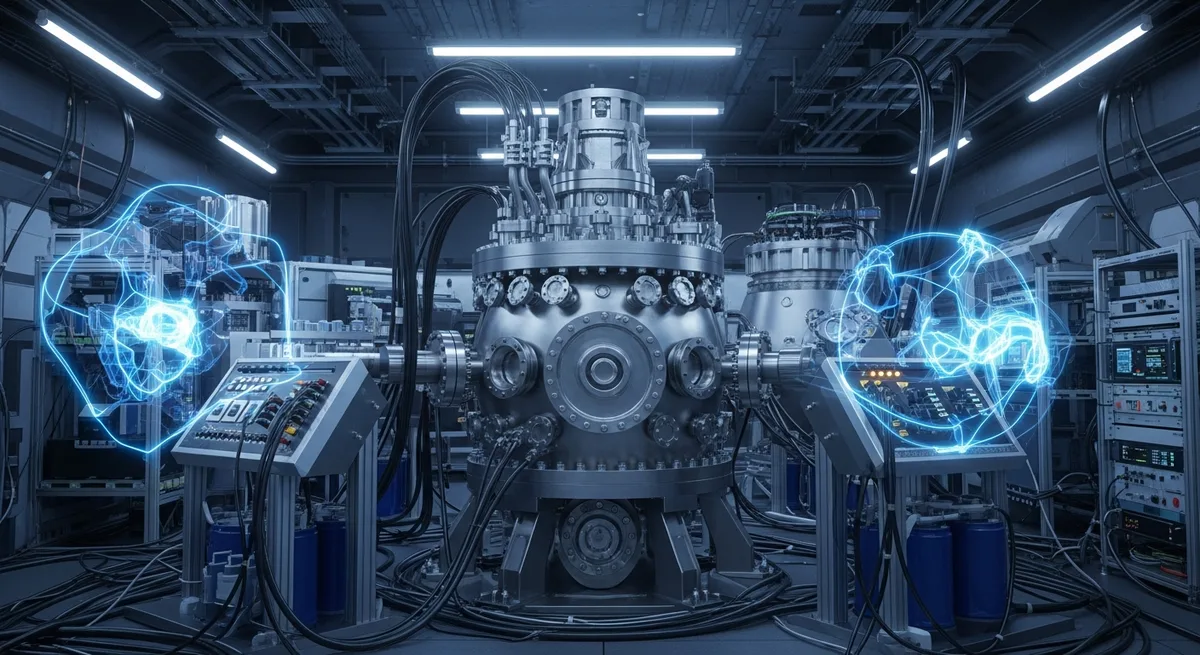
It was once assumed that the fabric of spacetime was an immutable constant, yet as we approach the stabilization of an anomaly possessing 1.23 kg of negative mass, we realize that matter is merely a taut string, waiting for the correct frequency to resonate. Within the 0.56-meter radius of the vacuum chamber, there exists a silence undisturbed by even the most fleeting molecular vibration, as the 10⁻⁹ Pa pressure evacuates the very possibility of an acoustic echo. Here, where the laws of physics shed their familiar gravitational weight, the Ti-6Al-4V titanium alloy walls serve as the sole anchor, preventing this exotic state from spontaneously dissipating into the surrounding void. As the 900 MPa yield strength reaches its critical threshold, the metallic structure begins to emit low-frequency oscillations—a distant, dull groaning of metal that bears witness to an internal struggle against an unnatural gravitational pull.
Every atom of the titanium hull is locked into a molecular framework, its integrity maintained through precise thermal processing that prevents the material from surrendering its structural resilience. The heat generated by the exotic mass does not merely distribute across the surface; it seems to permeate the metal’s molecular lattice, forcing it to expand in microscopic increments, which are monitored incessantly by laser interferometers. Should this molecular fabric lose its stability for even a heartbeat, the 400 W/m·K thermal conductivity coefficient would fail to dissipate the excess energy, irreversibly deforming the chamber’s entire geometric system and reducing it to an unrecognizable heap of slag.
A niobium-titanium coil, wound into filaments 0.0012 meters in diameter, generates a 5.67 T magnetic clamp that acts as a rigid frame, preventing the anomaly from breaking free of its vacuum cage. This field is not merely an invisible force; it is perceived as a sharp, tense shield, every line of which must be calibrated with absolute precision to avoid the formation of localized magnetic vortices. When the 1.23 GJ energy bank discharges over 0.56 ms, this magnetic shield sustains a blow so severe that the niobium filaments momentarily heat up, their electrical resistance teetering on the brink of losing superconductivity, thereby triggering a perilous electromagnetic recoil.
Tantalum and ceramic capacitors play a desperate role in this process, absorbing 500 kV of potential that forces every dielectric layer to stretch toward the point of rupture. Their internal matrix is engineered to maintain a dielectric constant of 1200 even under the most extreme electrostatic fluctuations, yet each discharge leaves microscopic scars upon the material’s structure. It is a perpetual tapestry requiring constant mending—after every energy surge, the capacitors suffer dielectric fatigue, their charge-storage capacity waning, forcing the system’s "brain" to continuously adapt its charging algorithms to prevent a chain reaction that could physically vaporize the entire capacitor bank.
The power conditioning assembly, governed by silicon carbide and gallium nitride switches, operates at a frequency of 10.23 kHz, creating a constant, rhythmic stream of pulses that maintains the negative mass in a state of equilibrium. These switches withstand 1200 V and 345 A, yet their operation is a ceaseless balancing act on the edge of thermodynamic collapse, where every switching cycle generates heat that must be scavenged by active cooling circuits. If a single switch were to lag by even a few nanoseconds, the 0.56 duty cycle ratio would be shattered, resulting in the instantaneous destabilization of the magnetic field and opening the path for the exotic matter to make uncontrolled contact with the chamber walls.
Processors operating at a 10.23 GHz clock speed continuously scan 1.23 TB of data streams, monitoring quantum fluctuations in the vacuum and attempting to predict the anomaly’s behavior before it manifests. This is not merely computational power; it is a real-time map of spacetime topology, where every shift in magnetic flux is analyzed to facilitate millisecond-scale corrections. Yet, this computing block is itself vulnerable, as the intense electromagnetic fields radiating from the engine core attempt to distort the logic signals within the processors, necessitating that all electronics be shielded by layered composites—a protection that simultaneously restricts the system's cooling efficiency.
The 10.23 kN of thrust generated by the engine is not the result of mechanical propulsion, but the consequence of a gravitational potential well created by the negative mass, which warps the surrounding space. Upon reaching a specific impulse of 3000 s, the space around the vessel begins to behave erratically: light bends slightly, and time around the engine block flows at a different rhythm than in the rest of the craft. This 10 percent threshold of the speed of light becomes an engineering horizon, beyond which unpredictable relativistic phenomena force the system’s control algorithms to recalculate their logic in real-time, as the direct correlation between command and execution becomes impossible due to the latency of information propagation.
The primary structural frame, formed from complex braids, must withstand the immense mechanical stresses arising from rapid acceleration and the interaction of magnetic forces. Each section of the frame is positioned to dampen vibrations radiating from the engine before they reach other critical modules, yet this damping creates its own echo—an internal resonant tension that can eventually lead to material fatigue. It is for this reason that the frame’s geometry is in a state of constant flux, adapted to absorb kinetic energy that would otherwise shatter the entire propulsion system.
When the system reaches its operational peak, a fundamental engineering paradox emerges: increasing energy conversion efficiency inevitably generates more electromagnetic noise, which destabilizes the negative mass itself. To ensure system stability, one must reduce the switching frequency, but this automatically diminishes thrust and increases the risk that the 1.23 GJ energy storage bank will overheat due to an excessively long discharge cycle. This balance—between total system collapse from noise and the melting of components from thermal overload—is a threshold that engineers cannot cross, leaving the engine in an eternal compromise between raw power and physical survival.