Corrosion and Threads: The Decay of a Mechanical Dream
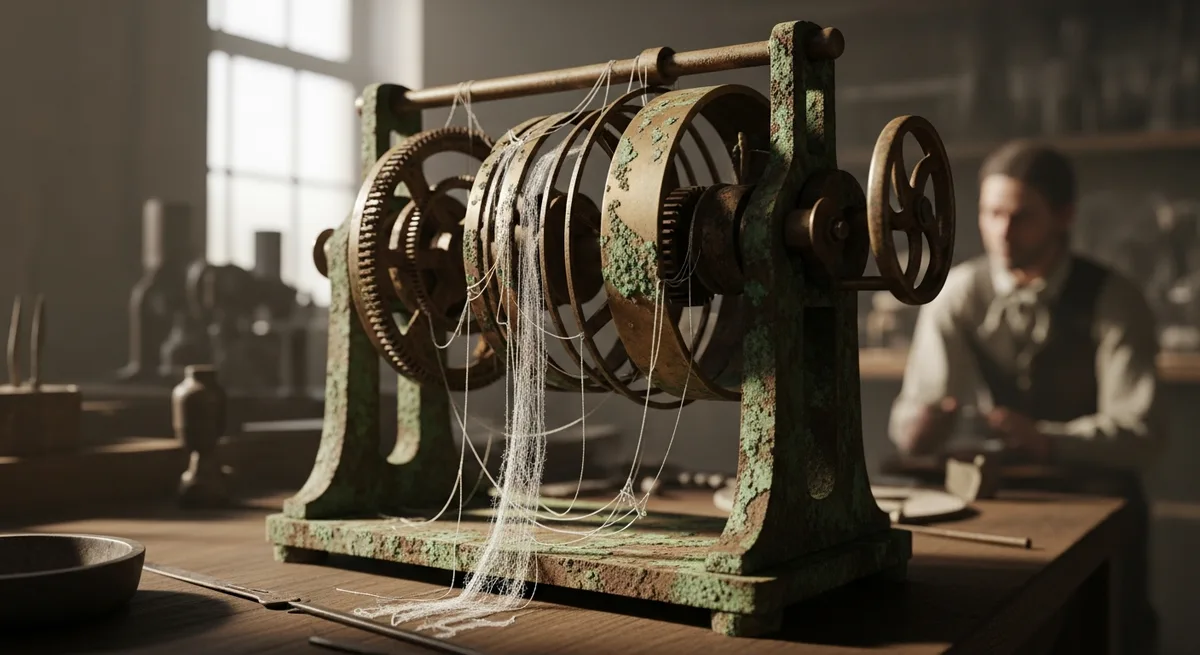
In the workshops of 1810 Lyon, the air was not merely humid; it was saturated with the taste of oxidized iron dust, a metallic grit that settled upon the tongue like the slow, chemical decay of the earth itself. Here, amidst damp, weeping walls, Joseph Marie Jacquard’s creation was never venerated as a sentient marvel. It was, instead, a ruthless system open to entropy, where every component drifted, with agonizing certainty, toward its own structural dissolution. The 1,200-kilogram cast-iron frame, while formidable with its compressive strength of 140–170 MPa, was never intended for eternity. It suffered under the relentless fatigue of cyclic loading, its molecular lattice accumulating microscopic fissures—invisible, structural wounds that engineers monitored with a visceral dread, knowing that every percussive strike brought the machine closer to an inevitable, catastrophic fracture.
The rigidity of the cast-iron frame was a fragile illusion, sustained only by the liturgy of constant maintenance. Each day, as a 5,000-Newton tension surged through the warp, the frame endured microscopic cycles of deformation. It was never a "stable structure," but rather a cage in a state of perpetual, agonizing flux—expanding and contracting in a rhythmic, metabolic struggle. Under such duress, the metal gradually surrendered its elasticity. Over the decades, we watched as the frame’s once-sharp edges softened into dull, rounded profiles, while the surface, besieged by moisture and friction, bloomed with rings of corrosion—a process of mechanical senescence that no lubricant could ever hope to arrest.
The warp beam—a steel cylinder 1.8 meters in length and 0.2 meters in diameter—served as the true theater of this engineering war. Forged from high-carbon steel, its tensile strength of 1,000–1,200 MPa appeared insurmountable, yet it fought a losing battle against its own mass. Each thread coiled around the beam exerted a pressure that slowly, inexorably altered its surface geometry. This was no "surgical precision"; it was a grim compromise between the stubbornness of steel and the abrasive attrition of fiber. Subjected to constant torque, the beam gradually shed its ideal cylindrical form, and the grooves etched into its surface were not design elements, but the scars of material degradation.
The heat radiating from the friction points was another adversary, a direct transformation of kinetic energy into thermal pollution that compromised the viscosity of the lubricants. As metal slid against metal, temperatures climbed to a threshold where the molecular structure began to lose its temper. Lubricants, fouled by dust, curdled into an abrasive paste that gnawed at the bearings. It was a slow, silent process of auto-cannibalism. The workers heard not the "song of the machine," but a specific, discordant shriek—the sound of protective films rupturing, leading to direct metal-on-metal contact and the onset of microscopic welding.
The heddles—thousands of wires, each 0.5 millimeters in diameter—were the most vulnerable nerves of this system. Their 500 MPa tension represented a threshold; beyond it, the wire simply succumbed to fatigue and snapped. These were not permanent conduits, but disposable consumables. Their flexibility was finite; after several million cycles, the metal’s crystalline lattice could no longer return to its original state. They deformed, lost their alignment, and began to snag, triggering a chain reaction that frequently brought the entire weaving process to a grinding halt.
The shuttle, a projectile of steel and brass slicing through the air at 500 meters per minute, was the machine’s primary instrument of economic violence. Its acceleration of 10 meters per second squared generated immense inertial forces that, with every strike, sought to dismantle the loom’s frame. The brass-and-steel alloy, while impact-resistant, was not immune to deformation. After thousands of cycles, the shuttle’s edges grew jagged, and its center of gravity shifted due to micro-abrasion, causing its trajectory to deviate. This was the erosion of industrial precision, a decay that workers were forced to compensate for by manually adjusting the guides.
The gears and levers, tasked with transmitting up to 500 Newton-meters of torque, formed the system’s weakest link. Each tooth, as it engaged, endured contact pressures that exceeded the material’s yield strength. This was no "mechanical symphony"; it was the sound of wear, where metal particles flaked from the gear teeth, falling into the mechanism to act as a secondary abrasive. These gears were not built for longevity; they were engineered for the narrow window of economic utility, serving only until their backlash became too great to ensure the fidelity of the woven pattern.
The cams, though machined to a surface roughness of 0.1 micrometers, were subjected to relentless mechanical friction. Their mirror-like finish would dull to a matte haze after only months of intensive operation. Each curve, each encoded command, slowly lost its definition. This was the loss of information—a failure where the mechanical logic, the very shape of the cam, wore away, and the loom began to "err." It was not a failure of execution, but a systemic degradation where physical form could no longer faithfully replicate the original mathematical intent.
The punched cards, though masquerading as "memory," were the most ephemeral components of the system. Paper, exposed to humidity and the constant, violent piercing of needles, rapidly lost its structural integrity. The holes stretched; the edges frayed. This was a finite memory, its lifespan measured not in years, but in cycles. Jacquard understood that programming was not merely an abstract idea, but a physical problem: how to preserve the integrity of information in a medium that physically disintegrates through the very act of being read?
The beat-up blades, concluding each cycle with 100 Newton-meters of force, were the machine’s most brutal elements. Their task was not merely to compress the fabric, but to physically deform it, forcing the fibers into submission. This process was so violent that the blades themselves eventually lost their straightness. Under the impact loads, the metal began to "flow," and the edges, which required perfect linearity, developed a subtle curvature. This was the machine’s limit—the moment when physical force could no longer improve quality without a total replacement of components.
Viewing this machine not as a miracle, but as an engineering challenge, it becomes clear that its greatness lay not in its durability, but in its ability to function despite inevitable degradation. The engineers who tended these looms were not artists; they were combatants against entropy. Every bolt, every lubrication point, was a desperate attempt to delay the inevitable collapse. It was an era when engineering meant a constant, wearying compromise with the laws of physics, which always sought to return this 1,200-kilogram pile of iron to a state of quiet, motionless rest.
Today, looking at these surviving mechanisms, we see more than history. We see the traces of material fatigue, the layers of metallic corrosion, and the deformed gears. This is the true face of industry: not a triumphant march, but a constant, exhausting struggle against the processes of material decay. Every component standing in a museum today is a witness to how humanity, wielding steel and cast iron, attempted to conquer time, even as the mechanism itself was, by its very nature, destined to become dust.
The workers of Lyon, laboring at these looms, felt this struggle in their own bodies. Every sound, every metallic groan, was a signal of an impending fracture. It was no "dance"; it was heavy, rhythmic labor intended to keep the machine alive for one more day, one more hour, one more cycle. And while we view this mechanism today as an engineering masterpiece, its creators knew the truth: it was merely a temporary, fragile attempt to harness forces that were always, and would always be, stronger than the metal itself.
Ultimately, these looms leave us with a lesson regarding the limits of engineering. There is no "perpetual motion" or "perfect mechanism." There are only materials that wear, and the human mind that attempts to govern that wear. The Jacquard loom is a monument not only to human ingenuity but to our persistent efforts to create order in a chaotic, decaying world. It is 1,200 kilograms of proof that even the most powerful tools are merely temporary intermediaries between the human will and a ruthless physical reality.