The Condenser's Flint: James Watt's Breakthrough
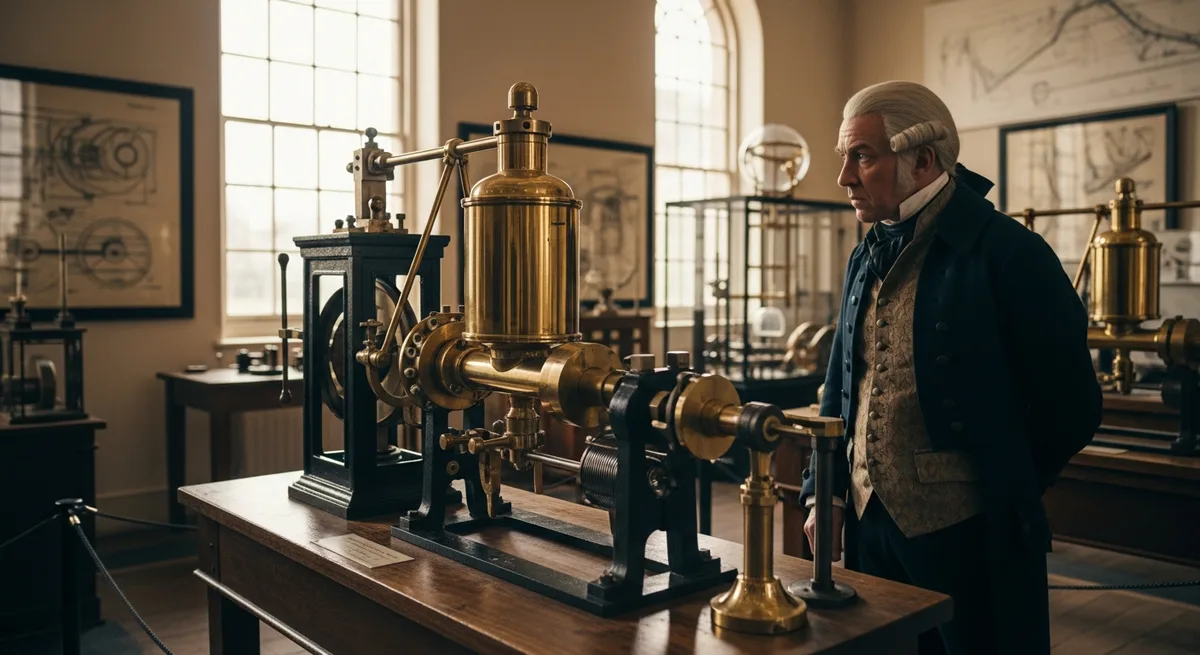
In the eighteenth century, the industrial landscape was defined less by innovation than by a relentless, grinding war against inefficiency. James Watt’s endeavors were never intended to conjure something “alive”; they were designed to resolve a singular, pragmatic crisis—how to prevent Thomas Newcomen’s atmospheric engine from hemorrhaging fuel. Mine owners in Cornwall watched, helpless, as vast mountains of coal dissolved into furnace heat without yielding a return on investment. It was a cold, economic calculus, devoid of any romanticized technical dance.
Watt’s primary engineering breakthrough—the separate condenser—became a necessity dictated by the physical limitations of the cast-iron cylinder. In earlier iterations, the cylinder was forced to cycle between extreme heat and cold, a thermodynamic suicide pact. Cast iron, with its inherently brittle molecular structure, was never meant to endure such constant thermal expansion and contraction. Every temperature fluctuation induced internal stresses that inevitably manifested as hair-thin fractures. Engineers understood the stakes: if the cylinder walls heated unevenly, the 689 kilopascals of pressure would instantly exploit the weakest point, reducing an expensive machine to a heap of scrap metal.
The piston assembly demanded a degree of precision that the machine tools of the era could barely provide. John Wilkinson’s improved boring mill allowed for a cylinder interior with minimal deviation, yet the seal between piston and wall remained a persistent failure point. Hemp fiber and tallow were packed into the gap, a desperate attempt to mitigate the friction where every movement generated heat—not merely from the steam, but from raw mechanical resistance. If the lubrication failed, the metal would seize, stalling the entire mine operation and leaving workers vulnerable to the encroaching threat of flooding.
The wrought-iron rod connecting the piston to the beam had to withstand immense shear forces. Its fabrication was a grueling, protracted process: iron ingots were heated to a blinding white and hammered by hand to purge the slag. This imparted a degree of ductility essential for surviving the sudden load shifts when the engine lost resistance. Yet, with a carbon content approaching 0.5 percent, the rod remained susceptible to corrosion and fatigue. After years of intense operation, the metal’s crystalline lattice would begin to show signs of structural decay, forcing engineers to perform regular, anxious inspections for the telltale signs of catastrophic fracture.
The crankshaft and its phosphor-bronze bearings represented the pinnacle of contemporary metallurgy. This alloy—copper fused with tin and precisely dosed phosphorus—acted as a vital buffer. Phosphorus was the critical element, enhancing hardness while providing the wear resistance necessary to endure 135 Newton-meters of torque. The bearings required constant lubrication with thick animal fats, which, when mingled with grit and metal shavings, formed a black, viscous sludge. This substance was the true “blood” of the industry; its depletion meant instant overheating and the liquefaction of the bearing itself.
The flywheel, a twelve-hundred-pound monolithic disk of cast iron, served as the system’s stabilizer. Its mass was calculated based on the moment of inertia required to compensate for the uneven steam pressure. As the piston reached the end of its stroke, the flywheel’s kinetic energy sustained the rotation, preventing the system from hitting the “dead point” that had plagued earlier designs. Yet, this immense weight introduced a new problem: the foundation. If the engine was placed on unstable ground, the vibrations would quickly compromise the stone footings, forcing engineers to install massive oak beams driven deep into the earth.
The brass valve system was a testament to Watt’s genius, yet it remained the most vulnerable component. While brass offered superior corrosion resistance, it was softer than steel or iron. After thousands of opening and closing cycles, the valve seats would wear down, losing their hermetic seal. This resulted in steam leakage that not only degraded the engine’s coefficient of performance but emitted a distinct, ear-piercing hiss. Engineers working these machines could diagnose the health of the engine by ear, knowing exactly when a valve required grinding.
The economic impact of these machines was ruthless. Watt’s engine allowed mines to reach deeper coal seams that had previously been impossible to drain. This shifted the price of coal and ignited a new demand, which in turn accelerated further mechanization. Yet, behind this progress lay thousands of hours of manual labor: the casting of cylinders, the hand-grinding of valves, the forging of shafts. This was not automated production; it was the zenith of craftsmanship, where every bolt was individually fitted.
Historical records often omit the failures that shadowed these experiments. There were instances where an improperly cast cylinder would explode during initial trials, spraying superheated steam and metal shrapnel in every direction. It was hazardous work, demanding not only engineering acumen but raw physical courage. Each engine was idiosyncratic, possessing its own “character”—a euphemism for the sum of manufacturing inaccuracies and material inconsistencies that the operator had to learn to master.
Viewed from today’s perspective, the Watt engine is more than a historical exhibit. It is a reminder of how the laws of physics—thermodynamics, material strength, friction—dictated the trajectory of technology. Engineers lacked computer models; they possessed only their experience, the skills of the iron-casting masters, and an intuitive grasp of how metal reacts to heat. The process was slow, sometimes painful, yet it laid the foundation for all modern mechanics.
The Industrial Revolution did not begin with a single brilliant thought. It began with the patience required to refine copper condensers and bronze bearings. It was an era in which humanity learned to reconcile itself with the limitations of matter, overcoming them through precise, relentless engineering. Every detail, from the weight of the flywheel to the seal of a valve, was a response to a specific obstacle posed by physical reality itself.
Ultimately, Watt’s legacy is not merely the engine, but a methodology. He demonstrated that to harness a powerful force, one requires not just raw power, but an understanding of the processes occurring deep within the machine’s core. It was a time when the engineer was not just a designer, but an observer, compelled to master every property of a metal alloy, for the smoothness of the machine’s operation—and the safety of those working beside it—depended on it.
In today’s technological world, where everything occurs in an instant, the slow, rhythmic pulse of a Watt engine might seem like an artifact of a bygone age. Yet its essence—the constant refinement and the obsessive attention to detail—remains a foundational principle. We are still battling friction, we are still seeking more efficient ways to convert energy, and we remain dependent on materials that must withstand immense loads. The story of the Watt engine is not a fairy tale of success; it is a narrative of persistence that, despite all obstacles, fundamentally restructured the world.