Heat and Hammer: The Forge of the Future
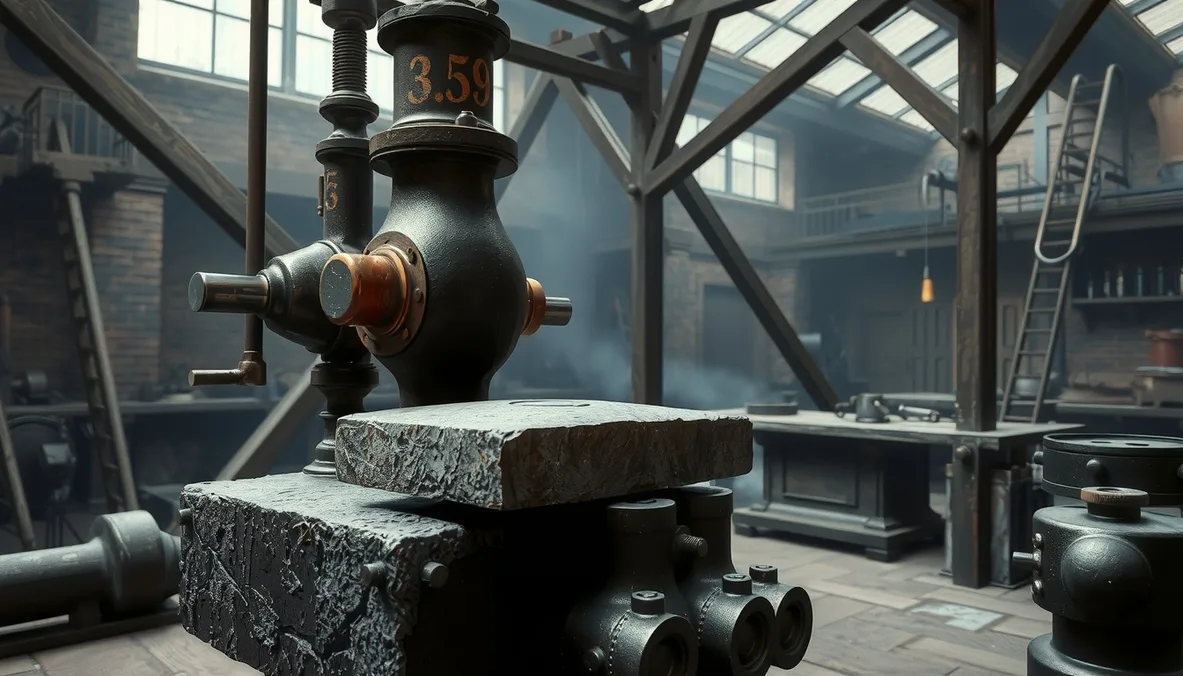
In the 1840s, the workshops on the fringes of London were thick with the scent of damp coal dust and the acrid, near-incendiary stench of oxidized metal. William Brunton’s rotary drill was more than a mere implement; it occupied the corner like a starving, dormant beast, its very presence exerting a gravitational pull that frayed the nerves of every laborer in the room. When the steam valve finally hissed open, the chamber was not merely filled with mechanical noise, but with a palpable pressure—a physical weight that compressed the chest, thickening the air with the violent, rhythmic thrum of vibration.
The drill head was forged from steel tempered by smiths until it achieved a hardness that seemed to lock aggression itself into the molecular structure. This was not simply metal; it was the physical embodiment of a refusal to yield to wood or clay. As the worker pressed the tool against a block of granite, the blades did not immediately bite into the surface. First came a dissonant, ear-piercing shriek, as if the stone itself were recoiling from this brutal intrusion. The steel suffered—it did not merely cut; it seethed, absorbing the kinetic fury channeled through the levers and gears by the steam boiler.
Heat was the machine’s constant companion. Within minutes of operation, the head would reach temperatures that cast a faint, spectral glow into the workshop’s gloom. The metal expanded, seeking a spatial release it could not find, and this molecular strain generated an internal tension that occasionally culminated in a sudden, violent fracture. This was not a triumph of engineering, but a precarious balancing act on the threshold where steel maintains its integrity, yet stands a heartbeat away from collapsing into a formless, molten mass.
The drive shaft, the conduit between the engine and the cutting head, played the role of a silent martyr. It was forced to endure a gargantuan torque that sought to twist it like a willow switch. Every rotation was a skirmish against the laws of inertia. The masters knew that if the shaft yielded even slightly, if its crystalline lattice succumbed to the fatigue of constant torsion, the entire apparatus would transform into a lethal trap. This rod was the machine’s spine, yet it was never rigid—it vibrated incessantly, absorbing irregularities and transmitting them directly into the hands of the workers, who would leave their shifts with limbs numb and trembling.
The joints where the shaft met the cast-iron frame were perpetually lubricated with a thick, dark slurry. This fluid, caught between the grinding surfaces, degraded into a black, viscous sludge that clung to the machine’s chassis like hot sweat. Under the immense pressure, the bronze bearings emitted a distinct, muffled cadence, reminiscent of heavy, faltering footsteps. This was no perfect mechanism; it was a device that demanded constant vigilance, screaming for oil and threatening to seize at the slightest lapse in the engineer’s focus.
The cast-iron frame served as the machine’s anchor. It possessed such mass that it seemed to have grown into the workshop floor. This weight was the only thing preventing the drill from bucking when it struck a harder vein of stone. Yet, this stability carried the inherent risk of cast iron’s brittleness. One wrong angle, one impact too severe against a mineral deposit, and the frame could shatter, turning the steam-pressurized components into shrapnel. It was a pervasive, atmospheric dread—the fear that the machine, designed to conquer nature, would itself become its victim.
History remembers this device as a breakthrough, yet it forgets the gritty, daily reality where engineers spent hours attempting to patch micro-fractures in the shaft. They labored with unrefined metals, with alloys riddled with impurities, and with steam pressures that could only be managed intuitively, by sensing the machine’s "breath" through the vibration of the valves. It was a test of human will—not merely against the stone, but against the very materials that constantly threatened to slip beyond the threshold of control.
When the work ceased, the machine did not cool instantly. It would emit long, rhythmic clicks as the metal contracted, returning to its dormant state. It was a sigh after a grueling battle. The engineers watched this process with a somber reverence, knowing that tomorrow the cycle would begin anew. This machine was not perfect; it was a living, breathing, searing, and dangerous testament to the fact that the nineteenth-century mind refused to accept the world as it was, choosing instead to reforge it by hand.
No one spoke of "visions of the future" while standing before this steaming monster. They spoke of pressure, of whether the bronze bearings would survive another shift, and of how to calibrate the valve to prevent the machine from "skipping." This was the mundane reality of engineering—filthy, cacophonous, and fraught with peril. Each hole successfully bored into the stone was not merely an achievement, but a minor victory against entropy, against metal fatigue, and against the persistent probability that everything would shatter into fragments.
Today, gazing at this artifact on a museum plinth, it is difficult to perceive the heat that once radiated from it. The steel appears cold and lifeless, the bronze stripped of its luster. Yet, if you look closely at the edges of the drill head, you will see the very scars left by the granite a century and a half ago. This is not merely the wear of metal; it is a recorded history of a human who forced iron to do the impossible—to burrow through the depths of the earth, leaving behind nothing but a dusty trail and the enduring echo of the Industrial Revolution.
These were times when machines possessed character. They were unpredictable, demanding a "dialogue" with the engineer, who had to understand when to vent the steam and when to push to the limit. This rotary drill was more than a tool; it was a bridge between man and rock, between the dream of altering the landscape and the reality where every centimeter was wrested from the earth with sweat, grease, and an unyielding, sometimes irrational, tenacity.