When the 13B-MSP: A Symphony of Epitrochoidal Motion
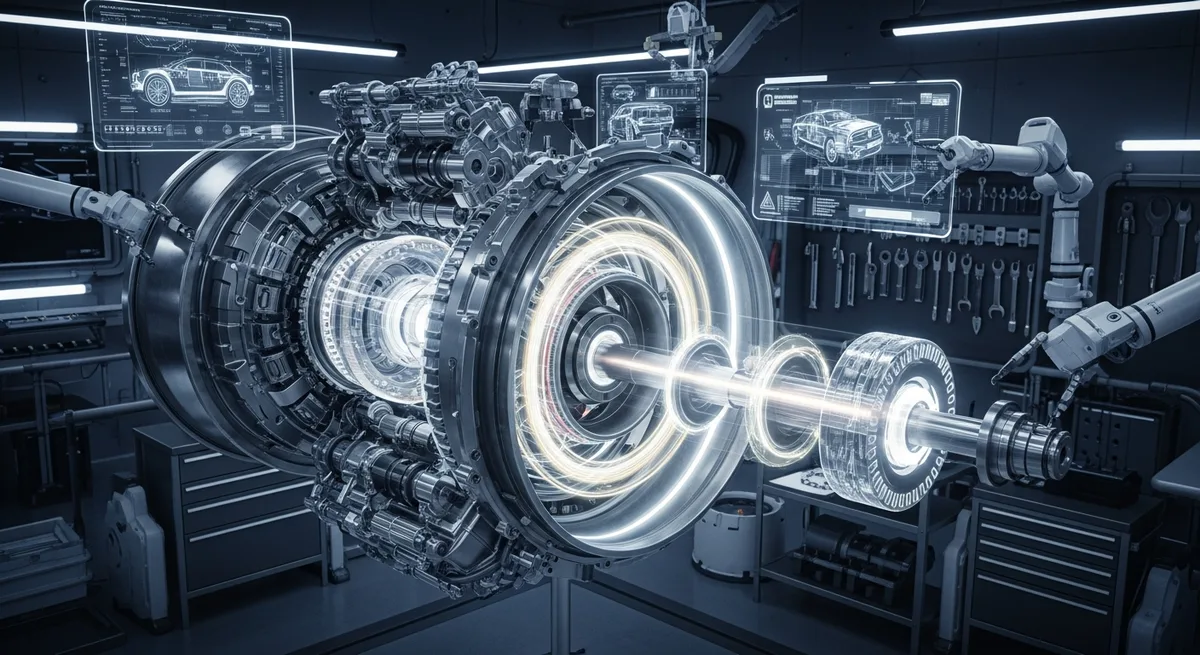
When the heart of the 13B-MSP begins its cycle, engineering precision transmutes into something akin to a geological process. Here, there are no pistons forced to arrest their own inertia and lunge forward again, as if trapped in a perpetual cycle of combat with physics. In place of this mechanical violence, the epitrochoidal trajectory allows the rotor to carve through space in a continuous, fluid motion reminiscent of running water. This is not merely an engine; it is a closed system where the 654-cubic-centimeter chamber volume fluctuates with such plasticity that the metal appears not solid, but liquid. Each curved flank, subjected to 200 Nm of torque, presses relentlessly against the inner walls like a massive tectonic block seeking its subterranean equilibrium, until the AISI 4340 steel shaft absorbs this fury, transmuting it into a smooth, near-silent vibration.
The resilience of pearlitic cast iron here becomes more than a metric; it is an existential inquiry. When temperatures within the combustion chamber reach 2200 K, the fabric of the material endures stresses that would liquefy conventional alloys. Yet, the internal matrix, boasting a tensile strength of 240 MPa, remains remarkably stable. It is a metallic armor that must maintain its geometry even as the 11x10⁻⁶/°C coefficient of thermal expansion pushes every atomic bond to its limit. In this microscopic realm, the 0.08 mm clearance is not merely a gap—it is a survival zone, where the 180 HB hardness coating serves as the sole barrier between harmonious operation and the catastrophic fusion of components.
The A356-T6 aluminum-silicon alloy in the housing construction functions as a nervous system, perpetually shunting thermal impulses into the cooling channels. The 150 kW of excess energy dissipated through this structure prevents the metal from surrendering its 280 MPa yield strength. When a pressure wave of 8 MPa strikes the epitrochoidal wall at 3000 RPM, the material must withstand a deformation that would otherwise warp the engine’s geometry. The flow of 80 liters of coolant per second acts as a cold, calming shower, preventing the structural frame from succumbing to the 22.6x10⁻⁶/°C expansion force, maintaining integrity where physics itself demands collapse.
The carbon-graphite composite apex seals represent the machine’s line of vulnerability. At 9000 RPM, each element endures 2200 g of acceleration—a force that renders the material as if it weighed tons. Inconel X-750 springs, with their 1200 MPa tensile strength, press these seals against the chrome-plated surface with 12 N of tension. It is a stubborn attempt to contain hot gases within 4 mm interfaces, even as ambient temperatures climb to levels where metals begin to lose their structural dignity.
The phosphor-bronze side seals act as silent observers, responding to dynamic loads. Their 400 MPa yield strength prevents fusion with adjacent surfaces, while their 90 Rockwell B hardness serves as a compensatory mechanism, adapting to the expansion of the cast-iron rotor. When a 1.2 kN axial load shatters the calm, these elements become a dynamic shield, absorbing pressure across a 6400 mm² area. This is not merely friction; it is a constant adaptation to fluctuating pressure that never ceases its assault.
The eccentric shaft, forged from steel, is the spine of this mechanism. Its 1100 MPa yield strength allows it to remain true even when a radial force of 7.8 kN attempts to deflect it. The 55 mm bearings, operating at speeds up to 12000 RPM, absorb massive 38 kN loads, demonstrating profound engineering stability. This element alone prevents the rotor’s orbit from deviating from its 15 mm eccentricity, binding chaos into a single, predictable kinetic vector.
The gear system, utilizing a 60 and 90-tooth combination, creates a 3:2 ratio order reminiscent of a perfectly calibrated antique timepiece. The AISI 8620 steel, case-hardened to 60 HRC, ensures that the 0.05 mm backlash remains stable even as force is transmitted to the shaft. This is not merely mechanical engagement; it is a synchronization where every tooth must hold its position to ensure the epitrochoidal geometry remains uncompromised, despite loads that strive to dismantle this precision bond.
Oil injectors, featuring apertures of a mere 0.8 mm, are the only defense against premature destruction. Lubricant supplied at 500 kPa creates a microscopic sliding film between the seals and the walls. It is a constant struggle against friction, which in this engine is an inevitability. Each drop reaching the rotor flanks acts as a vital elixir, preventing the metal from heating to the critical threshold where molecular degradation begins.
The architecture of the intake and exhaust ports, positioned in the side housings, shapes the vortices of gas flow. The 12x18 mm intake area draws air at 50 m/s, while the 14x20 mm exhaust port allows the remnants to erupt rapidly. This geometry creates an 8–12 percent residual gas fraction—a layer of engineering waste that is difficult to purge. It is a compromise between velocity and purity, which engineers attempt to resolve by optimizing the 20-degree overlap timing, always remaining a step behind the laws of physics.
The ignition system, utilizing two spark plugs per rotor, generates a 2 ms flame front. The M14x1.25 threaded sockets withstand 8 MPa of pressure as the chamber contracts to 67.4 cubic centimeters. This is the moment where thermal energy transforms into kinetic force, driving the rotor onward. This system produces 10 percent less torque pulsation than reciprocating engines, yet this tranquility is purchased at the cost of complex, precise ignition timing that must be accurate to the millisecond.
The interface between the rotor housing and the side housings endures the most brutal thermal gradient—a 150-degree differential over a mere 20 mm. This location becomes a zone of structural weakness, where 60 MPa of tensile stress can induce micro-cracking. Engineers employ 3 mm fillet radii here, attempting to dissipate the stress, but it remains a constant balancing act between compactness and durability, akin to walking a razor’s edge where every miscalculation leads to structural decay.
The cooling system, with its 150 L/min flow rate, maintains a temperature of 90°C. This is a critical metric, as every degree above the norm increases material expansion, which could lock the rotor within the housing. The thermostat, opening at 82°C, is the gatekeeper protecting the system from thermal runaway. Stability here is achieved only through constant circulation, which dissipates the excess energy generated during combustion, preventing the engine from becoming a prison of its own fire.
The use of hydrogen opens a new chapter in technology, where the absence of carbon deposits may extend the service life of the seals. Titanium and silicon carbide composites, featuring a thermal conductivity of 45 W/mK, will pave the way for 120 kW of power per liter. This is not merely an increase in output; it is a fundamental transformation of materials, where the epitrochoidal geometry becomes the foundation for achieving efficiencies previously relegated to the realm of dreams.
Piezoelectric actuators, embedded behind the side walls, provide the capability to alter chamber volume by 8 percent. A 300 V potential forces the ceramic stack to shift by 0.5 mm, granting the engine the ability to adapt to varying fuels. This is active system management, where mechanical space becomes a programmable parameter. It is a step toward a future where the engine is no longer a static structure of metal, but a dynamic organism responding to its environment.
Although the current 30 percent thermal efficiency lags behind diesel units, the compactness of the rotary system remains unrivaled. The 45 kg unit achieves its true potential in hybrid platforms. A stationary, constant 3000 RPM allows for the prediction of friction and thermal losses. Here, where there is no need for constant speed variation, the rotary engine becomes a testament to its own harmony, operating with minimal effort.
Yet, a fundamental obstacle remains—the wear rate of the apex seals, still reaching 1 micrometer per 100 kilometers. Even DLC coatings and nanotechnology, which reduce the coefficient of friction to 0.05, do not eliminate the physical boundary between the rotor and the epitrochoidal surface. It is a paradox: a system designed with a minimal number of moving parts is entirely dependent on microscopic precision, which is increasingly difficult to maintain at extreme temperatures, and wear becomes an irreversible sign of the system’s decline.
Engineers face a problem that cannot be solved by materials alone—the surface-to-volume ratio of the combustion chamber, reaching 800 m²/m³. This creates massive thermal losses that no mechanical perfection can compensate for. It is a physical limit where thermodynamics dictates its own terms. Further evolution will depend on the ability to manage gas flows in real-time, as mechanical elegance can no longer mask the inefficiency of thermal processes.
Every revolution inside the rotor is but a brief burst between air intake and exhaust. This cycle, occurring over 270 degrees of shaft rotation, remains a closed energetic process where all parameters are tightly coupled. Paradoxically, it is this very geometric closure, which made the engine so unique, that today becomes its primary limitation. We have reached a point where the intersection of sealing and thermal insulation prevents further progress, leaving only the engineering question: can one control gas flow where the construction itself demands collapse?