The Engineer's Truce with Matter
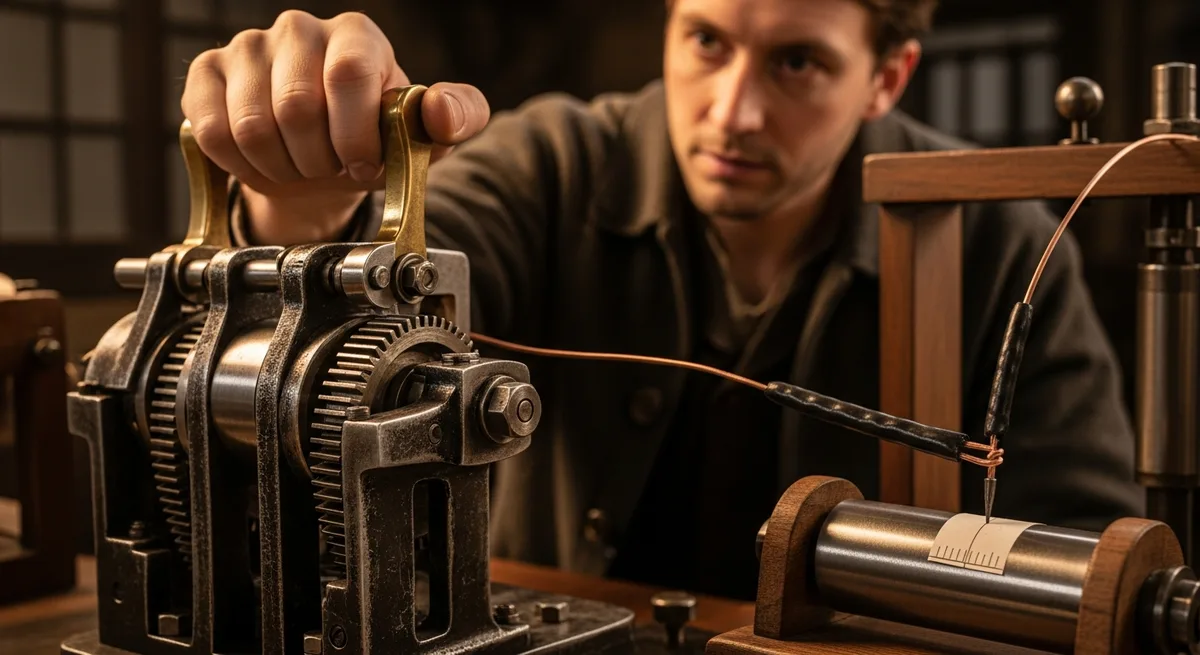
In 1837, the engineer’s workshop was thick with the acrid, ionized tang of ozone and scorched metal, an atmosphere where every movement demanded a surgeon’s absolute focus. The operator, gripping the heavy brass lever, felt the alloy—with its dense 8.55 g/cm³ mass—resist his every twitch, as if the material itself harbored a stubborn, primordial reluctance to submit to human volition. This was no mere switch; it was a physical antagonism that had to be overcome, a kinetic struggle to force the 10.5 cm lever to surrender its inertia and close the circuit, transmuting raw muscular effort into an invisible impulse destined to traverse the void.
Beneath the levers lay a cast-iron cam mechanism, its surfaces subjected to 250 MPa of compressive stress, appearing like tectonic fractures frozen in an epoch of geological stasis. As these components engaged, emitting a low, rhythmic grinding, the engineers heard more than the friction of metal on metal; they heard the very cadence of time, embodied in a steady ten revolutions per minute. Each stutter of this gear-driven tapestry felt ordained, a mechanical destiny that, once the electrical cycle commenced, could no longer be undone.
The silver contacts, fashioned into discs a mere 0.1 cm thick, served as the liminal threshold between two disparate states of existence: static matter and pulsating energy. With a conductivity of 6.3 x 10^7 S/m, these points allowed the spark to leap across the gap in an instant, shielding the signal’s clarity from the encroaching rot of oxidation. Each contact functioned as a neural nexus, a point of vulnerability the operator was compelled to guard against the slightest mote of dust, for even a microscopic impurity within this precise molecular framework could instantly sever the entire flow of information.
A copper filament, one hundred kilometers in length, stretched across the landscape like an artificial, unfeeling nervous system; its 1.5 mm diameter seemed impossibly fragile against the weight of the responsibility it bore. Though its 5.96 x 10^7 S/m conductivity ensured minimal resistance, the 10 Hz pulses waged a constant war against the physical expanse, shedding a fraction of their original intensity with every passing meter. As the engineers pushed the potential to 10 volts, they felt the current become a living, fading breath—a ghost of energy they were tasked with preserving until the very last centimeter of wire.
Gutta-percha—a dark, organic polymer—encased the copper core, forming a 0.1 cm thick insulating sheath that shielded the signal from the chaotic, humid indifference of the environment. With a dielectric constant of 2.5, the material prevented the current from bleeding into the surrounding ether, maintaining electrical integrity throughout the long transit. It was a silent, implacable armor, ensuring that the current would not lose its way in the vortex of the elements, reaching its destination in its pristine, original form.
Oak pylons, like petrified sentinels, rose toward the heavens, suspending this entire infrastructure ten meters above the earth. Their timber, with a density of 0.7 g/cm³ and a capacity to withstand 50 MPa of compressive stress, was the sole barrier separating the copper nervous system from the damp, corrosive embrace of the soil. Each pylon was more than a wooden frame; it was an engineering fulcrum, a structural bulwark preventing the fragile connection from succumbing to the gusts of wind or the relentless pull of gravity, which sought to drag the lines into the dust.
At the receiving end, iron electromagnets, possessing a magnetic permeability of 1000, captured the waning signal and, as if by some mechanical miracle, translated it back into physical motion. When the current reached these 2 cm components, they generated sufficient force to actuate a metal armature, producing a sharp, definitive click that echoed against the walls—a crisp, articulate reply. It was the singular moment where the intangible energy of electricity was reclaimed, rendered audible, and made undeniably real.
A strip of cotton-paper, coated in a 0.01 cm layer of graphite, became the canvas upon which history was inscribed. The paper, with a density of 0.5 g/cm³, was drawn through a system of oak rollers at a constant velocity, allowing the steel stylus to leave its indelible mark. This internal matrix, where physical motion intersected with electrical impulse, was the crucible where words were distilled into dots and dashes, etched into the graphite to await the scrutiny of future generations.
The steel stylus, though modest in scale, stood as a monument to engineering triumph, enduring the constant friction against the paper without a hint of structural fatigue. Its surface, hardened to 50 HRC, ensured that every stroke remained sharp and precise, regardless of the duration of the communication session. This tool was the final link, bridging the invisible current with the language of the human eye, transmuting raw energy into information that could be archived, analyzed, and understood.
The entire system relied upon atomic precision, where every 0.01 cm gap between contacts represented a critical threshold capable of collapsing the entire communicative chain. The engineers understood that within this delicate architecture, the smallest particle of dust or the slightest vibration could trigger a catastrophic loss of signal. Thus, cleanliness and mechanical stability were not merely conditions of labor, but existential requirements; without them, this intricate apparatus would revert to nothing more than a heap of inert metal and wood.
The copper, utilized in the lines, acted as a physical boundary, dictating the limits of how far information could travel through space, where a 10-ohm electrical resistance imposed rigid constraints on signal strength. Every kilometer was a skirmish against the laws of physics, a battle the engineers fought by increasing the sensitivity of the electromagnets, thereby striking a precarious balance between current intensity and mechanical response. This equilibrium was the only means of maintaining the connection, even as every additional kilometer presented a mounting challenge to the system’s survival.
The telegraph system became a manifesto of overcoming distance, where one hundred kilometers of copper wire forged a tangible link between two disparate points, yet the engineering paradox remained unresolved. The longer the line, the more the signal drifted from its original form, and the receiver’s response became increasingly dependent upon a distant, nearly extinguished pulse. The engineers were left with an eternal dilemma: how to amplify the signal to ensure its clarity without introducing the systemic noise that would inevitably compromise the entire mechanical precision of the machine.