Crushing Depths: Where Aluminum Meets Its Limit
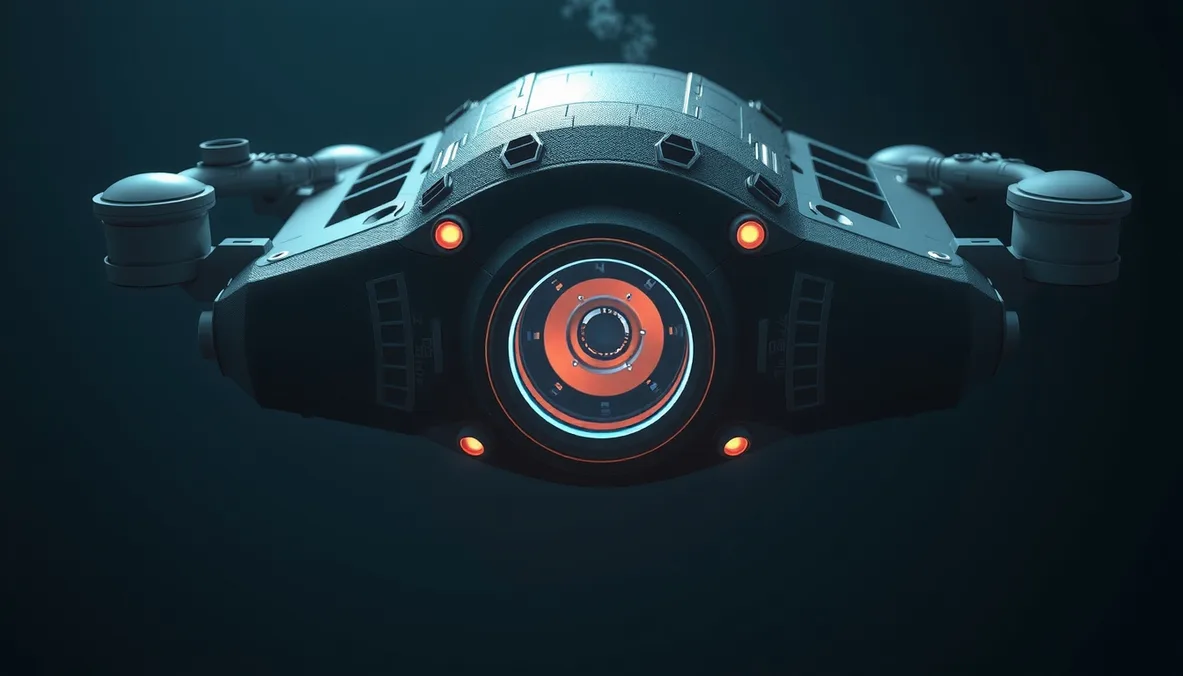
The pressure at the ocean floor is no mere abstraction; it is a visceral, existential weight that relentlessly seeks to equalize every irregularity, every void. When the T6 aluminum alloy housing descends to a depth of four kilometers, it is subjected to forces akin to a tectonic rupture. Here, the alloy’s Young’s modulus of 68.9 GPa functions not as a theoretical index, but as the final, fragile line between structural integrity and catastrophic implosion. The metal does not merely "house" logic—it engages in a brutal struggle against molecular compression, where every microscopic notch in the hull becomes a stress concentrator capable of reducing the entire system to metallic shrapnel in a heartbeat.
A grid of 256 piezoceramic elements endures a state of perpetual deformation. As a 100-volt pulse strikes the lead zirconate titanate, the material is physically distorted. A coefficient of 400 pC/N dictates that the ceramic is forced to generate waves in an environment that resists all movement. This is no delicate oscillation; it is a raw, kinetic exertion. Upon reaching a Curie temperature of 365°C, the ceramic becomes thermodynamically unstable. Should the control algorithm lag by even a millisecond, the internal structure begins to disintegrate, spawning micro-cracks that, under 100 MPa of pressure, propagate like a malignancy, irrevocably shattering the precision of the acoustic field.
The thermal management unit within this system does not breathe; it wars against the laws of physics. The 50°C threshold represents a point of technical expiration. As the FPGA processor, cycling at 100 MHz, processes incoming data, it generates heat with nowhere to dissipate. In the confined space, convection is stifled, causing thermal accumulation at the junctions. If heat exchange through the housing falters for even a second, the semiconductors begin to alter their conductive properties. This is no "harmony with nature"—it is a constant engineering tightrope walk, balanced on the razor’s edge where the velocity of electronics intersects with the physical endurance of matter.
The PMMA lens, focusing a 200-watt signal, reveals a different pathology: acoustic cavitation. When energy becomes critically concentrated at a focal length of 150 millimeters, water molecules surrounding the lens begin to dissociate. Microscopic gas bubbles form, and as they collapse under the ambient pressure, they deliver localized, percussive strikes to the lens structure itself. This is erosion occurring in real-time. No polymer is entirely immune to such bombardment. We observe the lens surface gradually lose the uniformity of its refractive index, meaning that after 100 hours of operation, the precise 10-degree beam becomes distorted, as if one were peering into the abyss through a veil of fog.
Doppler shift calculations demand an absolute precision often compromised by the uneven density of the water column. A margin of error of 0.1 m/s is our target, yet reality is far more recalcitrant. Thermal layers in the deep ocean act as optical prisms, bending sound waves into deceptive paths. We receive reflections that are fundamentally "false." The sonar may project an object where none exists, as the speed of sound in water fluctuates according to salinity and pressure. This is not "digital intuition"—it is a complex filter system struggling to isolate signal from ambient noise, frequently faltering due to the refractions induced by thermoclines.
When we integrate graphene, we aim to suppress noise below -50 dB, yet this will only birth a new crisis: an excess of sensitivity. The system will begin to register "noise" previously obscured: the turbulence of underwater currents, the vibrations of biological organisms, even the geological creaking of the planet’s crust. We are opening the door to informational overload. The FPGA processor, with its 1 GB of memory, becomes a bottleneck. To process this entire vibrational history will require not merely quantum-level power, but an entirely new paradigm of data rejection. We are no longer searching for an object; we are drowning in the noise of information.
This system is no symbiosis of the future. It is a cold, calculated instrument designed to extract data from an environment fundamentally hostile to human technology. Every bolt, every circuit board is engineered to withstand an environment that physically seeks to crush it. This is engineering resilience, not philosophical convergence. When we view reflections on a screen, we are not seeing the secrets of the ocean, but electrical signals filtered through thousands of physical and logical barriers. It is the ultimate proof of our limitation—we cannot perceive the deep directly; we must decompose it into numbers to grasp even a fragment of what transpires in the dark.
In the future, as these devices grow more sensitive, we will confront a paradox. The more we learn about the vibrations of the ocean floor, the more our own instruments will disrupt the natural environment. Every piezoceramic pulse, every 200-watt acoustic burst is an intrusion. We observe, yet in the act of observing, we alter the subject. This is not harmony; it is constant intervention. We are foreign bodies that, to survive the depths, must perpetually adapt, altering our physical structure to mirror the ambient pressure, yet we will never be a part of it.
This technology is our answer to the unknown, yet it is an answer constructed of metal and logic—both inherently transient. The housing will corrode, the ceramic will fracture, and the processors will become obsolete. This is the only true cycle: to create a tool that deciphers a fraction of the truth before it is consumed by the very element it sought to know. We do not perfect ourselves through philosophical union, but through relentless error analysis and structural reinforcement. Every lost millisecond, every overheated contact is a lesson inscribed into new materials, in the hope that the next iteration will withstand one more atmosphere of pressure.
Ultimately, this sonar network will be merely another layer of human-generated noise in the ocean depths. We believe we are reading the narrative of the ocean, but in truth, we are only gathering the reflections of data we generated ourselves. It is a closed loop, where engineering becomes the only validation of our reality. As long as we see these numbers, we feel secure, yet the deep remains a step ahead, regardless of how powerful our FPGA processor or how resilient our T6 aluminum alloy. We listen to the silence, hoping to find ourselves within it, but we find only our own reflection, returning through a grid of 256 elements.