Resonance of the Iron Matrix
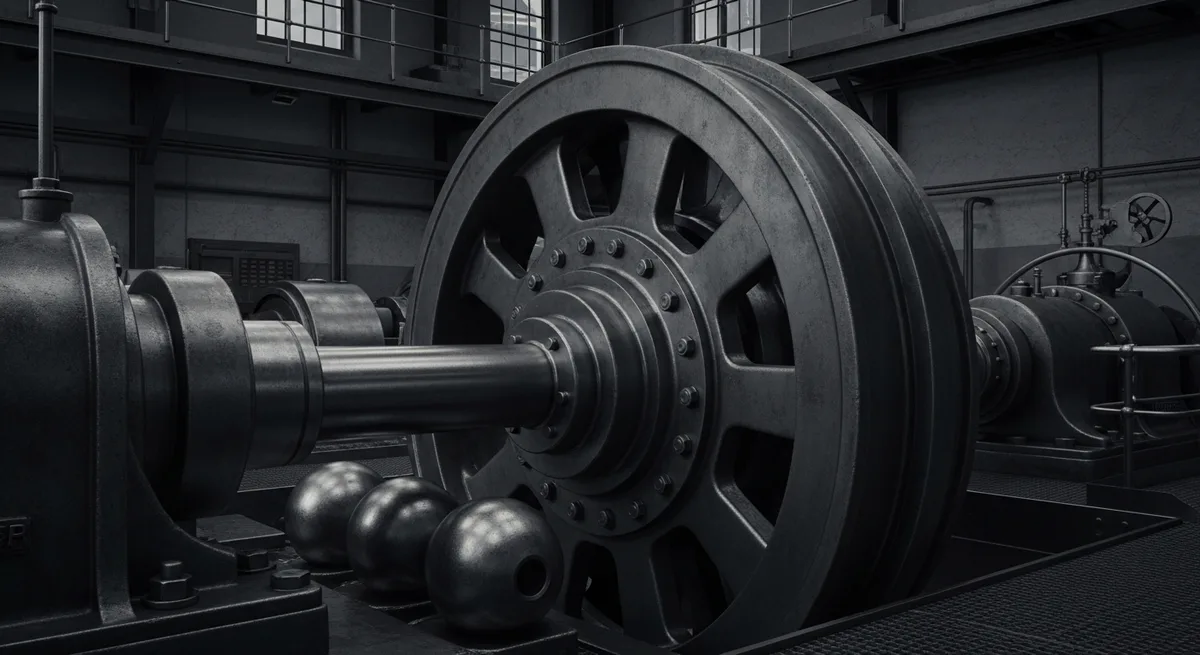
The steam engine hall was saturated with a thick, oil-heavy atmosphere, where every molecule vibrated in sympathy with a relentless, low-frequency roar. As the Watts-Hyde turbine accelerated, the cast-iron foundation did more than merely bear the weight; it absorbed a colossal kinetic impulse, transforming the floor into a living, pulsating organism. Carbon atoms, interstitial within the iron matrix, imparted an improbable rigidity, allowing the cast iron to withstand compressive loads of 170 MPa—stresses that manifested as a constant, muffled groaning of the metal. The walls, thirteen millimeters thick, functioned as an acoustic filter, isolating the chaotic expansion of steam from the environment like a monolith wedged between the currents of a torrential mountain river.
The shaft, forged from a steel alloy with a 0.03% carbon content, served as the system’s spine, subjected to a constant, unforgiving torsional strain. Its yield strength of 250 MPa prevented the rod from buckling, even as the energy transmitted through the bearing sleeves transmuted into a palpable, ambient heat. Each rotation of this shaft was a struggle against the plasticity of the metal—a trait tempered by engineers through a precise thermal cycling process that structured the internal matrix to maintain geometric truth even under extreme load.
The flyballs, cast from steel with a density of 7,850 kg/m³, acted as the system’s inertial arbiters. When the angular velocity reached 157 radians per second, centrifugal force drove these masses outward like predators coiled for a strike. Their movement was a physics-dictated response to steam pressure, where every millimeter of displacement from the axis translated into a direct adjustment of the valve position, transmuting chaotic steam flow into controlled, rhythmic power.
The bearing liners, cast from Babbitt—a mixture of tin, antimony, and copper—acted as a sacrificial buffer, shielding the steel shaft from attrition. This alloy, characterized by a coefficient of friction of 0.05, served as the mediator between the searing shaft and the static cast-iron structure. Even with surfaces of 2.5 centimeters in diameter enduring immense pressure, the material’s fabric possessed enough ductility to deform slightly, preventing metal-to-metal seizure and ensuring the system did not succumb to the crushing grip of its own power.
The turbine blades, resilient and bronze-wrought, were alloyed with 10% tin and 2% zinc, yielding a Young’s modulus of 100 GPa. They sliced through the air, bracing against steam pressure that transformed them into sharp, rotating scythes. A density of 8,700 kg/m³ provided the blades with the necessary inertia, while their fatigue resistance ensured stability even after thousands of operational hours, during which every pulse of steam acted as a continuous mechanical hammer against the bronze surface.
The control linkages connecting the flyballs to the throttle relied on a 0.2-millimeter gap between the joints—what the engineers termed the "living clearance." This was the critical threshold where any inaccuracy threatened to collapse the entire kinetic balance; too much clearance eroded the system’s sensitivity, while too little allowed thermal expansion to seize the mechanism. The system functioned as a mechanical brainstem, forcing the physical retreat of the flyballs to trigger the closing of the throttle valve, thereby modulating a steam flow capable of driving entire industrial districts.
Beyond its structural utility, the cast-iron housing acted as a thermal conductor; its thermal conductivity of 50 W/mK allowed it to dissipate the heat of internal friction and steam into the surrounding air. The engineers understood that if the housing could not "breathe" heat, the 170 MPa compressive strength would be rendered moot, as the heated metal would inevitably lose its rigidity. This delicate equilibrium between mass and thermal stability was achieved only after exhaustive iteration, where each pour of the alloy was an act of construction, immortalizing engineering patience.
The shaft’s rotation at 1,500 RPM generated a torsional load of 350 MPa, which the forged steel had to endure while pulsing in unison with every steam discharge. It was a metallic lament, a testament to the immense flow of energy harnessed through the ingenious logic of levers. The internal matrix functioned as a unified organism, embodying the first step toward automated control—a mantle later assumed by electronics, leaving this giant to rust in the shadows of history.
The principle of biomimicry employed by the engineers echoed the vestibular apparatus of the human inner ear, where the movement of the flyballs informed the turbine of shifts in velocity. The system’s reliability rested upon stringent tolerances, where every figure—from the thirteen-millimeter distance between the balls to the 0.5-millimeter radial clearance—was the result of an engineering triumph. It was a mechanical riposte to the chaos of nature, which the engineers sought to master through nothing more than metal, pressure, and repetitive geometry.
This mechanism remains a symbol of a fundamental engineering dead-end, where the latency of reaction time, though appearing instantaneous, became the boundary between power and stability. Attempts to reduce the mass of the flyballs or alter the leverage of the linkages inevitably increased the system’s susceptibility to mechanical fatigue. The engineers faced an intractable dilemma: how to reconcile physical inertia with the necessity of responding instantly to spikes in steam pressure, when the system’s response time always lagged behind the shifting load, inducing a perpetual, unresolved mechanical oscillation.