Steam Giant: Parsons' Gamble
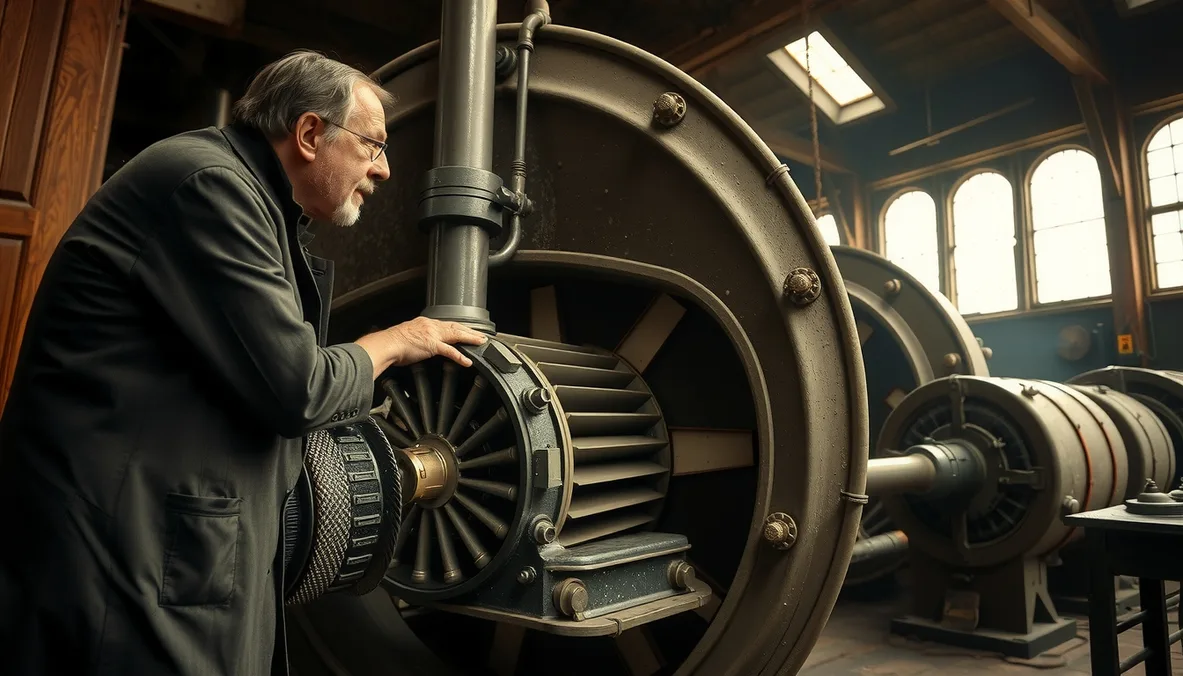
Newcastle, 1884, was no theater for romance. Standing in his workshop, Charles Parsons felt not the swell of pride, but the taut, vibrating anxiety of a man asking a singular, terrifying question: would his creation shatter into shrapnel, or would it fundamentally rewrite the laws of motion? The air was thick, cloying with the acrid stench of coal-smoke and a metallic particulate so dense it left a bitter, galvanic tang on the tongue with every breath. Parsons understood that the reciprocating engine—those lumbering, violent monsters of iron and steam—had reached its terminal physical limit. They were wounded beasts, tearing themselves apart with every jarring, stuttering stroke. He was chasing something else entirely: not the friction of combat, but the fluid grace of flow.
The cast-iron casing, a cylinder of 1.5-meter diameter, sat upon its concrete plinth like a toppled deity. It was no architectural triumph; it was a brutal, 5-centimeter-thick barricade designed to contain steam pressurized to 10 bar, a volatile vapor heated to the edge of instability. Every pore in the housing, every microscopic imperfection in the casting, stood as a testament to engineering dread. Parsons feared the vibrations more than the pressure itself—the harmonic tremors that could, in a fraction of a second, reduce the entire assembly to jagged debris. A compressive force of 400 MPa bore down on the casing, an invisible, relentless weight akin to the crushing depths of the ocean, where metal must either yield or fracture.
Inside, the high-carbon steel blades appeared impossibly fragile against such immense kinetic loads. Their 0.5-meter-long edges, arrayed with mathematical precision, were engineered to capture steam screaming past at 300 meters per second, forcing the vapor to surrender its energy to the shaft rather than rebounding. Yet, the reality was unforgiving: a modulus of elasticity of 200 GPa was not always enough to stave off deformation. Parsons recalled nights when the blades, whipped by centrifugal force, began to "sing"—a high-frequency, harrowing shriek signaling that the metal had reached its fatigue limit. As temperatures spiked toward 200°C, the steel expanded, the blade tips flirting with the casing walls in a dance of catastrophic friction.
The shaft—a 0.2-meter-diameter rod of forged steel—was the crucible where all ambition converged. It was tasked with sustaining a torque of 1,000 Newton-meters, a force that, if misaligned, would have twisted the steel like soft copper wire. The yield strength of 500 MPa was the razor-thin margin between engineering immortality and a humiliating mechanical failure. When the turbine hit 1,800 RPM, the shaft blurred into a ghostly shadow, its vibration bleeding through the very foundation of the factory floor. It was not a joyous hum, but a deep, anxious thrumming—the low-frequency rumble of an approaching storm.
The bronze bearings were the system’s weakest link. Although their 100 GPa modulus of elasticity was intended to ensure fluid rotation, they were in a state of perpetual thermal crisis. Parsons watched as the lubricating film, meant to isolate bronze from steel, evaporated under the heat, leaving the metals in raw, grinding contact. It was a war of attrition. If the lubrication faltered for even a heartbeat, the bearings would begin to "scream"—the sound of metal devouring metal, releasing a scorched, acrid stench that instantly saturated the shop. It was a brutal reminder that even the most elegant calculations are rendered meaningless by the cold, relentless physics of friction.
The brass nozzles—tiny, precision-bored apertures—were the gatekeepers of velocity. Their 0.01-meter-diameter orifices were under constant siege by erosion. Hot steam, carrying microscopic impurities, acted like a slow-motion abrasive, scouring the brass edges over months and warping the geometry of the flow. Parsons often cursed this inevitable degradation. He knew his turbine was no perpetual motion machine; it was a delicate instrument being slowly, methodically dismantled from within by the passage of time and the laws of thermodynamics.
The governor, a mechanical speed regulator, was the only bulwark against self-destruction. Its levers and valves, tethered to the steam lines, reacted to every fluctuation in load. But the system was imperfect. When electrical demand dropped suddenly, the governor would lag, and the turbine would surge toward a lethal velocity. Parsons would then rush to the valves, grabbing heavy wrenches, his hands feeling the violent, high-frequency shuddering of the metal as he manually throttled the steam. This was no grand industrial revolution; it was a sweaty, perilous labor where one’s reputation—and life—hung in the balance.
The rivalry with the manufacturers of reciprocating engines was ruthless. They dismissed Parsons as a dreamer whose "spinning toy" would never survive the brutal reality of factory life, pointing to their own massive, slow-moving pistons as the gold standard of stability. Parsons remained silent, even as his bearings melted and his blades shattered under the strain. He knew the future belonged to rotary motion, but that future was being forged in the crucible of failure, burnt-out bearings, and sleepless nights spent deciphering why metal behaved with such stubborn, unpredictable defiance.
Every successful test was merely a fleeting reprieve before the next crisis. The condenser, the pump, the boiler—they had to function as a single, flawless organism. But pipes burst, gaskets wept steam, and pressure fluctuations forced the entire system to "breathe"—expanding and contracting until the metal succumbed to fatigue. The engineers who worked alongside Parsons remembered not just the triumphs, but that persistent, gnawing anxiety whenever the turbine emitted an off-key note. It was not music; it was a warning that somewhere deep within the iron shell, a process had begun that they could not yet fully master.
Today, we see only the efficiency of the turbine, but in 1884, it was a war against entropy. Parsons did not create a miracle; he created a tool that demanded constant vigilance, precision, and the courage to court disaster. His turbine was a victory not over nature, but over the human limitation that failed to see how speed and power could be harnessed not through brute force, but through an elegant, albeit fragile, mechanical flow. Every bolt, every steel component, stands as proof that the most powerful inventions are born from error, sweat, and an unyielding desire to reshape the world, regardless of the technical abyss that stands in the way.