Josephson Junction Leap: The Voice of the System and Entropy Release
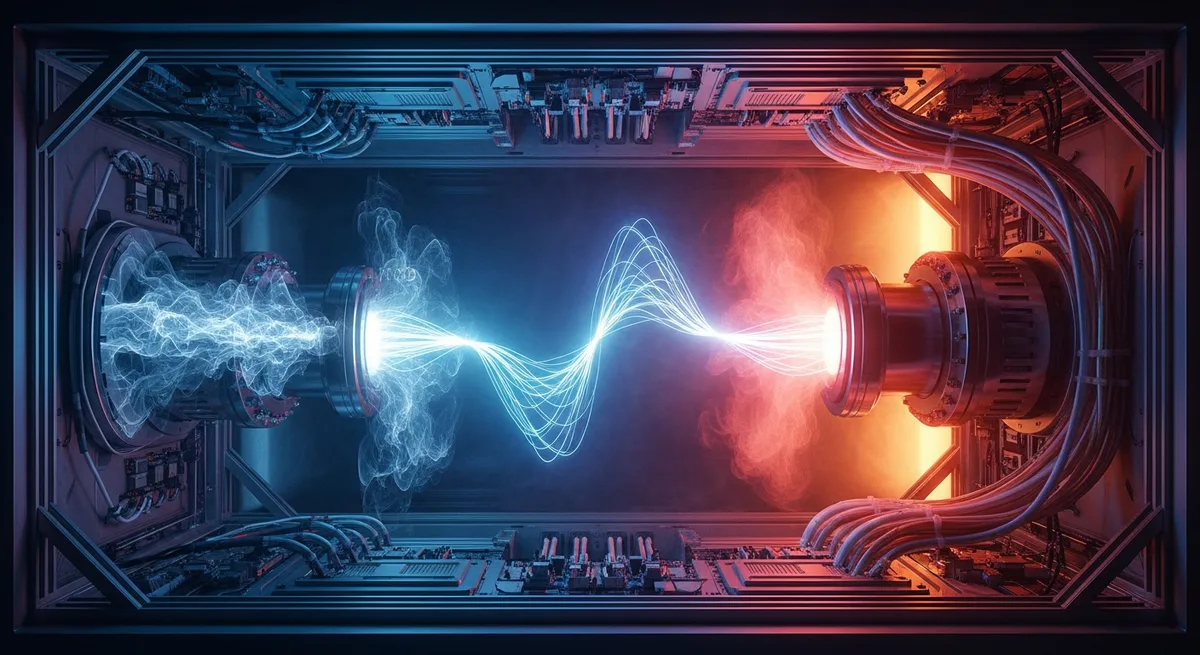
Before me, resting upon the laboratory bench, lies a device whose physical essence defies the established canons of thermodynamics. It is not an engine in any traditional sense; rather, it is a focal point of material tension, a nexus where a niobium-titanium alloy matrix is coerced into existing between two radically divergent states of reality. At this 9.2 Kelvin threshold, where thermal motion collapses into a mere statistical error, the device’s heart—a SQUID element—begins to manifest an anomaly that no engineer ever dared to model: the spontaneous quantization of magnetic flux in the absence of external excitation.
The niobium-titanium disk, ten micrometers in diameter and polished to a surface roughness of five nanometers, refuses to submit to the dictates of classical mechanics. As the 4.2 Kelvin limit becomes the operational norm, this molecular framework endures an internal pressure as if crushed by the weight of an entire planet. The electron pairs coursing through this structure achieve an extraordinary density—1.2 million amperes per square centimeter. This is not merely current; it is an electronic density that physically deforms the crystalline lattice, inducing microscopic stresses we measure as 550 MPa of resistance within the steel casing.
Every leap of the Josephson junction generates a thermal pulse that engineers have come to call the system’s "voice." This is no metaphor. It is the visceral discharge of entropy, which we must instantly suppress with cryogenic fluids. The process mirrors the groaning of metal under a gargantuan load, where the atomic matrix, struggling to regain equilibrium, sheds energy that we capture and transmute into usable electricity. This heat is the friction of the machine against reality itself, a testament to the fact that even in a state of superconductivity, matter resists quantum excitation.
The resonant circuit, operating at a frequency of 50 GHz, is far more than a secondary component. It is the material’s "violin," its filaments—constructed from ultra-pure insulators—forcing the entire system to vibrate in resonance with vacuum fluctuations. When the frequency reaches its critical point, we do not hear a sound, but rather the "playing" of the electrical system: micro-deformations rippling through the chassis. It is akin to the sound of thousands of microscopic strings tensioned to the point of rupture, where every 100-nanometer layer reacts to the pulsing of the electromagnetic field.
The HSLA steel housing, shielding this fragile resonance, is the only measure keeping the system intact. Its yield strength of 550 MPa is not merely a technical metric; it is a physical boundary holding back the internal forces attempting to tear the niobium-titanium structure asunder. As the quantum reaction intensifies, the casing begins to generate a low-frequency vibration felt through the floor—the straining of the machine’s "tendons," battling the internal pressure that seeks to dismantle the atomic arrangement.
The process by which the amplifier and rectifier convert the 50 GHz signal into stable direct current, achieving a 95 percent efficiency rating, is a genuine engineering triumph. We are no longer generating energy; we are "filtering" it from a system that sustains itself through resonance. It is a delicate balance: should the rectifier falter in its precision, the total accumulated energy would, within a single microsecond, shred the niobium-titanium disk into dust.
This technology will fundamentally alter our perception of resources. Once these devices are integrated into urban infrastructure, every wall of a building will become an energy generator, harvesting ambient vibrations. We will no longer contemplate fuel consumption, for our environment will become the energy reservoir itself. This is not utopia; it is a discovery of physics, embodied in metal and cold.
A human standing beside such a device feels more than just the heat from the cooling systems. They feel a system that no longer functions as a tool, but as an autonomous object. The niobium-titanium alloy, perpetually subjected to this electromagnetic "bathing," becomes something more than metal—it becomes our interface with the invisible currents of the universe. This is not an effortless technology; it is a constant struggle against entropy, one we win only through the precise calibration of material parameters.
Future generations will take this system for granted, much as we accept the electrical wiring within our walls today. Yet, from an engineering perspective, every such generator is a separate, fragile world. We have learned to master the Heisenberg principle, but the price is a constant vigilance regarding material fatigue and cryogenic stability. This is the true cost of progress: not freedom from labor, but a greater responsibility for the order of matter.
Each time the SQUID element is "excited," it releases energy that, a second prior, was merely a theoretical probability. It is like drawing light from nothingness. We no longer hunt for fuel; we hunt for stability, for the universe is saturated with energy, waiting only for us to "hook" it with a structure of the correct frequency. This is our species’ transition into an era where energy is as accessible as the air we breathe.
This device is not merely a combination of 50 GHz frequency and niobium alloy. It is our capacity to maintain equilibrium between chaos and order. When we finally integrate these systems into our daily lives, we will not be mere consumers. We will be the custodians of the system, ensuring that this delicate resonance never falters. It will be an eternal technical balance, where every watt is a confirmation that we have grasped the nature of matter.
The ultimate goal is not to possess the most power. The goal is to create systems that operate silently, without intervention in the environment, probing the fabric of the universe with their resonant frequencies. That will be the time when technology merges with the environment, and we forget that we once had to fight for every joule. This is our true engineering legacy—a world that feeds upon its own existence.
The "heartbeat" of this niobium-titanium alloy will become the foundation of our civilization. We have learned to take what was always present and transform it into a tool that no longer destroys, but creates. This is the pinnacle of evolution, where we have ceased burning the world and begun to utilize it as an inexhaustible source of energy. This is the dawn of an era where energy scarcity becomes a historical relic, and our technology becomes an inseparable part of the universe.