The Dissonant Forge: A History of Trial and Error in the Age of Steam
In 1788, the Soho Manufactory in Birmingham was thick with the acrid, visceral resonance of heated lubricant and pulverized cast iron; in James Watt’s workshop, silence was a rare, fleeting anomaly. Observing the nascent prototypes of his governor, the engineer noted a disturbing structural fatigue: microscopic fissures manifesting on the surface of the cast-iron spheres, defying all logical explanation. While calculations dictated that the 1.36-kilogram masses should withstand 150 megapascals of compressive force without compromise, the metallic fabric was, in reality, undergoing a strange molecular displacement. It emerged that the sand molds used in the casting process were being dampened unevenly, inducing internal stresses during cooling that engineers later mistook for simple operational wear.
Each sphere, with a diameter of 152.4 millimeters, presented a metallurgical enigma, as the uneven cooling created an internal matrix where the 100-gigapascal Young’s modulus fluctuated in direct correlation to the distance from the center. The sphere was not a monolithic entity, but a layered construct—an outer shell harder, yet significantly more brittle, than its core. As the machine reached 200 revolutions per minute, this heterogeneity forced the spheres to vibrate not from external friction, but from a fundamental imbalance of internal forces, a condition exacerbated by a 0.26 Poisson’s ratio that compelled the metal to expand along unpredictable vectors.
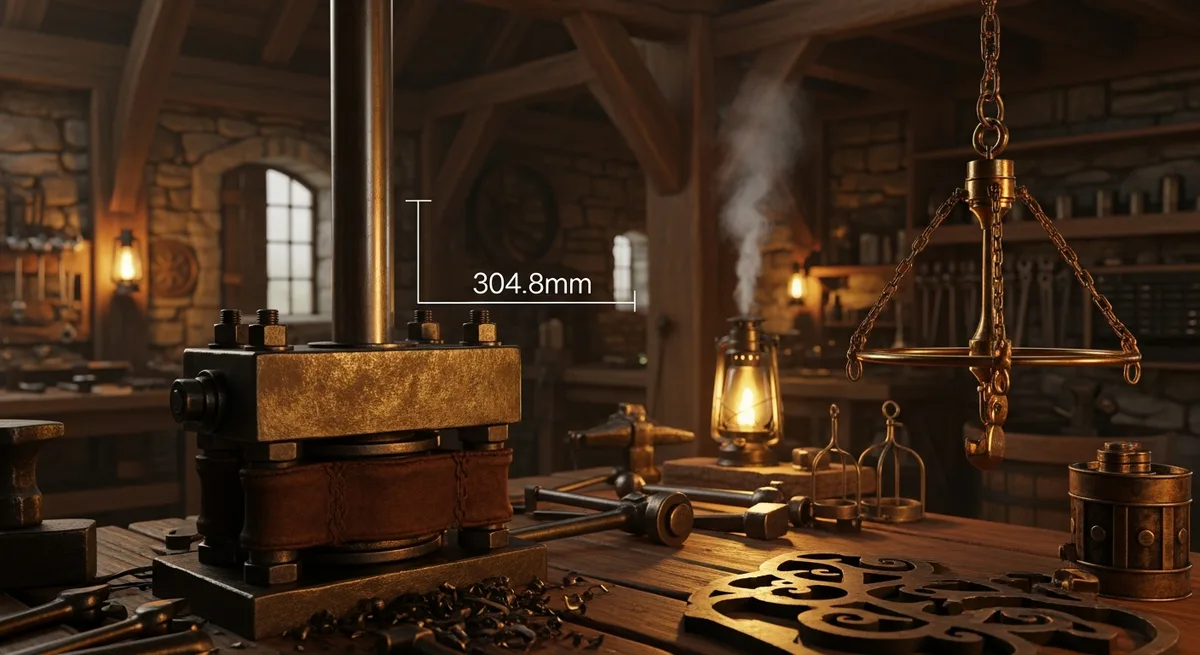
The vertical spindle, a 304.8-millimeter axis, was forged from a specific carbon-rich steel commissioned by Watt from the Sheffield foundries. This component was tasked with enduring not only the rotational torque but also a constant, near-invisible polishing process inflicted by the fine particulate impurities suspended in the lubricants. Though engineers viewed the spindle as an immutable pillar of the system, microscopic analysis later revealed that, due to continuous rotation at speeds of 10.47–20.94 radians per second, the steel’s crystalline structure gradually oriented itself along the axis, forming a fibrous texture that increased resilience at the cost of ductility.
The bearing housings were an engineering agony, as the metallurgy of the era could not provide alloys sufficiently hardened to withstand prolonged contact without the catastrophic loss of lubrication. When temperatures within the bearings climbed past a critical threshold, the lubricant—typically a mixture of animal fats and graphite—would lose its viscosity and bleed away, leaving the metal to face direct, unbuffered contact. This triggered instantaneous surface “welding,” where microscopic metallic shards fused together, only to be brutally torn away as the spindle continued its rotation, leaving behind craters that further compounded the friction.
The fork-like mechanism linking the spheres to the spindle was cast in iron, yet Watt frequently contended with the assembly’s inability to withstand sudden velocity shifts. The 12.56–50.24 newtons of force acting upon these joints often exceeded the tensile limit, particularly if air bubbles had been trapped during the casting process. It was for this reason that engineers pioneered “wrought-cast” technology, where the cooled metal was subjected to additional mechanical impacts, shattering the irregular crystalline structure and forcing the material into a denser, more uniform frame.
The lever, known as the governor’s arm, pivoted on a fulcrum of hardened bronze, a deliberate choice to avoid the iron-on-iron friction that would have rapidly consumed the bearing surfaces. This lever functioned as a primitive analog computer, translating 0.125–0.5 newton-meters of torque into precise valve displacement. Yet, even the most infinitesimal wear on the bronze induced “backlash,” which operators termed “the machine’s hesitation.” This temporal gap between the rise of the spheres and the subsequent reduction in steam flow was the primary reason steam engines could never achieve absolute rotational stability.
The throttle valve, the final link in the chain, was a perennial source of failure, as the steam was not merely hot, but contaminated with boiler scale and moisture. This aggressive slurry would scour the valve seat within months, rendering the 12.56-newton force required to close the valve insufficient if it “stuck” to its housing due to hardened deposits. Watt attempted to introduce precision-ground seals, but these only increased friction, rendering the machine even more hypersensitive to any mechanical resistance.
The connecting rods, forged from hardened steel, were prone to plastic deformation if an operator opened the main steam valve with excessive haste. While the structural frame appeared robust, it had been calculated for static loads, not the dynamic shocks induced by a sudden pressure spike. Each such surge left an invisible trace—a micro-fissure that propagated slowly through the metal’s fabric until the rod simply sheared in two, invariably at the most inopportune moment.
The central control principle, predicated on centrifugal force, was so delicate that even minor fluctuations in ambient temperature altered the inertia of the spheres by changing the lubricant’s viscosity within the bearings. When the 50.24-newton force became dominant, any additional friction in the bearings acted as a brake, forcing the spheres to rise lower than the theoretical trajectory required. This created a paradoxical state: the hotter the machine ran, the slower its control mechanism reacted, ensuring that Watt’s governor was never truly autonomous.
The feedback loop, while ingenious in its simplicity, was constrained by the physical inertia dictated by the mass of the spheres. It was this very mass that necessitated the governor’s lag: when steam pressure dropped, the spheres could not instantly descend due to their kinetic energy, causing the machine to operate at lower revolutions than intended for a duration. This “mechanical latency” was hard-coded into the system’s physics and proved impossible to eliminate, for to reduce the mass of the spheres was to forfeit the system’s ability to overcome bearing friction.
The kinetic energy stored in the rotation of the spheres acted as a mechanical buffer of inertia, yet this property possessed a dark side. If the machine were to stop abruptly, the moment of inertia of all rotating masses had to dissipate somewhere, often resulting in the governor becoming the final component to collapse. The spheres, subjected to immense centrifugal force, would occasionally break free from their linkages, becoming lethal projectiles that shredded everything in their path.
The biomimicry Watt employed by observing natural processes was successful only to a point, as the mechanical system lacked the biological capacity to compensate for its own degradation. Once the bearings wore and play developed, the system lost its “homeostasis,” and operators were forced to manually adjust the tension, reducing the automatic process to a semi-mechanical game. It was a stark demonstration that engineering could never fully replicate biological adaptation.
The selection of materials, constrained by the cast-iron technologies of the day, meant the governor was a perpetual compromise between weight and strength. Because cast iron was brittle, engineers were forced to increase the dimensions of the parts, which only increased inertia and necessitated even stronger supports. This closed technical loop was the primary barrier preventing the creation of lighter, more precise systems until the advent of high-temperature steel casting in the mid-19th century.
Ultimately, this mechanism remained trapped between its physical limits and its engineering elegance. While it allowed for the mastery of immense steam power, the governor remained sensitive to temperature fluctuations that altered lubricant viscosity and, by extension, bearing friction. This dependence on environmental conditions meant that perfect stability remained an unreachable ideal, and every revolution was merely a precarious balance between mechanical precision and the inexorable rise of physical entropy, dictated by the shifting viscosity of the lubricant in response to the ambient heat.