Bramah's Buried Giant: The Power of High-Pressure Engineering
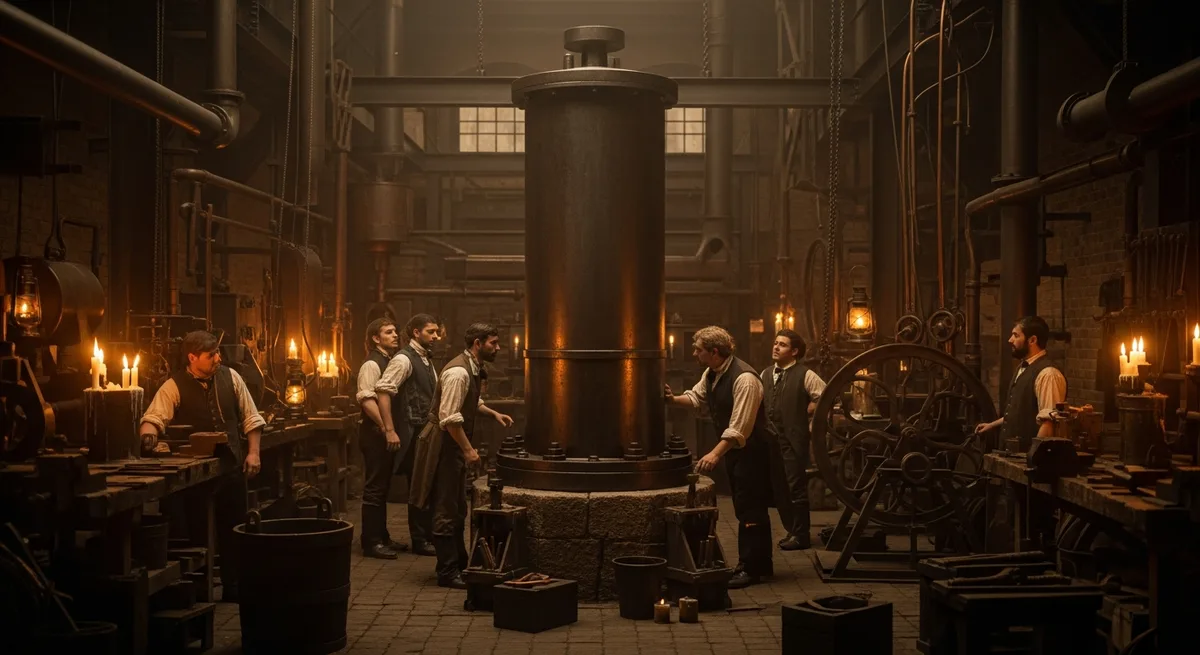
The London suburbs of 1795 were thick with the acrid perfume of damp coal and the metallic tang of freshly poured iron, a sensory backdrop to the shadows coalescing within Joseph Bramah’s workshop. Here, a mechanism was taking shape—a device intended not merely to displace weight, but to fundamentally rewrite the laws of physics. Two and a half tons of cast iron, anchored deep into a limestone foundation, functioned as more than a static monument; it was a spine fused to the earth, every atomic bond, tightened under 50 MPa of compressive force, straining toward the ideal of absolute support. As the engineers gathered around this monolith, they could feel the stone trembling beneath their feet, absorbing a latent potential energy that hung in the air, heavy and electric, like the atmosphere preceding a violent storm.
At its core lay a cylinder of malleable iron—a formidable engineering challenge whose 0.3-meter diameter concealed a metallic fabric capable of withstanding a tensile strength of 250 MPa. This structure, operating as a closed molecular matrix, was forced to contain internal stresses comparable to the shifting of tectonic plates, manifesting in a low, almost imperceptible groan of stressed metal. When water, with its viscosity of 1.002 mPa·s, surged into the chamber, the walls—despite their relative thinness—tautened to their limit, transforming into a rigid, almost sentient organism that grappled with the fluid’s volatility, struggling to preserve its geometric integrity.
To ensure this internal matrix would not succumb to the ravages of friction, Bramah employed a 0.001-meter layer of tin to line the cylinder’s interior. This was no mere surface treatment; it was a sacrificial interface, where a surface roughness of 0.5 μm allowed the piston to glide as if through a stream of solidified light. This tin fabric acted as a buffer between the brutal hardness of the metal and the hydraulic pressure, smoothing out every microscopic irregularity that would have otherwise become a fatal fissure, capable of shattering the system’s delicate equilibrium.
The forged steel piston, acting as the machine’s primary muscle, was fashioned from metal with a density of 7.8 g/cm³; its 500 MPa strength allowed it to serve as the conduit between human volition and raw force. Its mirror-like surface, polished to a tolerance of 0.5 μm, reflected not only the flickering candlelight of the workshop but the inherent fragility of the engineering itself, where 0.01-meter grooves, cut with surgical precision, were tasked with arresting every pulse of pressure. This was the component subjected to the most punishing daily loads, a precision instrument capable of transmuting human effort into 94.2 kN of destructive force, sufficient to alter the very nature of any material it encountered.
The soul of the piston resided in its capacity to withstand the deformation induced by a 10 MPa working pressure, which pulled the entire apparatus taut like a string stretched to the point of snapping. As water flooded the chamber, the piston’s rigidity refused to yield, rendering the device not merely a tool, but a precisely calibrated expression of force. In this process, the exertion of human muscle was distilled into a brutal, controlled energy that compelled the metal to submit, as if the material itself acknowledged its own limitations when confronted with such hydraulic intensity.
Attached to the piston, a steel ram with a diameter of 0.1 meters became the focal point where accumulated energy met resistance, while a 0.05-meter rod transmitted that force without dissipation. This was a structural nexus, allowing the ram to sense every moment of material compression as wood or metal began to yield under the unbearable weight. Each movement of this component was a negotiation with matter, where force was transferred directly, with a brutal efficiency that allowed Bramah to dictate his terms to the natural world.
Brass valves, possessing a density of 8.5 g/cm³, functioned as the system’s arteries, governing the fluid flow; their 300 MPa tensile strength allowed them to withstand pressure spikes reminiscent of a sudden surge in a circulatory system. These 0.05-meter components were engineered to render even the slightest leakage an impossibility, making the 0.5 μm surface finish a critical performance metric. Each opening and closing of a valve was akin to a heartbeat, regulating the rhythm of the system and ensuring that not a single particle of energy was squandered through uncontrolled fluid discharge.
The hand-operated pump, forged from massive cast iron, became an extension of the operator’s will, forcing water toward the cylinder, where a 0.2-meter diameter and 0.3-meter stroke generated 5 MPa of pressure—a force felt by the human frame as physical resistance in every movement. It was a mechanical dialogue, where muscular labor was converted into hydraulic power, flowing through the pipes like vital energy. Each stroke was physical proof that humanity could master the elements, transmuting fatigue into the machine’s power, which would later be unleashed with terrifying force.
The movement of water within the system was a precisely calculated process, where a flow rate of 0.01 m³/s filled the cavities, driving the piston upward at 0.1 m/s, with an acceleration of 0.5 m/s² sufficient to generate a powerful impact. Yet, Bramah managed to harness this force, grounding every stage of the process in the principles of hydrostatics, which prevented the device from spiraling into chaos. It was a subtle balance between velocity and power, where every movement was controlled to avoid structural failure resulting from excessive inertia or sudden pressure drops.
The physical load borne by the ram was so immense that a work output of 10 kJ seemed miraculous, particularly given the 80 percent energy efficiency—a testament to an engineering subtlety where friction had been reduced to an absolute minimum. Force was transmitted without superfluous loss, transforming this machine into a device that did not waste energy, but rather hoarded it, only to release it in one precise, world-altering motion. This was the zenith of engineering, where every component operated at peak capacity, ensuring that every joule of the operator’s input was converted into purposeful impact.
The selection of materials was dictated by the necessity of achieving a balance between mass and rigidity; the cast iron frame provided the inertia required to absorb pressure, while the properties of the malleable iron allowed the cylinder to remain elastic under extreme loads. Forged steel, in turn, provided the necessary hardness for the moving parts subject to the greatest wear, ensuring the machine’s longevity. This combination of materials was no accident; it was a calculated engineering decision that yielded a reliable, durable device capable of withstanding constant, grueling labor.
The process of wear was inevitable, yet the engineers managed to constrain it to a rate of 0.01 mm per year, with the tin lining inside the cylinder playing a critical role in reducing the coefficient of friction to 0.1. Each surface was polished with devotion, grounded in the knowledge that even the slightest scratch could become the genesis of catastrophe when 10 MPa of pressure acted upon the metal. It was a perpetual war against entropy, won only through meticulous maintenance, ensuring the machine remained in pristine condition despite the relentless physical burden it endured.
The absence of rotational motion in the system was a deliberate choice, avoiding complex mechanical transmissions and the associated losses; everything occurred linearly, with force directed straight toward its objective. The pump’s speed of 10 revolutions per minute and 10 N·m of torque were merely auxiliary factors, ensuring the water reached the required pressure without unnecessary kinetic transformations. This linear principle allowed for maximum efficiency, as force was not dissipated through complex levers or gears, but directed precisely where it was needed most.
The system relied on a paradoxical premise: water, which in nature is soft and fluid, became a rigid tool capable of deforming steel—a technical challenge Bramah overcame through isolated valves and hermetic seals. Despite its immense power, the machine’s precision depended entirely on its ability to maintain integrity under 10 MPa of pressure, as any fluid leakage would instantly render this giant a useless heap of scrap metal. The ultimate engineering paradox remained: the greater the pressure the system could generate, the more it relied upon the smallest, nearly invisible sealing components, the failure of which would signify the total paralysis of the machine.