Autonomous Bastion for Interstellar Voyages
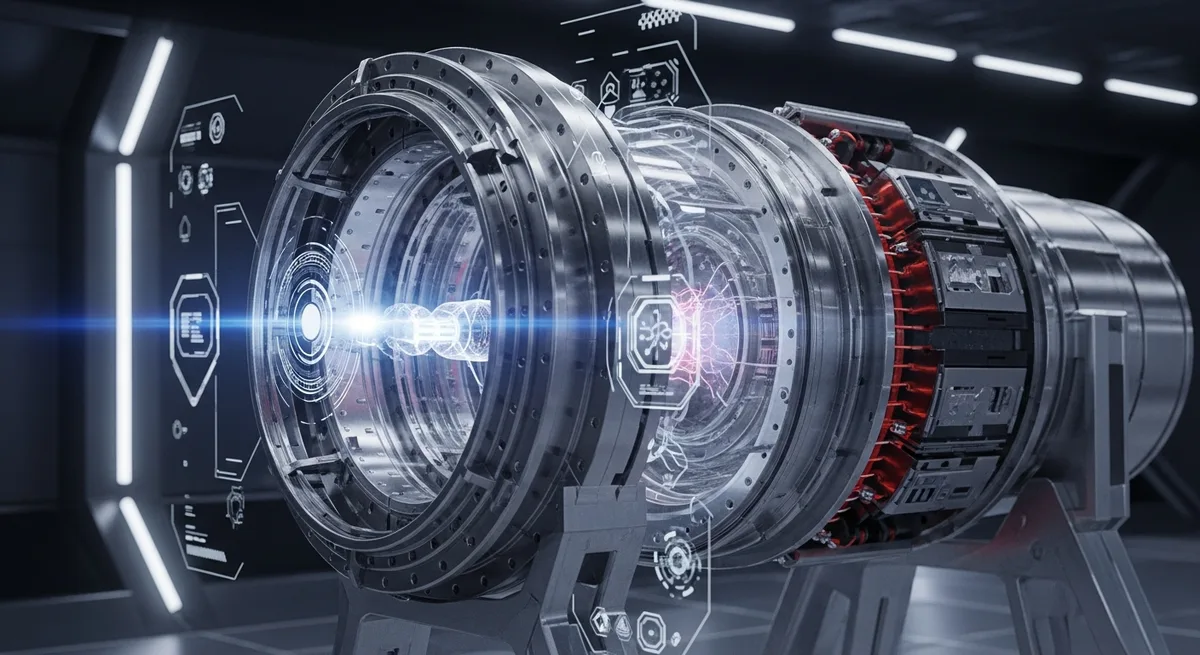
The vacuum of interstellar space is no longer an obstacle, but a canvas upon which the magnetohydrodynamic thruster etches its vector of existence. The engine’s housing, forged from a sophisticated chromium-molybdenum alloy, boasts a yield strength of 850 megapascals—a structural threshold capable of withstanding static loads equivalent to the crushing depths of an ocean pressing against a submarine’s hull. This metallic capsule, engineered to sustain an internal operating pressure of 15 bar, functions as an autonomous bastion; its walls absorb the cyclic vibrations born from plasma flow irregularities, ensuring structural integrity in regimes where conventional alloys would surrender their crystalline lattice.
At the heart of the mechanism pulses not liquid helium, but a high-temperature yttrium-barium-copper oxide (YBCO) superconductor, allowing the coils to function at the 77-kelvin limit. This open system eliminates the need for cumbersome cryogenic insulation, while a thermal conductivity of 0.15 W/mK ensures that no parasitic energy bleeds into the surrounding environment. It is a space where a current density of 500 kiloamperes generates a magnetic flux of such intensity that it warps local spacetime geometry, mimicking the gravitational well of a star, all governed by the cold precision of artificial intelligence algorithms.
Hafnium carbide electrodes shoulder the burden of the primary pulse, positioned 15 millimeters apart to maintain structural stability even at temperatures reaching 4000 kelvins. Each conical tip is armored with a nanostructured carbon fiber layer, possessing a dielectric strength of 20 kilovolts per millimeter, which acts as a molecular scaffold preventing electrical discharges from eroding the electrode surface. It is an architectural fortress, containing the power of lightning within a confined space where every electron leap is strictly choreographed.
The plasma chamber, with a diameter of 0.9 meters, becomes a dynamic matrix where matter is transmuted into a directed stream reaching velocities of 25 kilometers per second. Here, where ionized gases bombard the HSLA steel walls, a constant atomic pressure is generated, and a tensile strength of 600 megapascals allows the material to absorb the kinetic shockwave without permanent deformation. This interior space operates not as a static vessel, but as a reactive fabric that adapts to an electromagnetic field pulsing at a frequency of 200 hertz.
The thermal management system consists of graphite and carbon composite plates arranged around the main chamber. These 5-millimeter-thick layers exhibit a thermal conductivity of 450 W/mK, efficiently dissipating excess energy into external radiation shields. Every second, this conductor redirects a furious heat flux, striving to maintain an operating temperature of 800 kelvins—the optimal state for plasma stability, carefully avoiding the catastrophic risk of material liquefaction.
The magnetic field, with an induction of 8 teslas, acts as an invisible thread of force that, interacting with a 50 kilovolt-per-meter electric field, compels the plasma to move along a precisely defined vector. This process relies on the fundamental equations of fluid dynamics, where the rotation of the vector in the B-field becomes the decisive factor. Here, engineering logic transcends theory, as a 200-kilovolt DC source, operating at 98 percent efficiency, converts every watt into pure thrust, defying the limitations of classical mechanics.
A boron nitride ceramic core, around which the superconducting coil is wound, provides the structure with a density of 2.2 grams per cubic centimeter. It serves as a support with a Young’s modulus of 45 gigapascals, preventing the windings from deforming under the Lorentz forces induced by a power density of 15 kilowatts per kilogram. This material acts as an internal matrix, maintaining geometric precision where any other metal would succumb to fatigue and fracture from the cyclic stress triggered during engine ignition.
The system’s startup algorithm begins with the evacuation of the chamber to a pressure of 10^-9 torr, until a near-perfect vacuum is achieved. Only when the superconductor reaches its critical state is the electric field engaged, exciting the plasma source. It is akin to the impulse of a living organism’s nervous system, creating in a fraction of a second a thrust force that propels the craft through an infinite void—a realm devoid of resistance, save for the staggering distance to the nearest star system.
The plasma acceleration process is a collision of quantum electrodynamics and relativistic fluid mechanics, described by vector equations where plasma density and pressure gradients serve as the primary variables. When the current density interacts with the 8-tesla magnetic field, a force vector is generated, ejecting ionized particles through the exit nozzles. It is a controlled physical acceleration of matter, during which particles attain the velocity required to overcome gravitational wells, leaving no room for error.
Although engineering thought has evolved since the inception of magnetohydrodynamic theories, only modern digital modeling has allowed for the optimization of this process to molecular precision. Each pulsation of the plasma stream is meticulously calculated to avoid turbulence that could compromise the HSLA steel walls. We harness physics that mirror the nature of solar flares, yet we cage that elemental fury within a compact, controlled metallic capsule that could never exist in a natural environment.
Yet, there exists a boundary that engineering has not yet crossed: the paradox of thermal expansion and magnetic saturation. When the 200-kilovolt potential reaches its peak and the plasma pressure within the chamber exceeds critical limits, even the most advanced ceramic insulators begin to show signs of micro-fracturing. This physical barrier, which limits continuous operation, remains the greatest engineering bottleneck; for the more efficiently we accelerate the plasma, the faster we approach the point of material fatigue—a threshold that current metallurgy cannot yet overcome without a catastrophic increase in mass.