The Crystal Lattice Under Siege
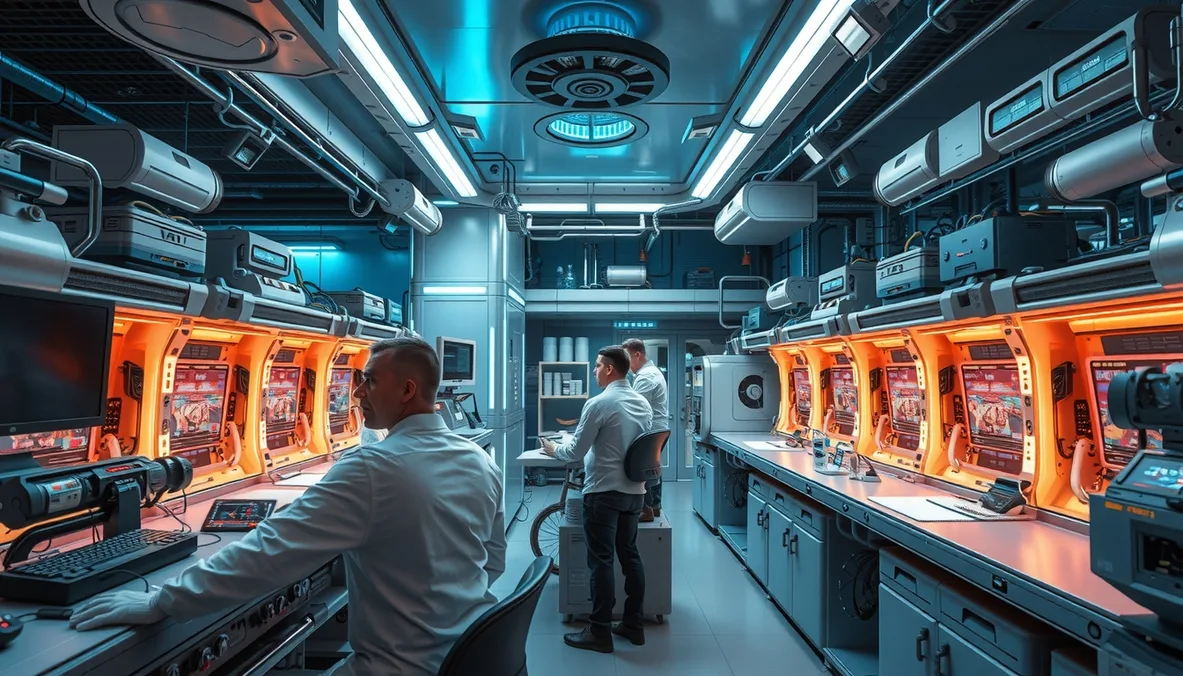
Engineering at the quantum scale is not an act of creation; it is an unending war against entropy. We operate within an environment where thermal noise acts as a destructive force, relentlessly seeking to dismantle any coherent logical structure. When the niobium-titanium alloy filaments carry a current density of 1.5 x 10^6 amperes per square centimeter, we are not merely managing electricity; we are restraining a primal element that, by its very nature, strives to erupt from this microscopic cage. This is no graceful process; it is a brutal exercise in physical control, where metal atoms are forced to maintain their lattice integrity under conditions that would be physically impossible in any natural environment.
Every silicon substrate, refined to a thickness of five hundred micrometers, endures immense internal stress. We measure this pressure in megapascals, observing how the crystalline structure deforms in response to thermal fluctuations reaching the 9.5 Kelvin threshold. At this level, metal turns brittle, and any microscopic defect becomes a catalyst for decoherence. This is not a search for a "soul"; it is a battle against material fatigue, where every displacement in the crystal lattice triggers a collapse of the wave function, obliterating the information we strive to preserve.
The cooling system—a mixture of helium-3 and helium-4 isotopes—functions as a thermodynamic barrier. We supply one hundred microwatts of cooling power to maintain the system at the ten-millikelvin limit, for beyond this threshold, random background vibrations become uncontrollable interference. It is a form of technical asceticism. Every unit of heat that penetrates the system is an error we must isolate. We are not seeking harmony; we are constructing an isolated vacuum where the only existing truth is an accuracy of ±10 microcoulombs.
Josephson junctions act as gates whose physical integrity is perpetually on the razor’s edge. The ten-micrometer area is a domain where a charge energy of 200 micro-electronvolts forces electrons to tunnel through the insulating barrier. This occurs across the very fabric of spacetime, defying the prohibitions of classical physics. Here, engineers face a singular dilemma: how to maintain stability when the quantum state is so exquisitely sensitive to environmental fluctuations. This is precision engineering where the slightest calibration drift triggers a total system collapse.
When the system reaches a frequency of 5.4 gigahertz, we do not hear a "sigh"; we observe electromagnetic resonance. A wavelength of 55.56 millimeters defines the operational range where qubits are entangled into a unified matrix. This is engineering precision achieving a 0.99 reliability coefficient. Each ten-nanosecond pulse is a meticulously planned sequence designed to minimize randomness—the ultimate adversary of quantum computation.
A Mu-metal shield, with a permeability coefficient reaching one hundred thousand, is an essential physical barrier. We are speaking of suppressing fields at the 10^-6 Tesla level. This is not mysticism; it is a requirement of magnetic shielding. Without this layer, any external magnetic disturbance would distort the superposition of the qubits. We are erecting physical walls between our macroscopic reality and the quantum level to maintain processor stability.
The SQUID device is our only sensory organ in this process. Its sensitivity, measured at 10^-8 flux quanta per hertz, allows us to identify the precise points of decoherence. It is a diagnostic tool that reveals when the quantum system ceases to be entangled. When we observe the state of quantum superposition, we are, in effect, observing the system’s resilience against external interference. The SQUID provides the data that allows us to adjust magnetic fields and temperature gradients in real time.
Quantum entanglement, in this context, is an engineering task. We must ensure that information moves between qubits without leaking into the environment. This requires a distance-five error-correction code system. We are not "nurturing" systems; we are building error-correction algorithms that recognize bit-flips and compensate for them. It is an iterative process where a 0.5 code transmission rate reveals the system’s lingering fragility against noise.
Future architecture will be oriented toward the mastery of this noise. We are moving toward integrated systems that function as autonomous nodes, capable of self-compensating for their own decoherence. This will not be an ecosystem, but a precisely calibrated network where every element is shielded from thermodynamic and magnetic fluctuations. We will no longer force matter to obey; we will optimize its states so that they remain stable for longer than a few microseconds.
A quantum computer is not a philosophical object. It is an extreme engineering challenge whose success depends on our ability to isolate the system from the "noise" of the universe. We are building tools that operate at the very limits of physics, where the rules shift and our influence must be minimal, yet absolutely precise. On this path, there is no room for randomness—only a deep, mathematical understanding of the system and an unceasing continuity in the fight against decoherence.
We are not in symbiosis with matter—we are its stewards, having learned to work with its fundamental properties without unnecessary intervention. Future processors will be built upon this experience, where stability is not a goal to be reached, but a constant state of being. This is our true technical evolution: to learn to manage quantum information in an environment that inherently seeks to destroy it, and to do so with incredible physical precision.